
4TB Apricorn Aegis Secure Key cracks $3,000 quantum-resistant hype
Apricorn’s 4TB hardware-encrypted USB shows what “quantum-resistant” can look like without going full panic-buy.
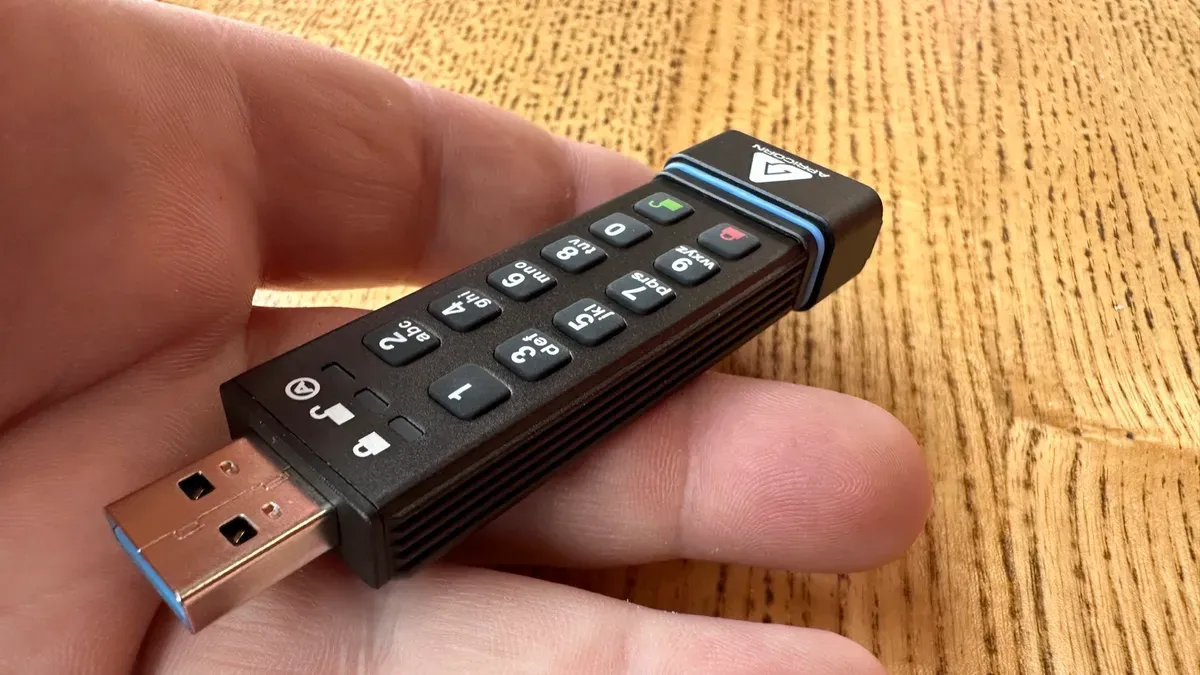
Apricorn launched the 4TB Aegis Secure Key, positioned as the biggest-capacity hardware-encrypted flash drive on the market right now, with quantum-resistant framing. For decision-makers, it offers a way to think about long-term data protection without immediately tying security upgrades to a $3,000 price tag.
Apricorn just upped the storage ceiling for hardware-encrypted USB drives with its new 4TB Aegis Secure Key, and ZDNet’s hands-on angle is refreshingly practical: you do not have to spend $3,000 to get “this much security.” The headline that matters here is the one that is easy to miss in a world of security theater. Apricorn is pitching a large-capacity drive with hardware encryption as its core value, and the specific product in play is the 4TB Aegis Secure Key, called by ZDNet the biggest-capacity hardware-encrypted flash drive on the market right now.
That matters because the phrase “quantum-resistant” tends to trigger sticker shock and urgency-driven budgeting. In security buying, that combo can push teams toward the most expensive option first, then justify it later. ZDNet’s framing flips the sequence: yes, this drive is marketed around being quantum-resistant, but the practical point is that a big-capacity encrypted device is achievable without paying the “secure everyone, instantly” premium. In other words, the spend does not have to match the fear.
To understand why this is a real procurement story, not just gadget coverage, zoom out to how hardware encryption fits into modern security models. Software encryption is only as strong as the endpoint and the key-handling story around it. Hardware-encrypted devices, by contrast, aim to move sensitive operations into a more controlled boundary. When you are distributing data across people, locations, and devices, that boundary becomes a governance lever. A USB drive that is both high capacity and hardware-encrypted reduces the temptation to move data in plaintext “because it is easier,” since the device is built for encrypted transfer.
Now add the “quantum-resistant” narrative. Quantum computing is still not here in the way security roadmaps fear, but the industry has been planning for a long time because timing is everything when you are dealing with encryption algorithms and the lifecycle of protected data. The second-order implication for executives is that planning can become expensive if every upgrade is treated as an emergency response. When a product like the Apricorn Aegis Secure Key is positioned as both high capacity and quantum-resistant, it creates a budgeting path that does not require replacing every control, every device, and every workflow on a single big-bang timeline.
There is also a market dynamic hiding under the marketing. If the “biggest-capacity hardware-encrypted flash drive on the market right now” claim holds, it suggests the competitive center of gravity is moving toward usability plus security. Historically, encryption gadgets often optimized for security and then asked users to tolerate smaller storage. Here, the logic is the opposite: give people enough capacity that encrypted storage does not feel like a constraint. That can matter for adoption inside organizations. Adoption drives effectiveness, and effectiveness drives auditability.
From a compliance and risk perspective, executives should think in terms of how encryption decisions show up in controls. Regulators and auditors generally want clarity: what protects data at rest and in transit, how keys are managed, and what prevents unauthorized access. Even when “quantum-resistant” is part of the story, hardware-encrypted USB drives are still concrete controls that can be mapped to practical data protection requirements. The strategic advantage of a product like this is that it can support long-lived data protection planning without forcing teams into a constant cycle of replacing hardware simply because a new threat headline appeared.
Finally, there is the internal boardroom reality. Security budgets are scrutinized, especially when upgrades feel speculative. A hands-on look at the 4TB Apricorn Aegis Secure Key, including the explicit comparison point that you do not have to spend $3,000, gives decision-makers something rare: a way to connect “future-ready” language to present-day purchasing logic. If you are a CIO, CISO, or finance leader overseeing security procurement, this kind of product can help you design upgrades that are incremental, defensible, and easier to roll into broader technology roadmaps.
In short: Apricorn’s 4TB Aegis Secure Key is the biggest-capacity hardware-encrypted flash drive on the market right now, and ZDNet’s takeaway challenges the default assumption that “quantum-resistant” automatically equals “pay a fortune.” That is the stake. It changes how teams can plan encryption upgrades, reduce unnecessary spend, and still move toward stronger long-term protection.
This story's Key Insights and Take-aways are locked.
Create a free account to unlock Executive Actions for one credit.
Register to UnlockAlways free for Executives Club members. Join the Club
More in Technology

Google quietly links your phone number to every Android account on your SIM
Adding a SIM now ties your phone number to all Google accounts - and future accounts inherit it. Here's the security and privacy stakes.

Hijacker AI 'Skynet mode' runs 100,000 attack steps against exposed models
Symantec caught a criminal AI agent that borrows other models, steals data, and mines crypto; the only relief is no confirmed victims yet.

Nvidia's AI-financier shift faces its first big test as neoclouds stumble
A rout in neocloud stocks is forcing investors to weigh Nvidia's hidden exposure as both supplier and lender to the AI buildout.