
A 3-kilowatt solar system costs $3,678 while Cuba endures 12+ hour blackouts
Solar buys resilience for some Cubans, but charcoal, smoke, and unpaid electrical silence keep winning for others.
In Havana, taxi driver Camilo Merejon compares photovoltaic systems, lithium batteries, and generators as Cuba’s 2026 energy crisis deepens. The result is a widening split in who can buy power and who is pushed toward charcoal and homemade stoves.
Havana’s electronics aisles are turning into a real-time dashboard of Cuba’s 2026 energy crisis. Taxi driver Camilo Merejon stands over price tags for photovoltaic systems while his neighborhood of Regla waits through another blackout, with power missing for 26 hours on the day of his visit. A three-kilowatt solar system costs $3,678. A 10-kilowatt installation exceeds $10,000.
That gap is the whole story, and it is immediate. Cubans are not just choosing a technology, they are choosing which version of “staying on” they can afford. Camilo says three kilowatts might be enough to cover basic needs, but he also says friends who are “Italian friends” want to help buy one, and that it is extremely expensive. When electricity comes and goes for long stretches, the market does not care about averages. It prices outcomes.
Cuba’s situation is especially intense because the island is long dependent on Venezuelan oil, and the country now faces fuel shortages plus an ageing electrical grid weakened by decades of underinvestment. The article notes that across much of the country, blackouts last more than 12 hours a day. In plain terms: even if you can get a generator, or even if you can store daytime energy, reliability still depends on fuel availability, maintenance, and the ability to pay upfront.
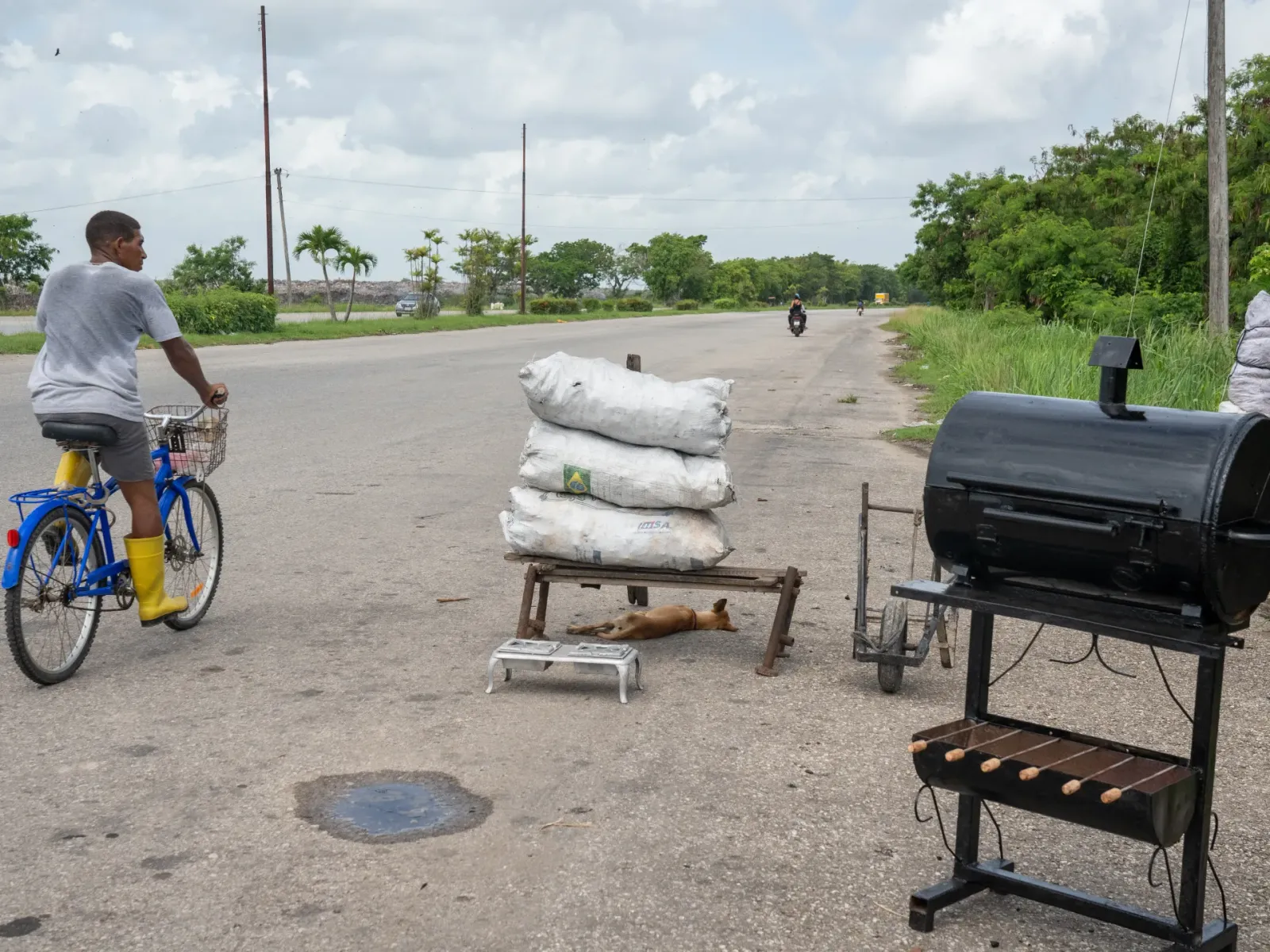
That is why the crisis is creating a new fault line inside Cuban society. Those with savings, successful private businesses, or financial support from relatives abroad invest in solar panels and lithium batteries. Others turn to charcoal and homemade stoves. The price signal is visible in the street-level economy. On a dusty road in Cotorro, charcoal bags are stacked beside metal-sheet stoves. Cars slow down and pull over to buy. Amora Rodriguez sells charcoal seven days a week and says demand has never been this high. She ties it directly to outages, saying more people are buying charcoal because power cuts have made life harder. A bag of charcoal costs around 2,500 Cuban pesos, roughly $4 at the informal exchange rate, or nearly half an average monthly salary.
Cooking becomes the bluntest example. Inside the home of Cari and Idalberto Espinoza in Cotorro, a pressure cooker sits on a charcoal stove while thick smoke rises toward the ceiling. Cari says they have very little gas, so they are forced to cook with charcoal. She adds it takes longer and produces a lot of smoke, but “we don't have a choice.” The couple only began using this method a few months ago, and she says most people cook with charcoal there now. When energy scarcity hits, the “energy transition” is not just an investment story. It is a daily health and time story, and it lands hardest on households whose budgets can absorb short-term substitution but cannot absorb capital costs.
Now look at the other side of Havana Bay, where the economics flip. At the Fuego Lento restaurant on the Malecón waterfront, workers move large photovoltaic panels across the roof under midday heat, while technicians drill, bolt, and connect the new installation. Josecal Duarte, one of the technicians overseeing the project, says demand has surged: more and more people are importing solar panels and batteries, buying them for businesses, for homes, to survive. The economics are still not cheap, but the numbers show why the upgrade feels rational for some operators. A 615-watt solar panel costs about $160 before transport and installation. Most homes and businesses require several panels plus lithium battery systems to store daytime generation.
Restaurant owner Aris Lopez Torres says she spent years trying to keep the business afloat. She started with a generator, then lithium batteries, but rising fuel prices and increasingly frequent blackouts exposed the limits of those options. It was either this or close the restaurant, she says, explaining that without electricity, “we can't do anything.” The photovoltaic installation will not cover all needs, but it supports essential equipment. She prioritizes refrigerators, and says the restaurant uses only one air conditioner out of three now. Her framing is “survival economics because the situation is very serious.” For decision-makers watching from outside Cuba, the second-order implication is clear: outages reshape capital planning. It is not enough to have any backup power. Operators optimize for critical loads and accept partial coverage because full coverage can be financially unreachable.
Across Havana, installation companies and battery retailers are struggling to keep up. MIDICAS installs solar systems throughout Cuba, and Mario Perdomo there says demand keeps growing, while Elizabeth Diego, a saleswoman in central Havana, adds that people want to be prepared when the power goes out. Even institutions with different mission profiles are not immune. In El Cerro district, a retirement convent has begun a modest transition toward solar energy thanks to donations from churches in Florida. It installed photovoltaic roof panels and acquired rechargeable solar lamps. Sister Concepción Sánchez places one lamp in the sun to recharge before nightfall. But she also says the system is far from sufficient: the convent is large, and energy from the panels is not enough. On the day of the interview, the convent had already been without electricity for 20 hours. The story is a reminder that even “supported” energy projects face the same constraint as households: panels are expensive, and scale is expensive.
Camilo’s day ends where many Cubans are still stuck: waiting for the grid. After crossing Havana Bay by ferry, he returns home to Regla, where electricity has not come back on, so fans are silent and appliances remain off. His taxi has been parked for weeks. A litre of petrol costs about $10 on the black market, and Camilo says it is unaffordable for many Cubans. He relies on a small rechargeable battery to charge his phone and, occasionally, neighbours’ phones. He also says a complete solar installation remains out of reach without outside assistance. “You can save money for years and lose everything because of this crisis,” he says. And while some Cubans see solar as an escape, others cannot access it, leaving Camilo without an immediate solution. He says, “I don't see the end of this problem.”
For executives, founders, and investors tracking energy systems, the strategic stake is not just “renewables under crisis.” It is the market segmentation created by reliability breakdown. When blackouts last more than 12 hours a day, buyers prioritize survival hardware, critical loads, and backup capacity. Meanwhile, affordability determines who gets resilience and who is pushed toward charcoal, smoke, and halted work. In other words: the crisis is not only a power failure. It is a compounding inequality signal built straight into the price of watts.
This story's Key Insights and Take-aways are locked.
Create a free account to unlock Executive Actions for one credit.
Register to UnlockAlways free for Executives Club members. Join the Club
More in Business
Accenture’s $4.18bn play fails as AI fears spark a 20% worst-ever stock plunge
On Thursday, Accenture hit its biggest one-day drop on record after forecasting worries that AI could hollow out consulting.

SpaceX stock jumps 3% after it overtakes Amazon’s market cap
CNBC says SpaceX’s shares surge following its IPO Friday, forcing investors to reprice what “space” and “AI” are worth.
SpaceX’s first options day breaks U.S. records after a $85B IPO win
Big IPO, bigger options debut: what it means for investors, risk teams, and anyone benchmarking market appetite.