
Artemis landings could spread methane and contaminate ancient lunar pre-life ice
A new study finds rocket exhaust can race across the Moon in days, potentially destroying molecules needed to understand life’s origins.
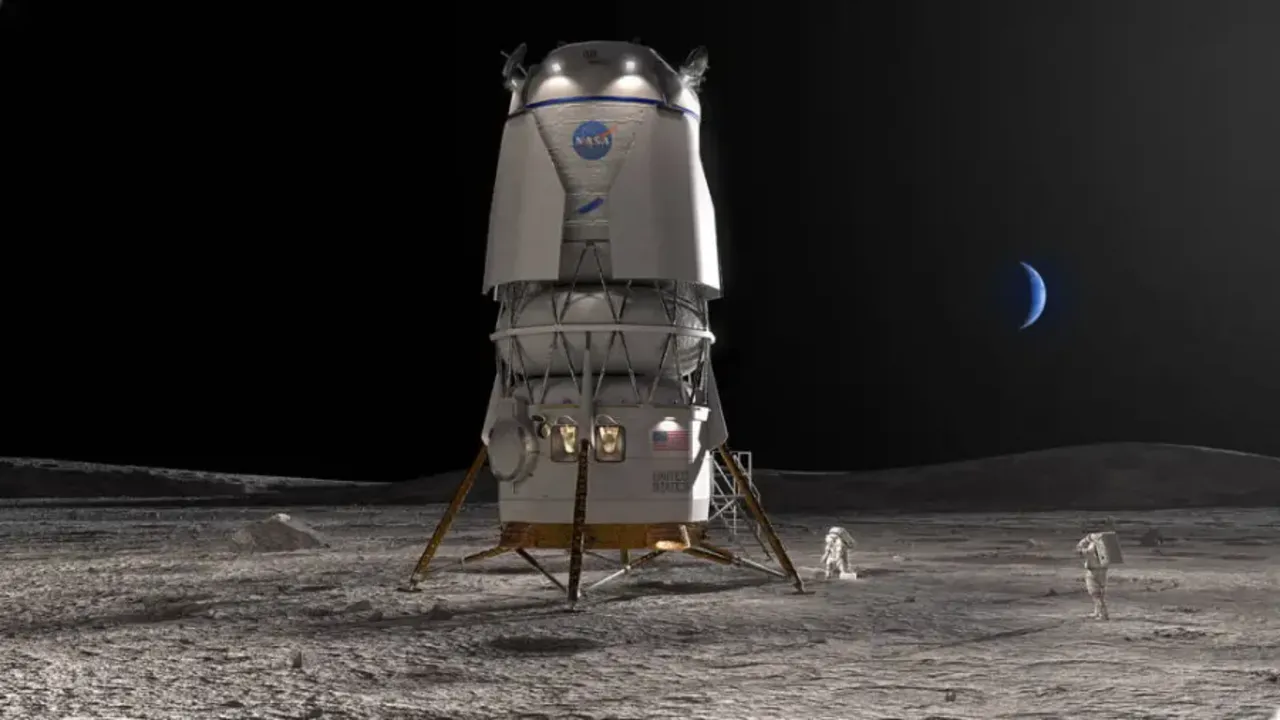
NASA’s Artemis plans for crewed lunar landings are running into a contamination risk highlighted by a new study. Researchers say methane exhaust could quickly contaminate ancient ice near the Moon’s poles, possibly harming the prebiotic organic molecules scientists want to study.
Artemis is aiming to send astronauts back to the Moon, but a new study suggests the mission could inadvertently erase some of the Moon’s best evidence about how life began. Researchers modeled methane exhaust from planned lunar landers and found it could spread across the Moon extremely quickly, reaching the north pole in under two lunar days and trapping large fractions in cold polar regions. In other words, the very act of landing may contaminate the archive scientists hope to read.
The study’s core warning is straightforward: within one lunar week, about half the methane was trapped at the Moon’s cold polar areas, with 42% trapped at the south pole versus 12% at the north pole. Because those polar ices exist in perpetual shadow and have remained largely unchanged, they are thought to preserve material from ancient asteroid and comet impacts, including “prebiotic organic molecules,” molecules that could have preceded life on Earth. If methane gets into those same pockets, it could destroy molecular evidence researchers need.
That puts planetary protection, which often sounds academic, into a very real operational spotlight for Artemis and any longer-term moon strategy. The European Space Agency’s Silvio Sinibaldi, the planetary protection officer and senior study author, framed the issue bluntly in a statement: “We are trying to protect science and our investment in space,” and “Our activity can actually hinder scientific exploration.” The point is not that space launches have suddenly become dirty. It is that the industry has mostly considered contamination issues on Earth, and the Moon has been out of the active conversation because human visits to its surface haven’t happened in over 50 years.
Artemis is changing that clock. The article notes Artemis IV will land astronauts near the Moon’s south pole, and future plans include building a longer-term moon base that would require many more trips. When missions become recurring, small risks stop being small. Even if only a fraction of exhaust reaches the most scientifically valuable sites, repetition can turn a manageable uncertainty into a lasting scientific penalty. The study essentially treats the polar ice not like empty real estate, but like a finite lab sample sealed for billions of years.
So what exactly is the mechanism? The researchers used computer models to simulate how methane, described in the article as the main organic component expelled by planned lunar landers, would spread across the Moon after a landing at the south pole. They included effects of solar wind and radiation. Then they leaned on the Moon’s big advantage and big problem: the lack of an atmosphere means the methane spreads incredibly fast. The paper’s language is vivid and mechanical. Lead author Francisca Paiva, a physicist at Instituto Superior Técnico in Portugal, explained in the statement that the trajectories are “basically ballistic,” that “They just hop around from one point to another.” That matters because it reduces the Moon’s ability to dilute or slow down contamination.
The contamination is not portrayed as instantly vaporizing and vanishing. In the simulations, over half the methane got trapped in cold polar areas within one lunar week, and a notable share concentrated at the south pole. Those are the same cold pockets where ice and ancient molecules are thought to be collected and preserved. The article also highlights why this matters for scientific narratives. The molecular history of life on Earth is “pretty much nonexistent” because our planet has been reshaped by billions of years of change. The Moon, by contrast, is viewed as a more stable archive. That means contamination is not just an aesthetic problem. It can directly break the chain between ancient chemical ingredients and hypotheses about how life’s chemistry got started.
There is, however, a possible mitigation path. The study suggests that choosing colder landing sites might help avoid methane traveling as quickly or as far. The authors also call for additional simulations to better understand how exhaust compounds travel on the Moon, what other materials lunar trips might involve, and what risks exist for scientific investigations beyond methane alone. The implication for executives and boards: technical mitigation is not optional, it is part of mission design. If you are underwriting a lunar program, you are also underwriting a contamination-control strategy.
This lands in a familiar regulatory frame, even if the regulation is still catching up to the Moon. Paiva compared the situation to Earth protections: “We have laws regulating contamination of Earth environments like Antarctica and national parks,” she said, adding, “I think the moon is an environment as valuable as those.” For decision-makers, that is a tell. It signals that planetary protection will not stay a background concept. It will increasingly look like a compliance issue, a permitting issue, and potentially a reputational issue, because scientific value is now directly tied to how a mission is executed.
In the near term, this study becomes a design constraint for where and how Artemis lands, and it raises the bar for future missions that want to claim they are building a legacy of discovery rather than a legacy of contamination. In the longer term, it can shape procurement, mission timelines, and stakeholder trust for any company and agency involved in lunar operations. The stakes are simple: preserve the Moon’s priceless history, or risk turning the first steps of a new era into a scientific blindfold.
This story's Key Insights and Take-aways are locked.
Create a free account to unlock Executive Actions for one credit.
Register to UnlockAlways free for Executives Club members. Join the Club
More in Science
2026 Nikon Small World Winners Reveal the Hidden Machinery of Everyday Life
A mycologist's frozen Edinburgh garden became the backdrop for vivid views inside cells, a reminder of what advanced imaging now makes visible to researchers and the industries built on biology.

Study: 1 in 4 depression cases may be a body-clock problem, not a chemical one
A 10,000-person study finds standard antidepressants often fail these patients, but melatonin and morning sunlight may hit the real root cause.

Start-Up Says A.I. Designed a Virus to Attack One Patient's Superbug
If the claim holds up, personalized phage therapy could become a new frontline weapon against antibiotic resistance - but proof is far from final.