
Asia jumps from importing arms to exporting hardware as defense spend hits $573B in 2025
Japan loosens export rules, South Korea pushes land and missile systems, and Western inventories force a supply-chain rethink.
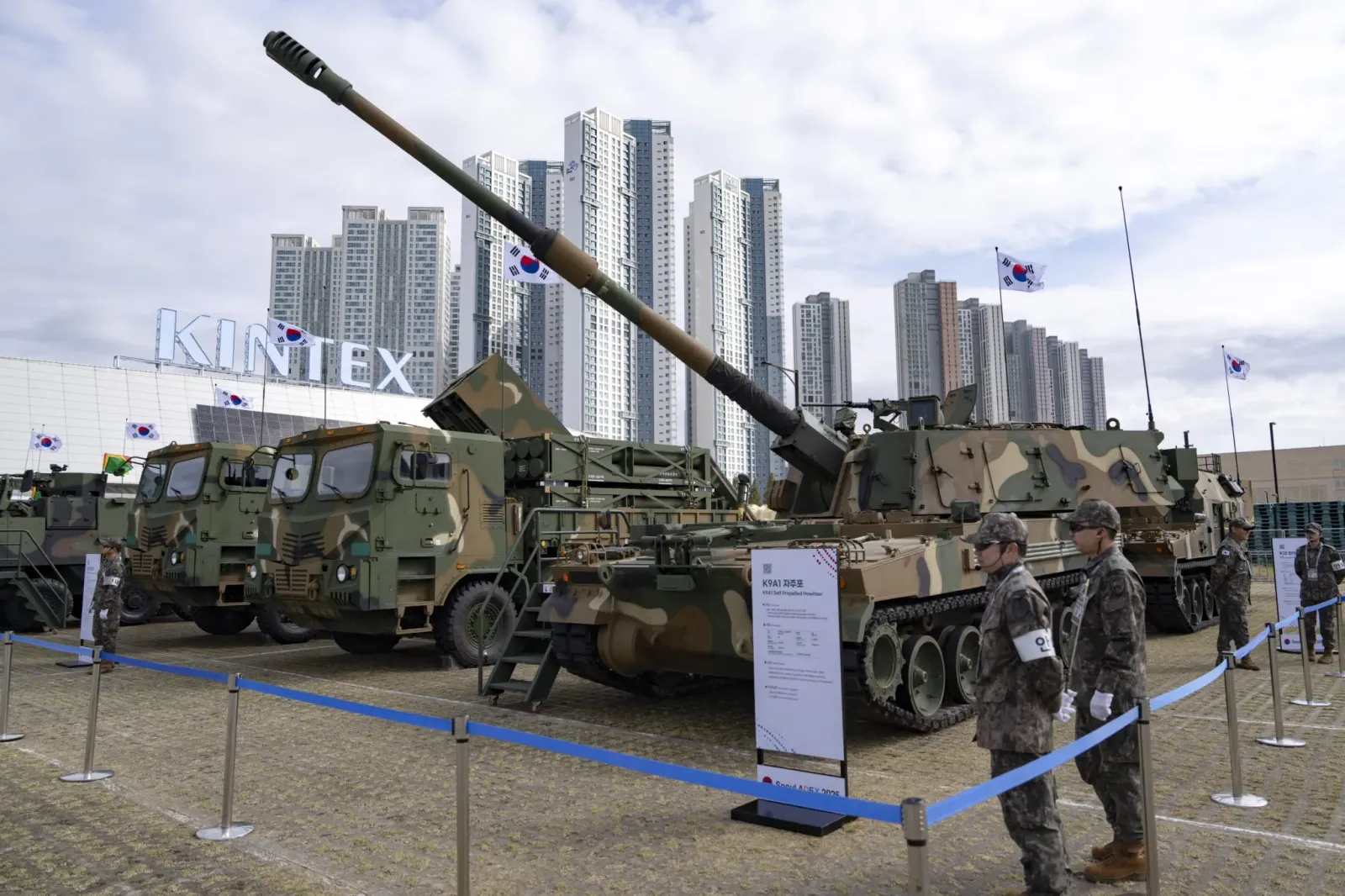
Asia is shifting from arms importing to hardware manufacturing and exporting, highlighted by Japan’s move to loosen arms export restrictions and South Korea’s expanding exports led by Hanwha Aerospace. In 2025, Asia’s defense spending rose 6% to about $573 billion, reshaping how global defense supply chains and replenishment plans will work.
For decades, the global defense supply chain had a default setting: the U.S. and Western Europe designed and supplied the most advanced weapons, while Asian countries bought them. That flow is reversing fast. In 2025 alone, Asia’s defense spending rose 6% to approximately $573 billion, outpacing global defense growth currently sitting at roughly $2.6 trillion. The implication for anyone underwriting defense procurement or industrial partnerships is simple and uncomfortable: the “buy from the West” playbook is no longer the center of gravity.
And the signal is not abstract. Japan’s recent decision to loosen its arms export restrictions is described as the clearest signal of Asia’s changing role in global defense. South Korea is also stepping in to fill gaps in Western inventories. Hanwha Aerospace kicked off Asia’s land systems exports to Europe in 2022, and LIG Defense & Aerospace recently stood out as the supplier of missile interceptors known as MSAM-II. In other words, the supply chain is no longer just moving at the speed of policy. It is moving at the speed of production and delivery.
Why does this matter now? Because the demand side is getting louder and the supply side is getting constrained. The source points to a more volatile world underscored by recent Middle East escalations, which have put additional pressure on existing U.S. defense inventories. Rebuilding Western capacity takes time because industrial scale and skilled labor are not switch-flippable. That creates an opening where Asian manufacturers can be more than backup suppliers. They can offer scale, cost competitiveness, and local supplier networks that reduce lead time and manufacturing bottlenecks when inventories are depleted.
Zoom out and the numbers get even more consequential. The source frames Asia’s defense spending acceleration as mainly driven by Europe’s response to the Ukraine war and sustained U.S. investment, rather than by China alone. It also notes that China’s defense ecosystem follows different market dynamics, customer segments, and interoperability frameworks, with exports and production shaped by trajectories that remain distinct from the replenishment and modernization cycle underway across NATO-standard supply chains. For boards and finance leaders, that distinction matters. It means “more Asian defense production” is not a single homogeneous pipeline. It is a set of different industrial and regulatory lanes.
Policy is adding structure to this shift. The U.S. National Defense Strategy puts the Indo-Pacific region at the center of long-term strategy and calls on allies to build what U.S. policymakers call “sovereign resilience,” meaning the capability to design, manufacture, and sustain critical defense systems on their own. The source says several Asia-Pacific economies are inching toward spending at least 3% of GDP on defense, investing in capacity expansion, advanced technologies, and export-focused production. That kind of long-cycle commitment changes how contracts are awarded and how governments evaluate partners. It also changes how quickly supply chains can scale when the West needs throughput.
On the U.S. side, the source is blunt about constraints: the U.S. does not have the manufacturing scale to fulfill its own or allies’ needs. So it needs to collaborate with other countries with strong manufacturing bases, many of them in Asia. This is not just a relationship-level point. It is material and operational. In early 2026, the U.S. Department of Defense announced plans to expand Asian production of solid rocket motors for guided weapons, drones, and ammunition. That is a concrete example of a shift toward more distributed manufacturing, where production is spread across regions to reduce single-point failures and speed replenishment.
Where Asia is leaning also matters for revenue models. The source says Asia’s defense investment is increasingly weighted to high-margin, technologically advanced systems, not just traditional military hardware. Air defense systems, unmanned drones, and autonomous ground and naval vehicles are among the fastest growing categories. Higher software content and frequent upgrades increase the need for ongoing vendor support and maintenance, which can turn one-time equipment wins into recurring revenue and longer relationships. Artificial intelligence is also moving beyond basic automation, enabling decision-support systems that can fuse sensor data, manage logistics, and support operations in complex environments, opening a new revenue stream for parts of Asia’s defense industry that were historically geared toward manufacturing conventional hardware.
Finally, look at the industrial bottleneck that tends to dominate headlines, shipbuilding. The source says Asia’s defense cycle will enter one of its most capital-intensive phases this year, driven by naval shipbuilding and maintenance across Northeast Asia and Australia. It aligns with U.S. efforts to rebuild maritime capacity and integrate allied shipyards into defense and commercial vessel programs. Naval programs have project cycles lasting 10 to 20 years rather than two to three years, with long build times, heavy upfront investment, and decades of maintenance. That makes naval activity resemble infrastructure investments, with long project duration, high visibility, strong barriers to entry, and repeat maintenance revenue. The second-order effect for executives is that the winners might be less about who sells the first platform and more about who owns the maintenance, upgrades, and sustainment treadmill.
Taken together, Asia’s defense expansion reflects a structural shift in global security and industrial capacity, shaped by geopolitics, technology, and evolving alliances. If the world stays more volatile and Western inventories remain constrained, Asia’s role in defense production and supply chains is likely to grow in both scale and strategic importance. For leaders in procurement, finance, and industrial partnerships, the question is not whether the supply chain is shifting. It is whether your assumptions about where systems get made, upgraded, and sustained still match the reality implied by $573 billion of spend, new export policies, and distributed manufacturing plans that are already underway.
This story's Key Insights and Take-aways are locked.
Create a free account to unlock Executive Actions for one credit.
Register to UnlockAlways free for Executives Club members. Join the Club
More in Business

SK Hynix jumps 11% after seeking up to $29.4B in Nasdaq listing
The chip giant filed for a Nasdaq listing plan that could raise $29.4 billion, instantly reshaping investor expectations.

Micron revenue hits nearly $42B as AI memory lifts gross margins above 81%
Fiscal Q3 results crush estimates, prove AI memory is rewriting Micron's margins, and change the momentum math for the whole chip stack.

SpaceX sells $25B in debt under two weeks after IPO, despite $90B in orders
The satellite and rocket company’s quick $25 billion borrowing move signals how it plans to finance scale after going public.