
ATEEZ’s “BAD” video turns Chase Infiniti’s wedding into a courtroom power play
The K-pop crew tries to win over Chase Infiniti in the “BAD” visual, then watches her choreography flip the verdict.
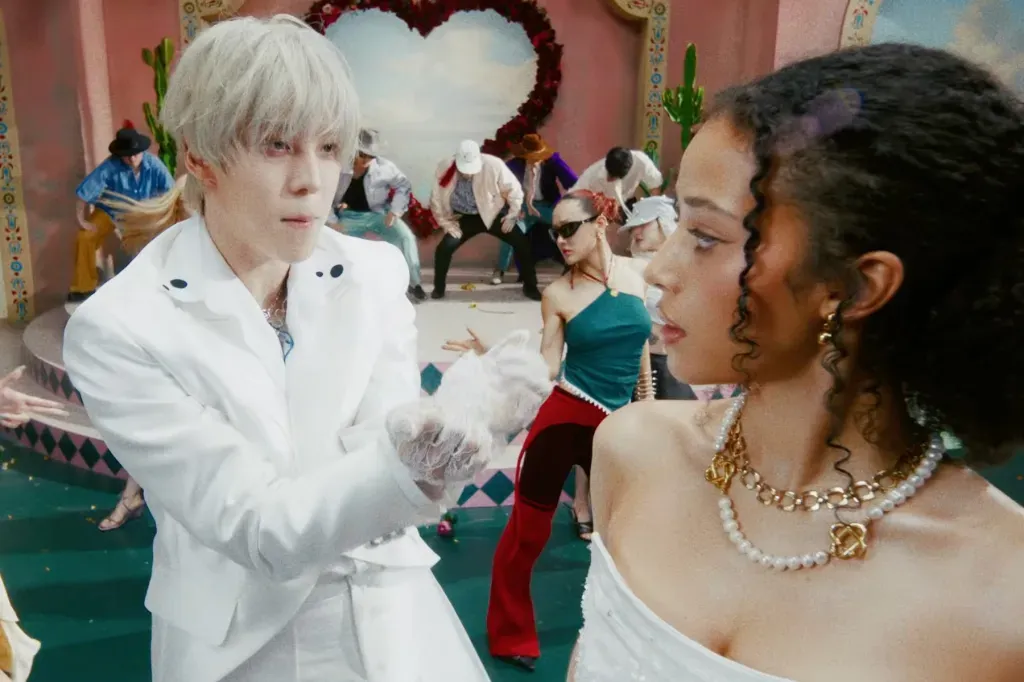
ATEEZ co-stars Chase Infiniti in the music video for “BAD,” released Friday (June 26) alongside the mini-album GOLDEN HOUR: Part.5. The video’s twist, with Infiniti controlling the chaos from start to finish, is paired with a release that adds to ATEEZ’s momentum after earlier chart success.
If you thought ATEEZ’s new era was just about catchy choruses, their “BAD” music video for GOLDEN HOUR: Part.5 makes a strong case for a different priority: narrative leverage. Released Friday (June 26), the action-packed visual drops Chase Infiniti into the middle of the group’s attempts to win her attention, only to reveal that she has been running the whole show.
The opening minutes set the tone immediately. The “One Battle After Another” star appears at her own wedding ceremony in a white gown, while her groom struggles to slide a ring onto her finger, which is already crowded with eight other rings. That detail matters because it acts like the preloaded metaphor for the whole video: eight members, one central control point. Then Seonghwa bursts through the doors in a white suit and hat, channeling Michael Jackson, and choreography takes over. The other members go after Infiniti one by one, trying to charm her or, at times, spy on her dates with other members.
For executives and operators, this is a useful reminder of how modern music marketing works, and why it is not just “content.” The “BAD” video is structured like a sequence of escalating stakeholder scenarios. First, the group tries direct engagement. Then the tension shifts to observation and indirect attempts at influence. Finally, everyone converges in a courtroom where Infiniti is on trial for being “bad,” as described in the lyrics. That shift from dance chaos to a formal setting is not random. Courtrooms signal judgment, authority, and accountability, which means the video is essentially putting the question of who controls the outcome on trial.
And it pays off in the reversal the headline teases with visuals. In the courtroom, the video shows how much Infiniti has been in control the entire time. Rather than being disempowered by the trial, she busts out her own choreography and uses powers to make the bandmates mimic her moves. The courtroom is not the end of her influence. It is the stage where her control becomes undeniable. The judge then declares Infiniti not guilty, and she exits by flashing her eight rings at the camera, turning that earlier prop into a final confirmation of dominance.
This matters beyond fan entertainment, because it is tied to a release strategy that has ATEEZ building momentum in a measurable way. “BAD” is one of five new songs on GOLDEN HOUR: Part.5, which comes after GOLDEN HOUR Part.4. The broader context is that the February project topped the Top Album Sales chart, marking the boy band’s seventh No. 1 on the tally. In other words, ATEEZ is not only stacking visuals. They are attaching those visuals to a performance track record that has already driven repeat demand.
From a decision-maker lens, there are two second-order implications here. First, the narrative inside the video mirrors a real-world pattern: if multiple parties compete for attention, the one who controls the framing wins. In “BAD,” that framing is the wedding rings, then the courtroom, then the choreography takeover. In media, that same principle shows up as “who owns the storyline” across formats: teaser, video, mini-album, and performance narrative all have to align. Second, the legal metaphor of “being bad” and the courtroom resolution are a form of brand clarity. They convert an abstract concept from lyrics into a plot that is easy to summarize, which helps audiences share it quickly, and helps platforms categorize and recommend it.
There is also a strategic pacing angle. The video arrives as part of a mini-album drop, not as a standalone single. That tends to concentrate marketing around a single moment in time, with the video functioning like a front door into the rest of the tracklist. The source explicitly ties the timing: the music video drops Friday (June 26) alongside GOLDEN HOUR: Part.5. When companies or artists coordinate release timing like this, it reduces the chance that attention fragments across weeks, and it makes it more likely that the first wave of viewers also becomes listeners of the full project.
For peers trying to match this kind of momentum, the takeaway is not “copy the choreography.” It is the operational discipline of making every release asset do two jobs: deliver an entertainment payoff and reinforce the positioning of the act as a coherent story world. ATEEZ’s “BAD” video does exactly that, using a wedding-to-courtroom reversal and Infiniti’s controlled chaos as the throughline. The end result is a release that feels like a plot, not just a performance, and pairs that creative punch with a catalog cadence that already helped drive seven No. 1s on the Top Album Sales chart.
This story's Key Insights and Take-aways are locked.
Create a free account to unlock Executive Actions for one credit.
Register to UnlockAlways free for Executives Club members. Join the Club
More in Entertainment

Blade Runner 2099 ties to Ridley and Denis, yet claims a standalone rebirth
Prime Video’s 2026 series anchors to the franchise while inviting new viewers into a “sunshine noir” world.

Matt Damon says Daniels pitched his new sci-fi as Breakfast Club meets Inception
The actor details the exact “Everything Everywhere All at Once” directors pitch for their next film and why it matters.

‘Blade Runner 2099’ drops its first Prime Video trailer at Comic-Con
Prime Video reveals the live-action sequel to Ridley Scott’s future-shock franchise, with big streaming and IP stakes.