

AWS's hidden network overhaul: 40% energy savings and flat-rate pricing
AWS's near-random network design cuts energy costs 40% and shifts to flat-rate pricing, but the real story is the SIDR routing protocol that makes it work.
AWS VP of Global Network Engineering Matt Rehder revealed that the company's new networking approach delivers up to 40% energy savings and is moving to flat-rate pricing. This signals a strategic shift that could disrupt cloud pricing models and force competitors to rethink their infrastructure.
AWS's VP of Global Network Engineering, Matt Rehder, confirmed that the company's new networking approach can be up to 40 percent more energy efficient than traditional designs. Even more striking, AWS is moving toward flat-rate pricing for new network products, a direct response to customer complaints about unpredictable rate-based charges. These two facts, buried in a recent technical paper and a re:Invent session, reveal a quiet revolution inside the world's largest cloud provider-one that competitors and customers alike have largely missed.
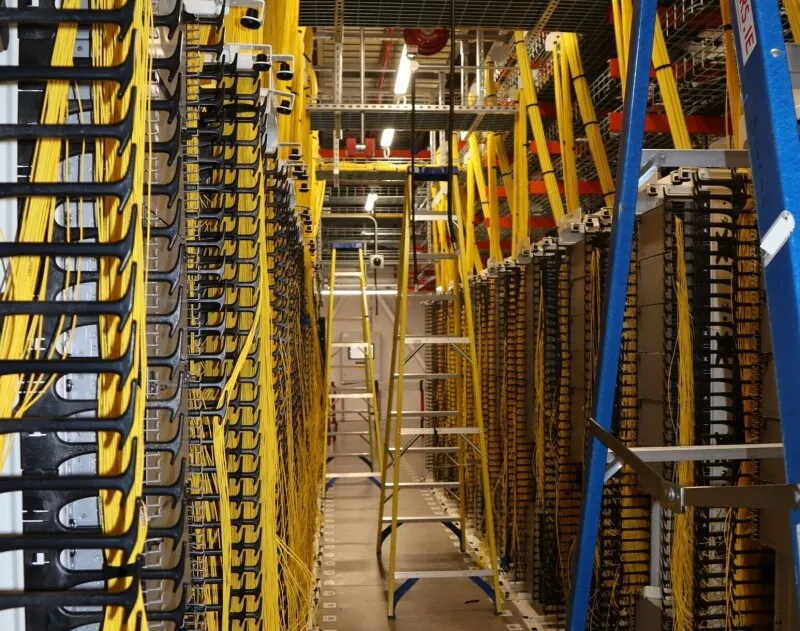
The 40 percent figure comes from AWS's decision to abandon conventional hierarchical network topologies in favor of a "near-random" wiring pattern. Instead of the classic three-tier tree with oversubscribed links, AWS now connects switches in a flat, deliberately irregular mesh. This design, detailed in a paper published last year, eliminates the need for expensive core switches and reduces the number of hops data must travel. The result is not just lower latency but significantly lower power consumption-because fewer active switches and shorter paths mean less electricity for cooling and transmission. Rehder's team has been rolling this out across new datacenter builds, and it's already the default for most new capacity.
The economic implications are profound. AWS has long been criticized for its opaque pricing, especially the two-cents-per-gigabyte charge for moving data between Availability Zones. But inside a single AZ, data movement remains free-a fact that becomes more impressive as AZs expand to encompass multiple physical facilities. The new flat-rate pricing model, already applied to AWS Interconnect for multicloud connections, charges an hourly port fee with zero per-gigabyte costs. For a 500 Mbps port, that's a free tier; for higher speeds, the flat fee replaces what would otherwise be thousands of dollars in monthly egress charges. This is a direct challenge to the industry's reliance on data transfer fees as a profit center.
The technical enabler is SIDR (Scalable Intent-Driven Routing), a protocol AWS presented at re:Invent in 2023 and again in 2024. SIDR handles the control plane, computing paths across the near-random mesh, while a separate system called Spraypoint manages the actual forwarding. Traditional routing protocols like BGP and OSPF compute shortest paths, but with thousands of equivalent routes between any two points, "shortest" becomes meaningless. SIDR solves this by allowing the network to express intent-like "keep traffic within this set of links"-and then dynamically load-balance across all available paths. AWS published the RNG paper without mentioning SIDR, and as far as anyone outside the company can tell, no one has publicly connected the two. Rehder confirmed the link when asked, noting it wasn't a secret-they just never got around to explaining it.
This storytelling gap has real consequences. The market currently believes that "neoclouds" and Nvidia's reference architectures are superior, but AWS's approach is fundamentally different. Many neocloud providers have built networks without deep routing expertise, and the result, as Rehder's colleague put it, is that "a lot of datacenter networks are run by absolute clowns." AWS's near-random design, by contrast, is the product of years of in-house research and a willingness to discard industry norms. The energy savings alone give AWS a cost advantage that compounds at hyperscale, and the shift to flat-rate pricing signals a willingness to pass some of that savings to customers-even as competitors raise prices.
For CFOs and CIOs, the takeaway is twofold. First, AWS's pricing philosophy is evolving: the days of punitive egress fees may be numbered, at least for new products. Second, the technical underpinnings of AWS's network are a competitive moat that isn't visible in marketing materials. When comparing cloud providers, the cost of moving data in and out of the cloud is often a hidden line item that can dwarf compute costs. AWS's move to flat-rate pricing for interconnect services is a direct answer to that pain point, and it's likely to spread to other services over time.
The broader implication is that AWS is betting on infrastructure efficiency rather than price hikes to maintain margins. While competitors like Google and Microsoft have raised prices on existing SKUs, AWS has held the line on many instances, even as component costs rise. The 9 percent increase for Graviton5 instances is modest compared to inflation, and AWS's energy savings give it room to absorb those costs. For enterprises, this means the total cost of ownership for AWS workloads could become more predictable, especially as network charges shift from metered to flat. The strategic stakes are clear: AWS is using its engineering prowess to redefine the economics of cloud networking, and rivals will have to respond or lose the cost-conscious customer.
In the end, the story isn't just about cables and protocols-it's about who controls the hidden infrastructure of the internet economy. AWS's near-random network, powered by SIDR, is a testament to what happens when a company invests in first principles rather than following the herd. The 40 percent energy savings and the move to flat-rate pricing are tangible proof that this approach works. For decision-makers, the lesson is to look beyond the glossy brochures and ask hard questions about how your cloud provider actually runs its network. The answer might just save you millions.
This story's Key Insights and Take-aways are locked.
Create a free account to unlock Executive Actions for one credit.
Register to UnlockAlways free for Executives Club members. Join the Club
More in Technology

Google quietly links your phone number to every Android account on your SIM
Adding a SIM now ties your phone number to all Google accounts - and future accounts inherit it. Here's the security and privacy stakes.

Hijacker AI 'Skynet mode' runs 100,000 attack steps against exposed models
Symantec caught a criminal AI agent that borrows other models, steals data, and mines crypto; the only relief is no confirmed victims yet.

Nvidia's AI-financier shift faces its first big test as neoclouds stumble
A rout in neocloud stocks is forcing investors to weigh Nvidia's hidden exposure as both supplier and lender to the AI buildout.