

Chandra’s June 30, 2026 reveal turns Messier 94’s starburst ring into sound
NASA used layered X-ray and optical data to give Messier 94 (NGC 4736) a new audiovisual “look” and “sound.”
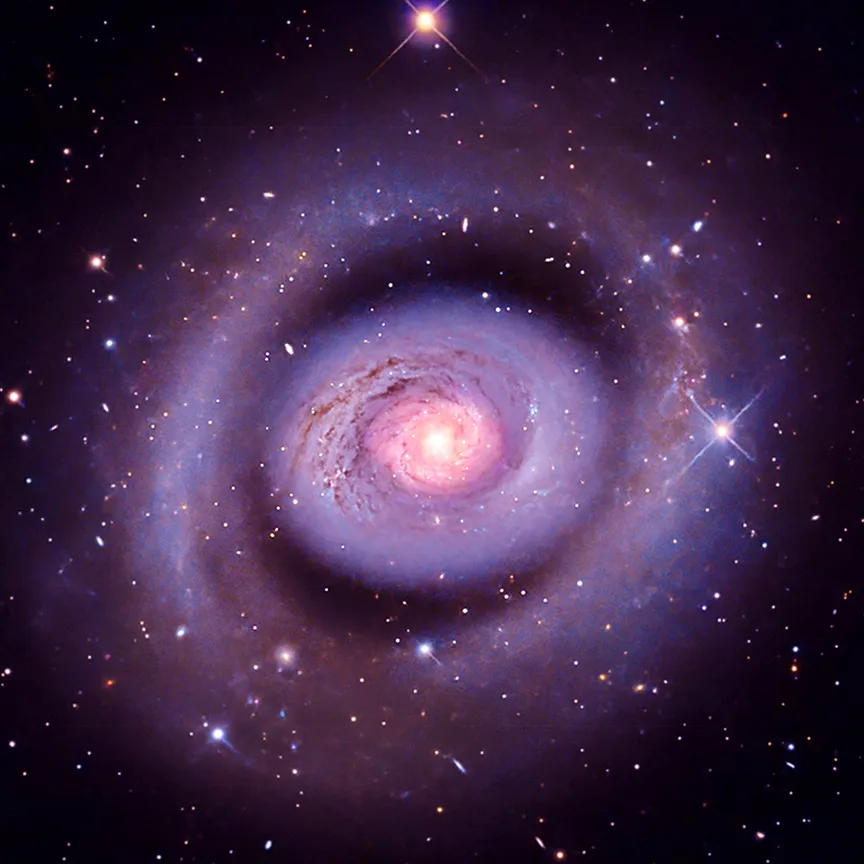
NASA’s Chandra X-ray Observatory unveiled a new look at the galaxy NGC 4736, also known as Messier 94, on June 30, 2026. The update layers Chandra X-rays of different wavelengths with visible light and offers an experience through sound.
NASA’s Chandra X-ray Observatory dropped a new reveal for the galaxy NGC 4736, also known as Messier 94, on June 30, 2026. This “new look - and sound” is not just a pretty update. It’s a clear, data-driven re-encoding of what Chandra sees in X-rays and what ground-based telescopes see in visible light, bundled into one layered view.
At the center of that view is Messier 94’s bright inner ring, called a starburst ring, where new stars are forming. NASA says those star-forming conditions “perhaps” get fueled by gas driven in a unique oval-shaped structure visible in the image. That matters because the story is about mechanism, not just aesthetics: the combination of X-ray colors from Chandra (red, orange, and blue) with visible-light colors from astrophotographers using ground telescopes (red, green, and blue) helps explain how energetic processes map onto stellar birth.
If you work in decision-making roles, this is the kind of transformation that’s worth noticing, even outside astronomy. Chandra’s new output is effectively an interface upgrade for scientific meaning. The same underlying observation becomes easier to “parse” by humans who are not trained to interpret X-ray spectra or multiwavelength overlays on sight alone. By adding a sound experience, NASA is converting wavelength differences and layered data into a sensory representation that can be reviewed, discussed, and shared faster than a technical figure that only specialists can quickly decode.
The technical framing in NASA’s release is also refreshingly straightforward. Chandra provides X-rays of different wavelengths, and NASA explicitly describes the color mapping: red, orange, and blue for the X-ray layer. Then it overlays a visible-light image, again with its own red, green, and blue mapping, sourced from astrophotographers’ ground-based telescopes. That sequencing is the whole point: you do not replace one dataset with another. You stack them, so differences in energy (what emits X-rays versus what appears in visible light) become spatially aligned. When a starburst ring is present, it is not merely “where stars look bright.” It becomes a region where energetic activity and gas dynamics can be compared across wavelengths.
Now zoom out to second-order implications. In many organizations, especially those that oversee public-facing research, education, or technology partnerships, “communication” is treated like a downstream step. NASA is illustrating the opposite approach: the way you present data can directly affect comprehension and, by extension, engagement, collaboration, and mission impact. A layered, multisensory product makes it more likely that students, creators, and stakeholders can discuss the same underlying feature (the starburst ring, the oval structure, the presence of new star formation) without requiring every viewer to be fluent in astronomy jargon.
There is also a governance and standards angle, even if the source is focused on the science. NASA is managing how observational outputs are packaged and credited. The release includes specific credit lines for X-ray data (NASA/CXC/SAO) and for optical and processing contributions, naming Brian Brennan and Remi Lacasse for the optical image, and L. Frattare and K. Arcand for image processing, with NASA/CXC/SAO/L. Frattare and K. Arcand attributed accordingly. For boards and leadership teams, that is a reminder that transparency and attribution are part of technical delivery, not administrative housekeeping. When organizations later scale these assets into educational products, exhibitions, or media toolkits, credit and lineage become compliance-grade infrastructure.
Finally, consider why this is timely for peers. Even without new policy announcements in the source, NASA’s move signals an ongoing shift in how scientific institutions compete for attention and understanding: less “here is a raw dataset,” more “here is an instrument-grade story you can experience.” When an agency publicly emphasizes a new look and sound for a named target, it reinforces the idea that multimodal interpretation is becoming a standard expectation. For executives watching innovation ecosystems, that sets a reference point for how products can translate complex measurement into human comprehension.
In other words: Chandra’s June 30, 2026 reveal is a reminder that starburst rings are only one part of the update. The bigger business lesson is that data becomes strategy when it becomes legible. Messier 94’s starburst ring, the layered X-ray and optical colors, and the sound experience are all tightly aligned to answer one question viewers actually have: what is going on there, and why does it matter?
This story's Key Insights and Take-aways are locked.
Create a free account to unlock Executive Actions for one credit.
Register to UnlockAlways free for Executives Club members. Join the Club
More in Science
2026 Nikon Small World Winners Reveal the Hidden Machinery of Everyday Life
A mycologist's frozen Edinburgh garden became the backdrop for vivid views inside cells, a reminder of what advanced imaging now makes visible to researchers and the industries built on biology.

Study: 1 in 4 depression cases may be a body-clock problem, not a chemical one
A 10,000-person study finds standard antidepressants often fail these patients, but melatonin and morning sunlight may hit the real root cause.

Start-Up Says A.I. Designed a Virus to Attack One Patient's Superbug
If the claim holds up, personalized phage therapy could become a new frontline weapon against antibiotic resistance - but proof is far from final.