
Chinese students turn to AI to choose majors as Alibaba, ByteDance, Baidu, Tencent compete
The college match scramble is pushing major decisions into AI-driven recommendations, with big tech shaping the funnel.
Alibaba, ByteDance, Baidu, and Tencent now help guide hundreds of millions of Chinese high-school graduates on university and major selection through AI-assisted systems. For decision-makers, it raises both regulatory and reputational stakes as the tech layer sits directly between students and life-changing outcomes.
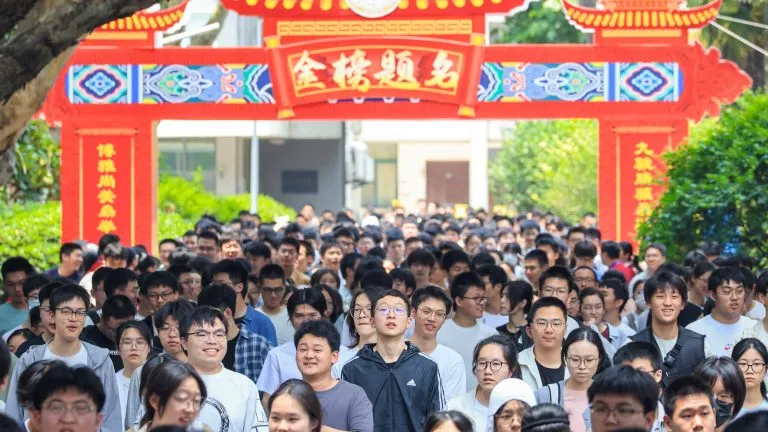
After the grueling national college entrance exam in China, Guo Xinyan has three weeks to make what could be the most important decision of her life: which universities and what majors to pursue. For years, that window has been terrifying enough without adding machines to the mix. Now, anxious students are trusting AI to help with the match, using systems shaped by some of the biggest consumer platforms and cloud-adjacent players in China.
The twist is that this is not happening in a vacuum. Alibaba, ByteDance, Baidu, and Tencent are each involved in guiding students through the high-stakes process of choosing colleges and majors, and together they influence a funnel that reaches hundreds of millions of students. The decision impacts careers, social mobility, and future income, but it also creates a different kind of risk for the companies: they are not just selling search, feeds, or cloud services. They are increasingly acting as an algorithmic gate in one of the most outcome-dense moments in a person’s life.
To understand why this matters, you have to zoom out to how the Chinese university matching system typically feels to families. The exam results are only step one. Students then have to translate scores into feasible options under the rules of admissions, which often means dealing with uncertainty, comparing tradeoffs across schools and specialties, and trying to avoid costly mismatches. In a three-week sprint, even small advantages in understanding and prediction can feel enormous. That is the perfect environment for AI: it can process messy constraints quickly, suggest likely fits, and package complex selection logic in a way that feels actionable.
But AI-driven matching also changes incentives for the platforms involved. When a student uses an AI tool for college planning, the company behind it can capture attention at a moment when intent is extremely high. That intent can then flow into downstream behaviors like applications, test prep, admissions consulting, or premium educational products. Even if the company does not directly sell a university, influencing the recommendation can shape where students focus their energy. That turns education from a passive market to an active, data-rich funnel where product teams and growth teams are competing for the same user in the same narrow time window.
There is also the regulatory layer, which is not theoretical in China. Education and youth-focused services are frequently scrutinized, especially when systems touch high-stakes decisions. When AI becomes part of major and college selection, regulators have to think about fairness, transparency, and the potential for opaque guidance that students and families cannot fully verify. For boards and executives, the compliance question is not just “is the model allowed,” but “can we explain the decision support clearly enough, and can we defend it if scrutiny arrives after an AI recommendation leads to disappointment?” In other words, the product may look like helpful guidance, but it behaves like a decision system.
Second-order implications follow quickly. A recommendation engine in admissions can amplify perceived success or failure in public narratives. If one platform’s AI guidance is associated with “better matches,” users will cluster there. If users later believe they were misled, the backlash can spread through social media and parental networks fast, and it can do damage beyond the education product itself. That makes this a cross-functional challenge for executives: legal and compliance, product, risk, customer support, and public relations are suddenly tied together around one user journey.
For the tech companies involved, the competitive dynamic is also sharper because the audience is so concentrated in timing and intensity. Hundreds of millions of graduates and families are all searching for clarity at the same time. That means demand spikes, traffic spikes, and model load spikes, which can stress infrastructure and data governance processes. It is not enough to have a working model. It has to operate reliably during the exact period when users are most stressed and most likely to interpret errors as destiny.
Strategically, peers in similar roles should treat this as a template for where algorithmic products are headed. The college and major match is a high-stakes, high-intent workflow, and AI is moving from “assistive tool” to “decision companion.” That shift forces boards to ask harder questions about how recommendation systems are monitored, how outcomes are evaluated, and how trust is preserved when the stakes are personal. As Alibaba, ByteDance, Baidu, and Tencent guide students at scale, the real business story is that they are not just competing on AI quality. They are competing on responsibility.
This story's Key Insights and Take-aways are locked.
Create a free account to unlock Executive Actions for one credit.
Register to UnlockAlways free for Executives Club members. Join the Club
More in Technology

Google quietly links your phone number to every Android account on your SIM
Adding a SIM now ties your phone number to all Google accounts - and future accounts inherit it. Here's the security and privacy stakes.

Hijacker AI 'Skynet mode' runs 100,000 attack steps against exposed models
Symantec caught a criminal AI agent that borrows other models, steals data, and mines crypto; the only relief is no confirmed victims yet.

Nvidia's AI-financier shift faces its first big test as neoclouds stumble
A rout in neocloud stocks is forcing investors to weigh Nvidia's hidden exposure as both supplier and lender to the AI buildout.