

Computex’s gacha PC hides RTX 5060, Ryzen 5 9600X, and tiny RAM capsules
TechLin’s custom build turns a Thermaltake Tower 600 into a vending-machine parody, showing how show-floor hardware now competes on story as much as specs.
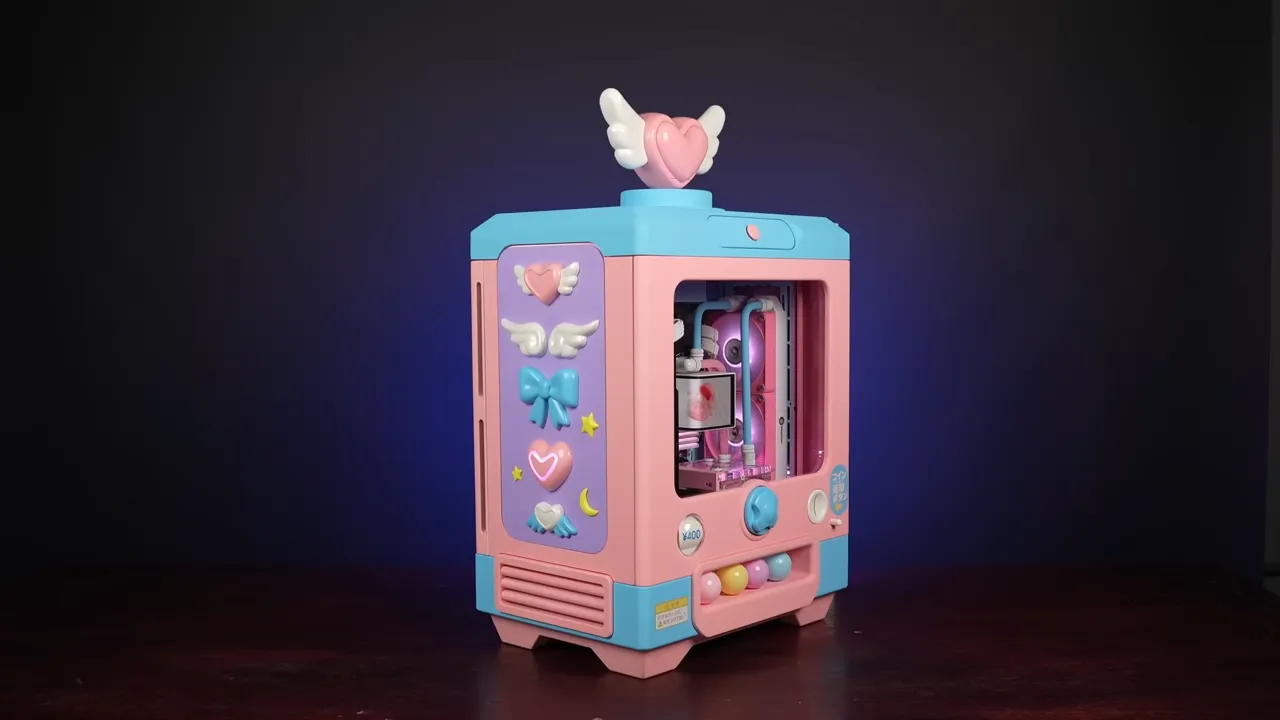
TechLin showed an updated gachapon-inspired custom PC at Computex, built on a Thermaltake Tower 600 and packed with an RTX 5060, Ryzen 5 9600X, custom water cooling, a floating heart, and tiny RAM sticks in its capsules. For hardware makers, the lesson is simple: at events like Computex, visual identity can become part of the product pitch, not just decoration.
TechLin brought a gachapon-inspired custom PC to the Computex show floor, and the build is doing the kind of work plain specs cannot. The case is a Thermaltake Tower 600, which already leans into the gag because its curved glass panel makes it look a bit like a vending machine before anyone adds the cosplay. Inside, the system pairs an RTX 5060 with a Ryzen 5 9600X and custom water cooling, while the outside goes fully theatrical with a big pink and white floating heart spinning on top. This is not a subtle machine. That is exactly the point.
The headline gimmick is not just the heart. TechLin also 3D printed a replacement front panel, added a spinning dial to mimic the crank on a gacha machine, and wrapped the case in the sort of detailing that makes the whole thing feel like a toy cabinet that somehow swallowed a gaming rig. Along the side sit a price tag icon and a string of gacha capsules. In the Computex version, those capsules no longer hold Care Bears, as they did in the version TechLin showed four months ago on its YouTube channel. Now they contain tiny sticks of RAM, which is the sort of detail that makes a hardware nerd smile and a marketing team immediately ask whether they can get one on the booth next year.
For context, gachapons are vending machines that have historically been very popular in Japan. You pay cash for a chance at one of many minifigures or collectibles, which is why the format has such strong built-in drama: you are buying uncertainty, not just a product. The source notes that without gachapons, the gacha game genre would not exist, or at least would have a different name. That matters because the PC build is not just borrowing a cute visual theme. It is borrowing a whole economic and cultural mechanic built around chance, collectability, and repeat engagement. In other words, the machine is not merely dressed up like a toy. It is dressed up like a system designed to keep people turning the crank.
That is a useful lens for understanding why this kind of build gets attention at Computex in the first place. Custom PCs are rarely the most efficient or the most cost-effective way to assemble a machine, and the source says that plainly. But on a crowded show floor, efficiency is not the metric that wins eyeballs. Recognition is. Memorability is. A build that instantly signals a theme, then layers in small physical jokes like the crank dial, the price tag, the capsules, and the floating heart, can cut through a sea of black boxes and RGB by giving people a story they can retell in ten seconds. For brands, modders, and case makers, that story has value because attention is scarce and physical demo space is expensive.
TechLin’s updated version also shows how show builds evolve between a creator’s channel and a major trade event. Four months ago, the project already existed in a prior form on YouTube. For Computex, it was updated with some fun flair to match the yearly tech event. That tells you something about the incentives around event hardware: the first version proves the concept, but the convention version is the one tuned for spectacle. The result is a build that still communicates its core idea, yet refreshes enough of the design to feel purpose-built for the crowd in Taipei rather than merely reposted from the internet.
The internal hardware choices matter too, even if they are not the centerpiece of the joke. An RTX 5060, Ryzen 5 9600X, and custom water cooling place the build firmly in the modern enthusiast lane, which helps explain why the project works as more than a sculpture. It is still a functional PC, just one wrapped in a highly legible narrative. That balance is what makes these builds so effective at trade shows: they let the audience enjoy the craft while also reminding them that the object on stage is not a prop. It is a running machine, with enough contemporary hardware to anchor the theme in reality.
And because Computex is never short on hardware theater, TechLin’s gachapon PC sits in a larger field of attention-grabbing cases and concepts. The source also points to darkFlash’s Floatron, described as an evil scientist-like build, and a custom PC based on the Taipei 101 skyscraper complete with rock climber Alex Honnold scaling the side. On the buyable side, there is a Venom-like ferrofluid case and Corsair’s military-themed Warthog. The shared lesson for anyone building, selling, or backing hardware is that the show-floor battle is increasingly about narrative packaging. Specs still matter. But when every booth can print a benchmark, the builds people remember are the ones that make the hardware feel like a character. TechLin’s gacha PC does exactly that, and then adds a floating heart on top just to make sure no one forgets it.
This story's Key Insights and Take-aways are locked.
Create a free account to unlock Executive Actions for one credit.
Register to UnlockAlways free for Executives Club members. Join the Club
More in Entertainment

Christopher Nolan’s “The Odyssey” posts his biggest Tuesday haul, surpassing “The Dark Knight’s” record
The film’s Tuesday breakout reframes Nolan’s box-office ceiling and forces competitors to rethink timing, budgets, and release strategy.

Kacey Musgraves cancels Aug. 20, 29, Sept. 2 Middle of Nowhere shows
Ticketmaster emails are telling fans refunds are coming, while the tour still starts Aug. 21 in Chicago.

Billie Joe Armstrong launches Epiphone Les Paul Junior and Marshall 1959BJA signature gear
Two limited releases turn decades of Green Day’s tone into branded hardware, including Marshall’s first artist amp in 14 years.