
Durham simulation study says Milky Way disk flipped over 90 degrees
Slowly rotating stellar halos make “disk flips” more likely, offering a new path to explain long-standing mysteries.
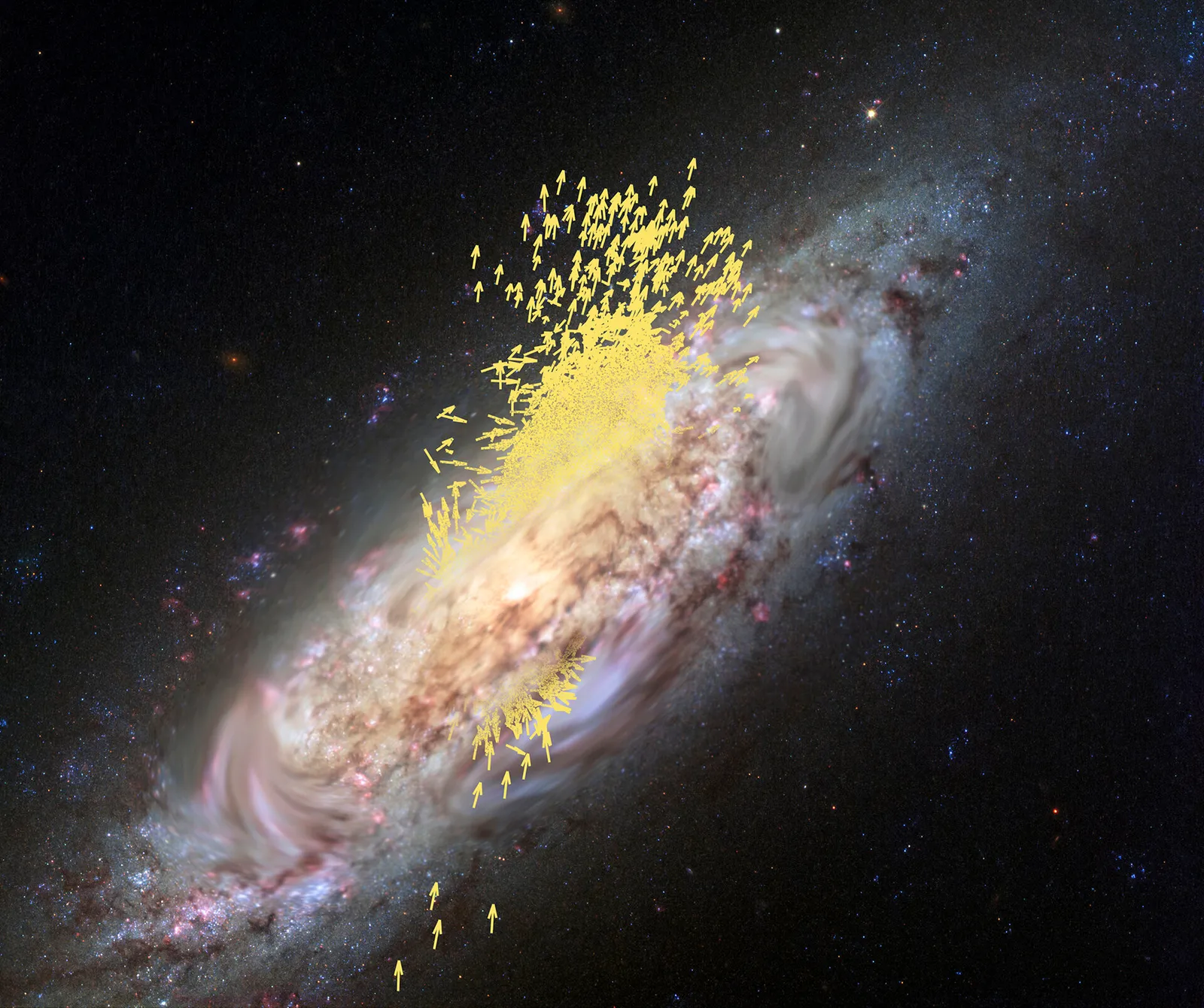
Astronomers from Durham University used supercomputer simulations of galaxies like the Milky Way to study galaxy orientation changes. Their results suggest that galaxies with slowly rotating stellar halos are more likely to undergo major disk flips, where the disk rotates more than 90 degrees.
The Milky Way may have performed cosmic gymnastics in its past. A new study using supercomputer simulations of galaxies like ours, led by astronomers from Durham University, finds that certain galaxies are far more prone to a dramatic event called a “disk flip,” where the galaxy's disk changes orientation by more than 90 degrees.
And the “why” matters: the researchers report that galaxies with slowly rotating stellar halos are more likely to experience that kind of flip. In other words, the long-term behavior of a galaxy’s outer stellar halo seems to act like a hidden driver of whether the inner disk ends up reoriented enough to qualify as a major turnaround.
Now zoom out. The Milky Way is not just a pretty photograph in the night sky. It is the one galaxy we can study in detail, and it anchors how scientists interpret the formation and evolution of disk galaxies in general. When researchers talk about a “long-standing mystery” about our galaxy, they are basically saying: something about the Milky Way’s history and structure has been hard to reconcile with simpler formation stories. If the galaxy’s disk really has undergone a >90 degree reorientation, that could reshape how astronomers think about what happened during key epochs.
This is where the Durham results become more than an interesting headline for space people. The simulations are built to test conditions. By varying properties of galaxy components, they look for patterns that correlate with dramatic reorientation events. The headline fact from the study is specific: slowly rotating stellar halos are linked to a higher likelihood of major disk flips. That is a lever. It implies that what happens in the halo is not just background scenery. It can be an upstream influence on later disk behavior.
For decision-makers in adjacent fields, the analogy is simple even if the physics is not: in complex systems, second-order drivers often matter more than the things you can observe directly. In a company, you might obsess over the product while missing that the “halo” equivalent is the operating constraints, governance, or incentives that govern long-term outcomes. In galaxies, the outer halo’s rotation rate is not something you can casually ignore. The study suggests it can set the stage for a major reorientation of the disk.
It also helps explain why this kind of research generates careful attention in academic and funding circles. High-resolution simulations on supercomputers are expensive, and they are typically judged on whether they can account for real observational puzzles. The fact that the Durham team frames the work as helping explain a long-standing mystery about the Milky Way signals that the target is not merely to reproduce a generic outcome. It is to match the kind of history that could plausibly lead to the Milky Way’s present-day orientation and structure.
If you are wondering what a “disk flip” even means in practical terms, the study’s definition is the critical piece: more than 90 degrees change in disk orientation. That threshold matters because it is not a small wobble or a gradual twist. It is a major reorientation event. In a galaxy that experiences such a flip, stars and gas in the disk would effectively end up pointing in a drastically different direction relative to the galaxy’s earlier configuration. So when the simulations connect that outcome to slowly rotating stellar halos, they are identifying a scenario where the system is primed for a big structural pivot.
Second-order implications show up in how researchers think about galaxy mergers and interactions, even if the source summary does not name specific culprits. Disk flips are the kind of signature that can complicate efforts to reconstruct a galaxy’s timeline. If orientation changes can happen dramatically due to halo rotation properties, then interpreting observational data becomes more nuanced. It also means that future simulation work could focus on the measurable halo properties that correlate with these outcomes, making the next generation of tests more targeted.
The strategic stakes for peers, especially anyone who works at the intersection of simulation, interpretation, and observational constraints, are straightforward: if halo rotation rate is a meaningful predictor of disk flip likelihood, it becomes a key variable to monitor and model. For teams trying to explain where the Milky Way came from, that is actionable scientific direction. For the broader field of galactic archaeology, it is a reminder that the cosmos can reorient itself in ways that are not obvious from the “surface” view of the disk alone.
This story's Key Insights and Take-aways are locked.
Create a free account to unlock Executive Actions for one credit.
Register to UnlockAlways free for Executives Club members. Join the Club
More in Science
2026 Nikon Small World Winners Reveal the Hidden Machinery of Everyday Life
A mycologist's frozen Edinburgh garden became the backdrop for vivid views inside cells, a reminder of what advanced imaging now makes visible to researchers and the industries built on biology.

Study: 1 in 4 depression cases may be a body-clock problem, not a chemical one
A 10,000-person study finds standard antidepressants often fail these patients, but melatonin and morning sunlight may hit the real root cause.

Start-Up Says A.I. Designed a Virus to Attack One Patient's Superbug
If the claim holds up, personalized phage therapy could become a new frontline weapon against antibiotic resistance - but proof is far from final.