
ESA’s Mars Express captures “molten metal” dunes, but it’s seasonal CO2 frost
Kaiser Crater’s chrome waves are dark basaltic sand, winter dry ice, and light tricks that rewrite how Mars moves air.
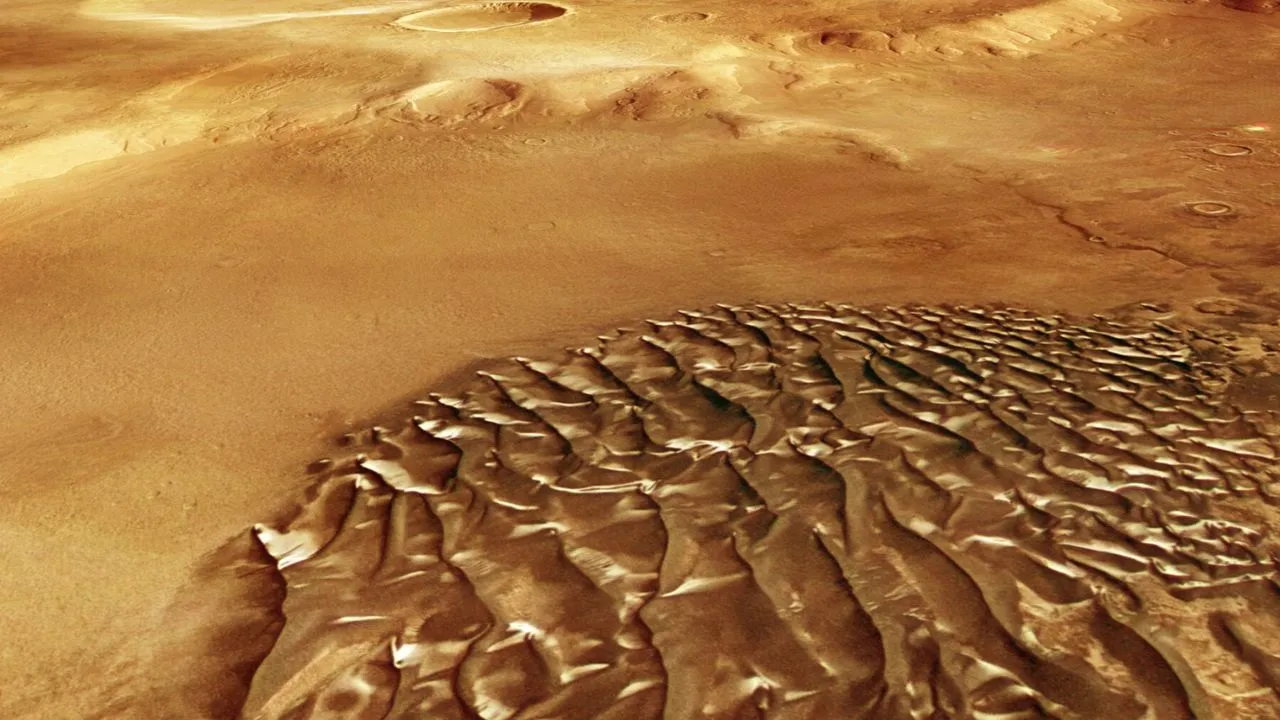
The European Space Agency’s Mars Express orbiter has captured strange, sci-fi-looking “metallic” dunes inside Kaiser Crater. The metallic sheen is not metal at all, but dark sand dusted with seasonal carbon dioxide frost, revealing how Martian winds sculpt landscapes over time.
Mars loves a good optical illusion. New images from the European Space Agency’s Mars Express orbiter show a sprawling field in an ancient crater that looks like molten metal frozen mid-pour. The punchline, though, is very non-alien: the shimmering “waves” are dark sand dunes dusted with seasonal frost, much of it carbon dioxide, also called “dry ice,” that settles on the surface during Martian winters.
In other words, the chrome-like look comes from physics, not metallurgy. Dark sand absorbs light, while the white frost reflects it. Put them together across rippling dune surfaces, and the interplay of light and contrast transforms the landscape into something that resembles a sci-fi movie set more than a windswept Martian plain. Mars Express has been orbiting since 2003, and these new images add another chapter to its ongoing record of how the Red Planet really works, even when it looks like it shouldn’t.
The dunes sit in Kaiser Crater, a 129-mile-wide (207-kilometer-wide) impact basin in Mars’ southern highlands. From above, the ripples read like tides, but they are wind-shaped features. The crater acts like a giant sand trap that prevents the sand from escaping, according to NASA. That matters because it helps explain why you can see such an extended, organized dune field rather than a scattered mess. Scientists also think there is a relatively limited sand supply shaping the field, largely because the crater floor remains visible between the ridges.
The “metal” illusion also hides a chemistry story. The dunes are darker than much of Mars’ surface because they are made of fine, basaltic sand rich in volcanic minerals such as pyroxene and olivine. That stands in contrast to the iron-oxide dust that gives Mars its familiar rusty-red appearance and the nickname “Red Planet.” So, even before you factor in frost, the base material is doing part of the work. On a planet where tiny changes in surface composition and texture can swing the way light behaves, those mineral differences can turn ordinary dunes into dramatic gradients.
Zoom out, and the images become a climate-and-history signal. Mars today has an atmosphere that is a thin veil, about 100 times thinner than Earth’s, and it slowly leaks into space. That low pressure makes it harder for winds to lift and transport sand compared with what happens on Earth. Still, the existence of towering dunes inside Kaiser Crater shows that Martian winds have been powerful enough to sculpt vast landscapes over long stretches of time, perhaps during a period when Mars’ atmosphere was thicker a few billion years ago.
And the scale here is not subtle. The ripples extend for several kilometers and tower more than 100 meters (320 feet) above the surrounding terrain. Those dimensions help distinguish this from a quick, local surface effect. This is landscape engineering. Over thousands of years, winds have carved and rearranged volcanic sand into dune ridges that can persist and be re-imaged by orbiters, while seasonal CO2 frost adds a second layer of seasonal contrast.
For decision-makers watching how space data gets turned into durable scientific and operational value, there is a practical pattern underneath the cool visuals. Mars Express is consistently producing image sets that capture different facets of Mars’ active surface processes. Just last month, it tracked a frenetic cluster of 30 dust devils swirling through the canyons of Mamers Valles, also in the northern hemisphere. And over the spring and summer, the orbiter similarly spotlighted Mars’ complex geological history, from Shalbatana Vallis, carved by groundwater floods about 3.5 billion years ago into winding valleys spanning the length of Italy, to a massive blanket of dark volcanic ash spread across a large chunk of the terrain over the last 50 years. ESA’s coverage describes that ash being either redistributed by Martian winds or exposed as overlying dust was blown away.
Put it all together and the “metallic dunes” are less about sci-fi vibes and more about Mars’ dynamics: wind strength, sediment availability, atmospheric pressure constraints, and seasonal CO2 cycling. For executives, boards, and investors tracking frontier science, that combination is the story. High-resolution observation is turning surface appearance into actionable inference about what conditions were like in the past and what processes can still operate today. And if Mars can look like molten metal because dark basaltic sand meets seasonal dry ice and the right angles of sunlight, then the bigger lesson is uncomfortable but valuable: interpretation matters, even when the images seem obvious. The strategic stake for peers in space and remote sensing is clear. Whoever can reliably translate “wow” into verified mechanisms gets the signal that funds next missions, informs mission design, and supports long-term scientific credibility.
This story's Key Insights and Take-aways are locked.
Create a free account to unlock Executive Actions for one credit.
Register to UnlockAlways free for Executives Club members. Join the Club
More in Science

2026 Nikon Small World Winners Reveal the Hidden Machinery of Everyday Life
A mycologist's frozen Edinburgh garden became the backdrop for vivid views inside cells, a reminder of what advanced imaging now makes visible to researchers and the industries built on biology.

Study: 1 in 4 depression cases may be a body-clock problem, not a chemical one
A 10,000-person study finds standard antidepressants often fail these patients, but melatonin and morning sunlight may hit the real root cause.

Start-Up Says A.I. Designed a Virus to Attack One Patient's Superbug
If the claim holds up, personalized phage therapy could become a new frontline weapon against antibiotic resistance - but proof is far from final.