
False Echo puts you at the Obscura machine, where truth changes daily
A Papers, Please-style submarine crypto adventure is coming to Steam, but the real twist is what counts as truth.
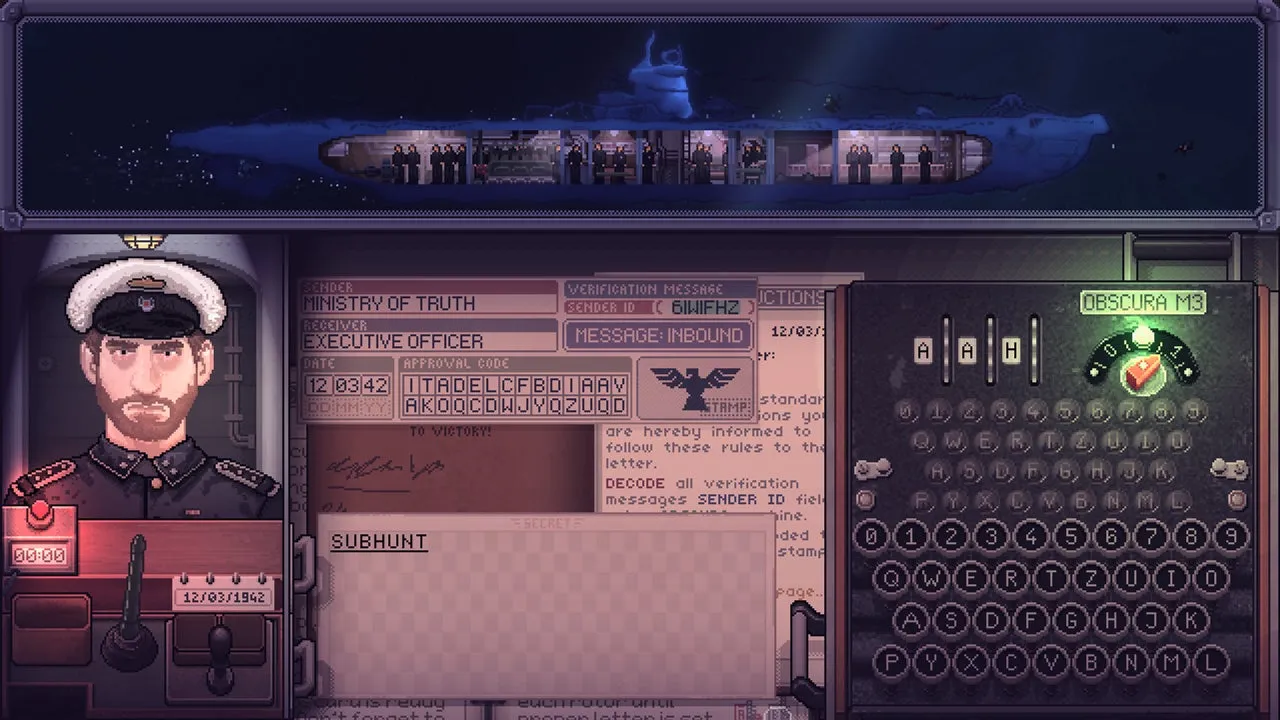
Retromagine is developing False Echo, a 2D pixel-art narrative adventure set aboard a WWII submarine, for Steam with no announced release window. The game tasks players with operating the Obscura machine to classify transmissions as TRUE or FALSE under shifting rules.
False Echo is being built as a Papers, Please-inspired cryptography narrative, but it is not the usual “read the clues, feel smart, win.” You are placed aboard a WWII submarine and put in charge of communications via the Obscura machine, where the whole point is separating truth from propaganda. Developer Retromagine’s description is blunt about the vibe: you adjust rotors, connect cables, align signals, then use the ECHO system to classify messages as TRUE or FALSE. Rules change every day. Orders contradict each other. Truth is not a single thing, and the regime is not judging you by some universal standard. It is judging you by whatever it will tolerate.
That “truth has many forms” setup is doing heavy lifting, because it means your job is not just puzzle-solving. It is decision-making under uncertainty with consequences that track your mistakes. The crew is on high alert, conversations do not match, and stories fall apart. You do not fully trust what you are told. Even the structure of the moment is designed to punish indecision: if you slow down, you fall behind. If you make mistakes, others notice. Being noticed is dangerous. Retromagine goes further, saying you are not here to save lives. You decide what gets through, and you live with the consequences.
Now zoom out and connect this to why this matters beyond the niche of pixel-art thrillers. Narrative games that simulate “procedures” have become one of the most effective ways to model real-world information systems. The Obscura machine is basically a toy interface for a familiar organizational problem: when inputs are noisy, standards shift, and incentives are misaligned, even intelligent operators can end up producing outputs that technically comply while functionally failing. In other words, the game is built around the same tension many teams face in communications, compliance, fraud detection, and security operations: classification is not just about correctness, it is about meeting a moving target.
False Echo’s specific framing is also a reminder that cryptography and truth are not always the same concept in the public imagination. The title itself is an alternate-history cryptography thriller, and the pitch leans into classification rather than math. You “process transmissions,” then “decipher the truth by the standards of the Oppressian Empire.” That detail matters because it implies a governance layer around the technical work. In real organizations, this is where things get expensive: the technical team can build accurate systems, but the downstream “truth” label may still reflect politics, risk tolerance, and operational convenience. Retromagine’s description makes that governance dynamic visceral by showing orders contradicting each other, rules changing daily, and the crew staying suspicious.
From a business perspective, the market signal here is pretty clear. Steam is the target platform, and there is no announced release window “as of yet.” That is a familiar cadence for smaller-to-mid teams building story-heavy experiences: lock in wishlist momentum, then use Steam’s ecosystem to find demand before committing hard to launch timing. The fact that IGN is publishing it as a preview also helps confirm it is on the radar of mainstream players, not just the hardcore narrative crowd. For executives and operators, the second-order point is that “systems-driven narrative” is a product strategy with differentiation that does not rely solely on graphics, marketing spend, or big-brand IP.
There is also a subtle organizational lesson hiding inside the gameplay loop Retromagine outlines. “Multiple endings await based on your choices” means the game is designed as a branching outcome system. “Rules change every day” means those branches are not static. “Orders contradict each other” means your decision framework has to adapt, not just repeat. If you are thinking like a studio leader, this is the kind of design that can increase replay value and discussion, but it also raises production complexity: more states, more contradictions, more edge cases, and more ways for player action to propagate through the narrative. If you are thinking like an investor, it is the kind of mechanic that can create a durable niche identity if executed well, while remaining risky if content scope blows up.
Finally, look at the stakes the developer highlights: conversations do not match, being noticed is dangerous, and “if you slow down, you fall behind.” That is a gameplay expression of a real operational truth: time pressure degrades judgment. When feedback loops are short and consequences are immediate, operators default to heuristics. False Echo turns that into tension and suspense, but the meta takeaway for decision-makers is bigger than gaming. Whether you are managing a compliance workflow, a security triage queue, or any domain where “truth” is operationally defined, the system can be rigged so that the cost of delay and the cost of error both compound.
False Echo is in development for Steam. It is not promising an easy win. It is promising a recurring reckoning, where “truth” is a moving standard and your job is to classify transmissions correctly enough to survive the day. For executives deciding what kinds of products to fund, what kinds of teams to support, or what kinds of systems to build, that is the appeal: it is a thriller about the friction between data and governance, disguised as a 2D pixel submarine job.
This story's Key Insights and Take-aways are locked.
Create a free account to unlock Executive Actions for one credit.
Register to UnlockAlways free for Executives Club members. Join the Club
More in Entertainment

12TB Steam 'teraleak' goes beyond Valve: GTA 3, Mafia 2 prototypes exposed
A 12-terabyte dump of Steam data reveals prototypes and builds of third-party classics like GTA 3 and Mafia 2, plus unreleased Valve content, rewriting game history.

LinkedIn's romance problem: 1 in 4 workers say dating on it is fair game
A new survey shows a quarter of U.S. employees treat the professional network as fair game for romance, even as LinkedIn bans it and removes hundreds of thousands of offending posts.

Enhypen's first No. 1 album breaks K-pop's Billboard 200 streak
The K-pop group's 98,000-unit debut tops the chart while Dolly Parton's catalog reentry shows how death reshapes streaming.