
Feynman’s reverse sprinkler was never “just backwards”: new PNAS study explains the angular momentum trick
A 2024 momentum flux theory, tested at NYU Courant, also cracks the physics behind “silly sprinklers”
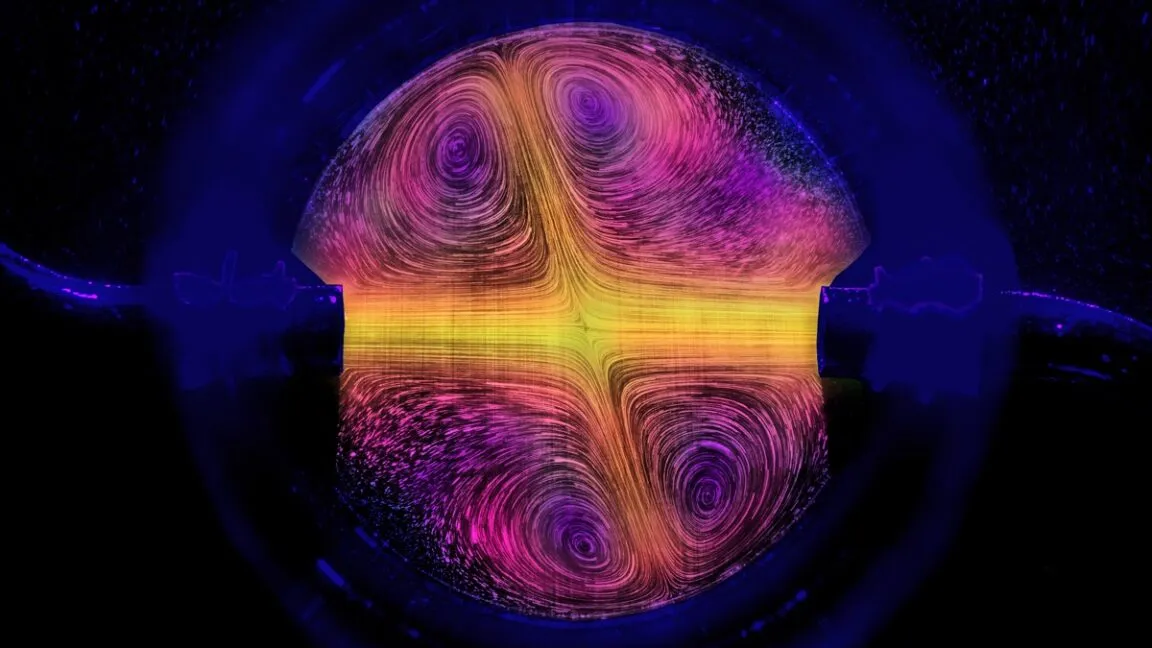
Researchers at NYU's Courant Institute ran experiments on multiple “silly sprinkler” designs and tied the results to a 2024 “momentum flux theory” about angular momentum in water flow. The work matters for decision-makers because it turns a long-debated fluid puzzle into a testable mechanism that could guide better models and simulations downstream.
If you ever watched a “reverse sprinkler” run in your head like a movie paused and played the other way, this new study is going to annoy you. That is because the solution is not merely “a regular sprinkler, played backward.” Researchers at New York University’s Courant Institute tested different “silly sprinkler” designs and reported findings in a paper published in the Proceedings of the National Academy of Sciences, confirming the 2024 “momentum flux theory” for how the angular momentum of water flows drives rotation.
The headline stake is simple: the rotation comes from where the water’s angular momentum goes, not from any naive time-reversal intuition. The study builds on earlier momentum flux ideas by showing how the same physics that resolves the reverse sprinkler problem also applies to silly sprinkler setups that produce loops and spirals. So, for anyone who thought the debate was a philosophical back-and-forth, the paper reframes it as a concrete mechanism you can measure.
To understand why this is such a big deal inside fluid dynamics, you have to meet the puzzle where it started. The reverse sprinkler problem is associated with physicist Richard Feynman because he popularized the concept, but it actually dates back to a chapter in Ernst Mach’s 1883 textbook The Science of Mechanics (Die Mechanik in Ihrer Entwicklung Historisch-Kritisch Dargerstellt). Mach’s thought experiment sat in relative obscurity for decades, until Princeton University physicists began debating it in the 1940s.
Feynman, who was a graduate student at the time, threw himself into the debate with gusto. He even devised an experiment in the cyclotron laboratory to test his hypothesis. That matters because it hints at the core tension: even when the setup sounds intuitive, competing “perfectly clear” interpretations can diverge. In Surely You’re Joking, Mr. Feynman (1985), Feynman wrote, “The answer is perfectly clear at first sight,” then explained, “The trouble was, some guy would think it was perfectly clear [that the rotation would be] one way, and another guy would think it was perfectly clear the other way.”
Fast-forward to the Courant Institute study, and the argument shifts from “who’s intuiting correctly” to “what the flow is doing.” The researchers did not just run one clever nozzle arrangement. They conducted a series of experiments with different silly sprinkler designs, looking for the unifying explanation. The paper’s conclusion is that momentum flux is the guiding concept: the angular momentum in the moving water stream is the driver of the rotational behavior you see.
Why should an executive care about a garden-hose physics debate? Because the real world is full of systems where time-reversal intuition fails. In operations, manufacturing, logistics, and simulation-driven planning, teams often rely on models that assume symmetry they do not actually have. When fluid behavior is involved, “it looks like it should reverse” can turn into a modeling bug, and modeling bugs are expensive. In other words: this is not just trivia about sprinklers. It is an example of how a mechanism-based theory can replace intuition-based disagreements.
There is also a broader second-order implication for the scientific and engineering ecosystem. When a theory like “momentum flux theory” is confirmed experimentally and applied across multiple related configurations, it reduces uncertainty for anyone trying to build or validate models. That can affect how quickly groups can iterate on designs, how confidently they can simulate outcomes, and how effectively they can communicate results across disciplines that do not share the same native intuition.
And for boards and decision-makers overseeing research, product, or tooling that depends on accurate modeling, the meta-lesson is uncomfortable but valuable: physics debates can look abstract for years, until a mechanism ties together scenarios that previously seemed separate. Here, the same angular-momentum framework that resolves the reverse sprinkler puzzle also applies to “silly sprinklers” creating amusing loops and spirals. That is a tidy win for the scientific method, and a reminder that the most practical theories are the ones that survive being tested in more than one contraption.
This story's Key Insights and Take-aways are locked.
Create a free account to unlock Executive Actions for one credit.
Register to UnlockAlways free for Executives Club members. Join the Club
More in Science

2026 Nikon Small World Winners Reveal the Hidden Machinery of Everyday Life
A mycologist's frozen Edinburgh garden became the backdrop for vivid views inside cells, a reminder of what advanced imaging now makes visible to researchers and the industries built on biology.

Study: 1 in 4 depression cases may be a body-clock problem, not a chemical one
A 10,000-person study finds standard antidepressants often fail these patients, but melatonin and morning sunlight may hit the real root cause.

Start-Up Says A.I. Designed a Virus to Attack One Patient's Superbug
If the claim holds up, personalized phage therapy could become a new frontline weapon against antibiotic resistance - but proof is far from final.