

French team watched mid-ocean rift spreading burst within 2 months of installing gear
The new remote data suggests most spreading can happen quickly, sometimes without seismic signals, reshaping how we monitor the seafloor.
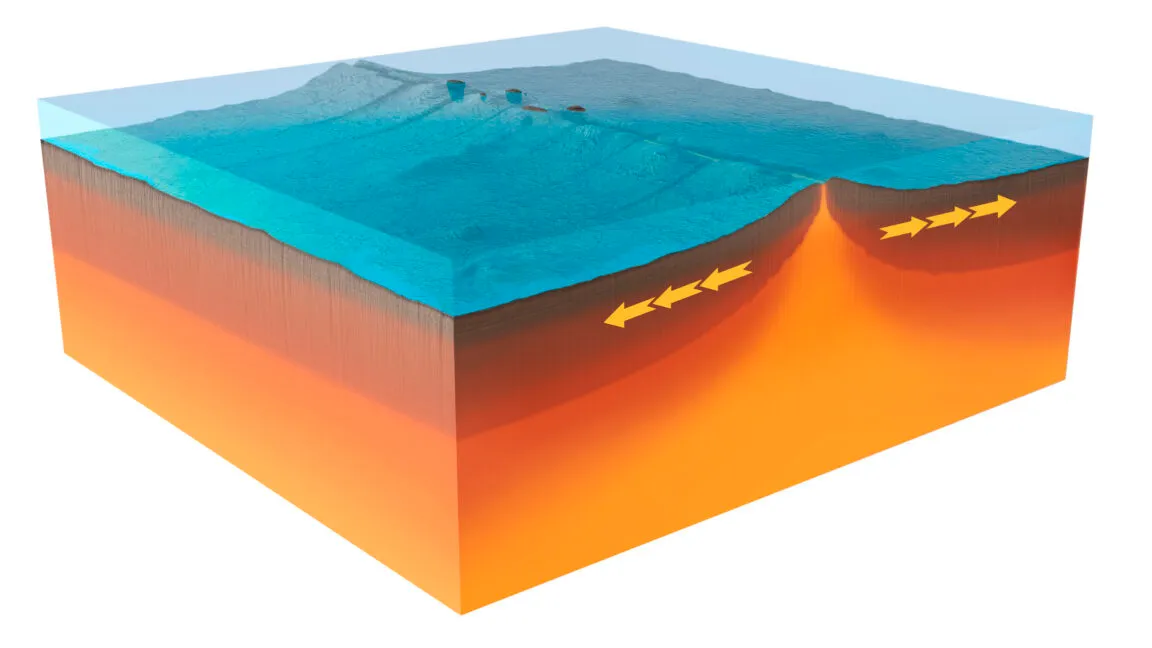
A French scientific team remotely monitored a major spreading event on the border between the Australian and Antarctic plates in 2024, just two months after installing ocean-floor equipment. Their observations indicate that most crustal spreading occurred in a short time window and that some key events happened without obvious seismic activity.
Mid-ocean ridges are where new ocean crust is born, and plate tectonics depends on a deceptively simple question: how does the spreading actually happen? For decades, scientists have had a pretty clear picture of what the resulting crust looks like. The missing piece was the “process” view, the sequence of events that turns expanding rock into the structured seafloor we map and study.
In 2024, a French team made that process view real by remotely monitoring a major event along the border between the Australian and Antarctic plates. The kicker is timing: they did it only two months after they installed equipment on the ocean floor. Their data shows that most of the spreading occurred in a relatively short time window, and it also shows that some key events happened without any obvious seismic activity. In plain English, a lot can change fast, and the seafloor does not always announce it with the kind of shaking humans expect to see.
This matters because monitoring choices reflect incentives. Earth science has to balance how much you can measure against where and when you can measure it. If spreading happens quickly, then systems that rely on long observation windows or assumptions about gradual change can miss the most important part of the story. And if some key events occur without obvious seismic activity, then even dense seismic networks may not be sufficient on their own, because the “signal” you want might be absent or too subtle for the instruments to categorize the event the way you hoped.
At a higher level, the discovery underscores why plate tectonics is both foundational and stubborn. Mid-ocean ridges are central features of plate tectonics, and they sit at the core of how continents separate as new crust forms. The widespread acceptance of plate tectonics was driven, in large part, by the discovery of these ridges. Over time, decades of exploration delivered a detailed understanding of the outcome: what the crust produced at spreading sites looks like. But the pathway, the step-by-step production of those features, remained incomplete. The French team’s remote monitoring approach is essentially an attempt to close that gap, turning “we know what happened” into “we know how it unfolded.”
The operational lesson for anyone managing complex, distributed monitoring is that instrumentation time-to-value is not theoretical. In this case, the researchers obtained meaningful results just two months after installation. That is a reminder that in ocean environments, equipment deployment is expensive and logistically heavy, so a quick ramp to useful data can dramatically improve scientific returns. It also suggests that future studies could focus on faster-to-deploy or more continuously connected systems, because the most transformative events might be the ones that occur earlier than expected.
Now zoom out to second-order implications. If major spreading can occur within a relatively short time window and without obvious seismic activity, then models that treat spreading as a steady or gradually evolving process may need adjustment. That affects interpretation across the board, from how scientists infer the mechanics of crust formation to how they decide what counts as an “event” worth attention. In practical terms, that can change where teams focus data collection, how they cross-validate observations, and which indicators they treat as reliable proxies for subsurface change.
There is also a governance angle, even if the paper itself is purely scientific. Earth observation programs are increasingly about data pipelines, not just instruments. When a team can remotely monitor a major event at a tectonic plate boundary quickly after installing gear, it strengthens the case for policies and funding decisions that prioritize real-time or near-real-time connectivity and data sharing. Regulators and oversight bodies might not directly regulate seafloor geology, but they do influence how research infrastructure is approved, how maritime operations are coordinated, and how long data collection systems can be deployed.
For executives, board members, and technology leaders in monitoring-heavy industries, this is a familiar pattern: the first time you truly observe the process, you discover that the world does not follow the timeline you assumed. The French team’s 2024 results are a reminder that the seafloor can reorganize rapidly, and it may not provide the seismic “heads up” you expect. The strategic stake for peers who build systems to watch complex Earth processes is clear: if the biggest changes are fast and sometimes silent, then success depends on coverage, timing, and the ability to detect events even when your preferred signals do not show up.
This story's Key Insights and Take-aways are locked.
Create a free account to unlock Executive Actions for one credit.
Register to UnlockAlways free for Executives Club members. Join the Club
More in Science
2026 Nikon Small World Winners Reveal the Hidden Machinery of Everyday Life
A mycologist's frozen Edinburgh garden became the backdrop for vivid views inside cells, a reminder of what advanced imaging now makes visible to researchers and the industries built on biology.

Study: 1 in 4 depression cases may be a body-clock problem, not a chemical one
A 10,000-person study finds standard antidepressants often fail these patients, but melatonin and morning sunlight may hit the real root cause.

Start-Up Says A.I. Designed a Virus to Attack One Patient's Superbug
If the claim holds up, personalized phage therapy could become a new frontline weapon against antibiotic resistance - but proof is far from final.