
Gmail’s Gemini Flows improves filters, then quietly caps power users at 2,000 emails monthly
The feature helps organize your inbox with AI flows, but only up to your first 2,000 emails a month.
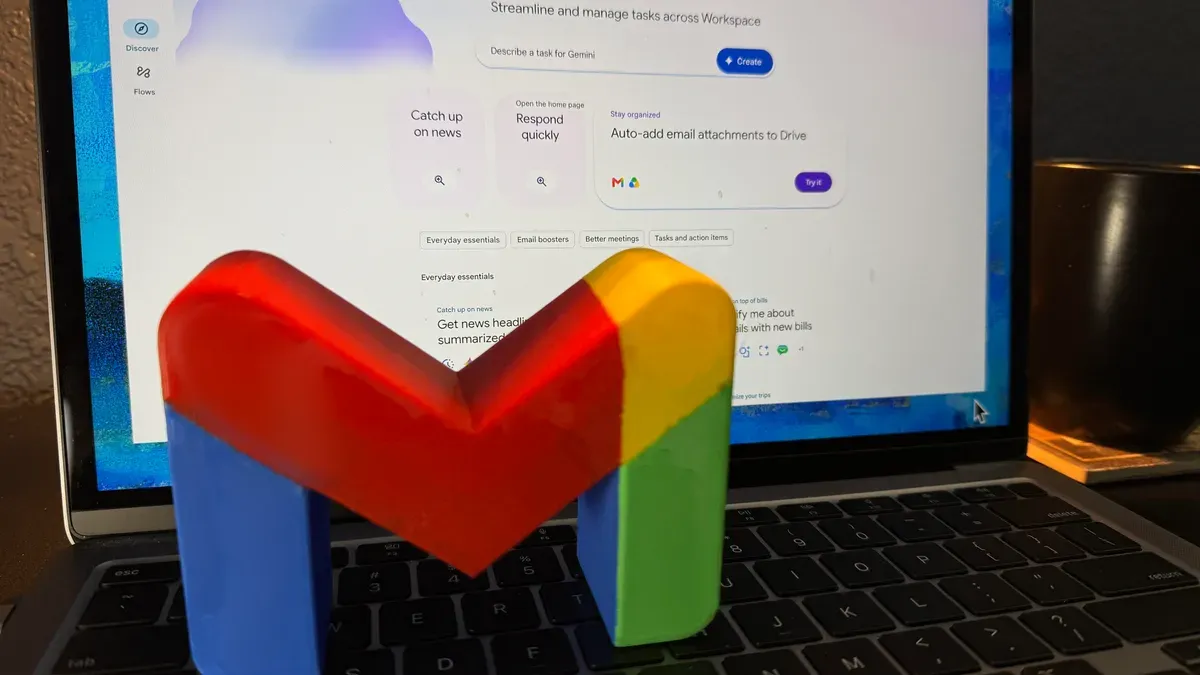
ZDNet reports on Gmail’s new Gemini Flows feature, which significantly improves how Gmail’s filtering works. The catch is that it only applies to a power user’s first 2,000 emails each month, creating a hard limit after that.
Gmail just gave its filtering superpowers a fresh coat of AI paint, and ZDNet’s hands-on test calls Gemini Flows a “huge” improvement. The immediate payoff: flows make it easier to route and organize messages in ways that feel closer to intent than to brittle, manually tuned rules.
But here is the part power users will feel in their workflow: Gemini Flows helps with your inbox only for your first 2,000 emails a month. That means the feature is not a universal fix for the “filter chaos” that comes from high-volume inboxes. If your job depends on squeezing signal out of thousands of messages, you can get a period of real improvement, then hit a wall that forces you back to older habits.
To understand why that matters, you need to zoom out from Gmail-specific details to how email filtering works in practice. For years, people have built systems of filters, labels, and rules to triage incoming messages. The system is effective, but it has a cost: you must anticipate what is coming and keep the rules updated when senders change formatting, subject lines drift, or new categories of email appear. That is why “AI flows” are interesting to busy operators. They promise less upfront guessing, more adaptive behavior, and quicker changes when your inbox environment shifts.
ZDNet’s framing suggests Gemini Flows lands in that “faster and smarter than classic filters” lane. In other words, it is not just a gimmick. It is a usability upgrade for inbox management, and ZDNet’s experience positions it as meaningfully better filter performance, not a cosmetic change.
The catch, though, is the kind of detail that becomes mission-critical once you deploy it at scale. A 2,000-email monthly cap is not a rounding error. It is a threshold that depends on your sending and receiving patterns, team role, and the nature of your communications. For some users, 2,000 emails is a comfortable month. For many power users, especially founders, operators, investors, and customer-facing roles, it is easy to exceed that limit simply due to volume and distribution lists. Once you do, the “AI advantage” does not disappear instantly for your whole life, but the feature will not keep delivering at the same level, and you will need to fall back to other filtering mechanisms.
This is also where second-order implications show up for decision-makers who manage productivity systems across teams. When a productivity feature has a usage cap, it effectively creates uneven benefits across an organization. High-volume users could hit the cap more often, while lower-volume teammates see continued performance. That pushes managers to think beyond “is this feature good?” and toward “who gets the benefit, and how do we ensure consistent outcomes?”
There is a broader industry pattern behind this kind of limitation. AI capabilities often ride on compute-intensive services, and platforms frequently manage cost and performance by limiting how much personalized or automated behavior users can trigger. Even when the product is excellent, the economics of scaling AI into everyday workflows can introduce hard boundaries like the one ZDNet reports here. That does not make the feature bad. It means expectations need calibration.
For the executives reading this, the strategic stakes are simple: inbox triage is one of those unglamorous systems that quietly determines whether you move fast or drown. If Gemini Flows can truly improve filtering for your first 2,000 emails each month, it may be worth integrating into your workflow for the months where it matters most, such as during fundraising, product launches, major partnerships, or seasonal support surges. But you should assume that the cap will eventually force you back into baseline approaches. The winners will not be the people who install the feature and forget it. They will be the ones who treat it like an upgrade phase inside a broader inbox operating system.
In short: ZDNet reports a real improvement in Gmail filtering via Gemini Flows. The feature’s effectiveness comes with a measurable boundary, 2,000 emails per month for power users, which turns this from a universal replacement into a time-bounded advantage. Plan accordingly, because the moment you hit the limit, your workflow will either adapt smoothly or become friction you did not need.
This story's Key Insights and Take-aways are locked.
Create a free account to unlock Executive Actions for one credit.
Register to UnlockAlways free for Executives Club members. Join the Club
More in Technology

Nvidia's $89B data center quarter: the 9 companies cashing in
The AI buildout is minting fortunes beyond GPUs, and memory, cloud, and cooling suppliers are riding the same wave.

Google quietly links your phone number to every Android account on your SIM
Adding a SIM now ties your phone number to all Google accounts - and future accounts inherit it. Here's the security and privacy stakes.

Hijacker AI 'Skynet mode' runs 100,000 attack steps against exposed models
Symantec caught a criminal AI agent that borrows other models, steals data, and mines crypto; the only relief is no confirmed victims yet.