

Historic Environment Scotland’s survey at Machrie Moor finds a buried 28-meter stone or timber circle
Geophysics under Arran peat reveals 12 pit-like anomalies in a Stonehenge-like ring, with possible 14 posts or stones.
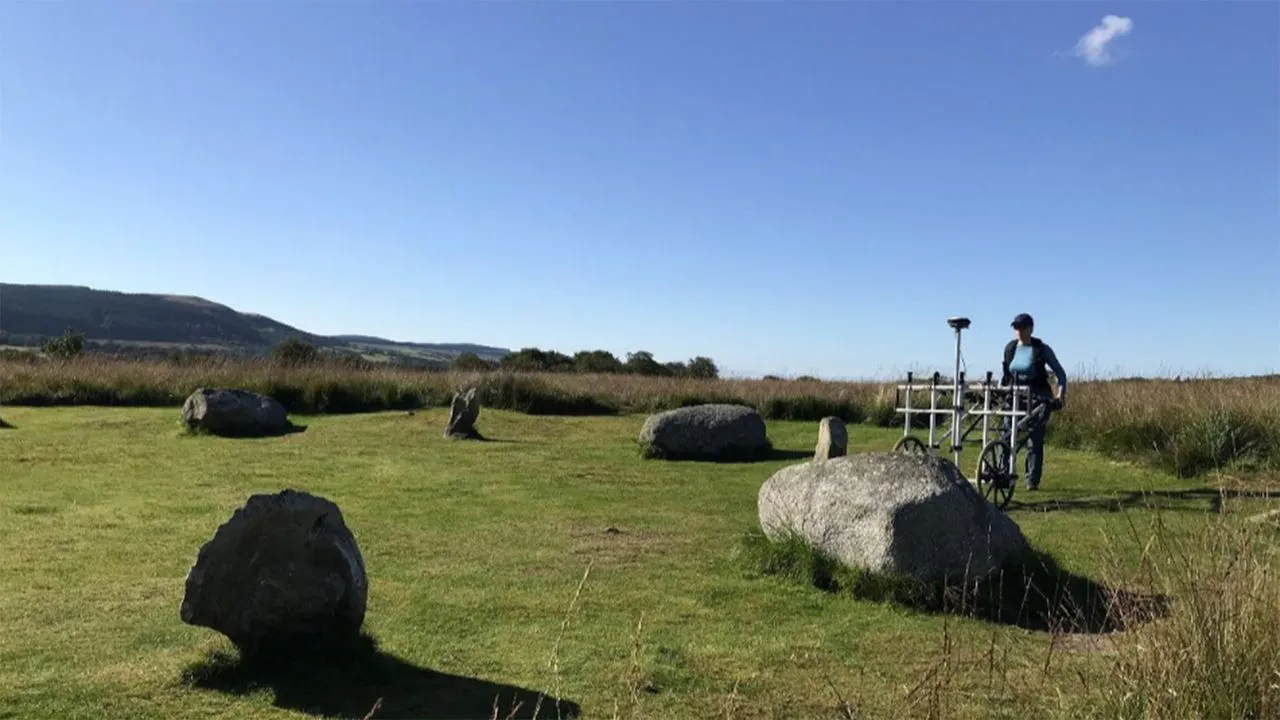
Researchers with Historic Environment Scotland detected a new, buried stone or timber circle beneath peat at Machrie Moor on Scotland’s Isle of Arran. The discovery adds a potentially Stonehenge-like monument to a landscape already known for multiple ceremonial circles dating to roughly 3500 to 1500 B.C.
A geophysical sweep under a Scottish peat moor has turned up something that looks a lot like a new ritual “ring” of the type that normally takes years of excavation to confirm. At Machrie Moor on Scotland’s Isle of Arran, Historic Environment Scotland identified a possible stone or timber circle buried beneath the peat using survey equipment that detects subtle magnetic changes underground.
The specifics matter because the signal is shaped, not random. The feature the team detected consists of 12 circular, pit-like anomalies arranged in a circle approximately 92 feet (28 meters) across, with pits spaced around 21 feet (6.5 m) apart. Researchers also flagged two unusually wide gaps that, if they represent decayed pits, could mean the monument originally had 14 posts or standing stones. And just as important for interpretation, the report notes there is currently “no indication that any of these anomalies contain a stone,” leaving open the possibility the circle was built from timber posts or standing stones that were later removed.
This is happening in one of Britain’s most intensively studied prehistoric landscapes. Machrie Moor is part of a ritual complex dated to between roughly 3500 and 1500 B.C., already famous for its towering standing stones, burial monuments, and ceremonial sites. Since the 1980s, archaeologists have identified six ceremonial circles there, and the new discovery was not part of a typical excavation push. Instead, the survey was designed to test how modern archaeological instruments work in peat-covered landscapes. The twist is that the test found a new monument, surpassing expectations.
For leadership teams in heritage, public sector archaeology, or any organization that funds long-running field programs, this is a real operational lesson: instrumentation can de-risk where to dig. The same kind of geophysical approach also helps revise what is already “known,” not just add new sites. At Machrie Moor Circle 2, the team identified a ring of anomalies suggesting that what had been reconstructed as seven or eight stones may actually have had 14. At the site’s Circle 11, previously excavated work dated it to the Bronze Age. So the survey is doing double duty, improving both discovery and precision across known features.
There is also a cultural logic to why this should feel consequential, even though no spade has hit the ground for this new circle. The circles at Machrie Moor share a striking orientation. They align with a notch at the head of nearby Machrie Glen, where the midsummer sun would have risen. Researchers say this suggests astronomical observations may have played a role in ceremonies conducted at the location. If the newly detected ring really was laid out with similar intent, it would extend a pattern of planned, repeatable celestial alignments across multiple monuments, rather than treating each circle as a one-off.
The most strategic detail for decision-makers is what still remains unknown. Unlike the circles already identified at Machrie Moor, the newly detected monument has not been excavated yet. That means the current evidence is indirect, based on magnetic anomalies and pit-like features inferred from subsurface disturbance. The team is careful about interpretation: without signs that the anomalies contain stone, the ring could have been timber-built. The report also notes that earlier periods at the site involved a material shift. Previous excavations have revealed that several other stone circles at Machrie Moor were originally built as timber circles, with wooden posts replaced with stones around 2000 B.C. Later, human cremations and bodily burials were placed within some of the circles, suggesting the monuments' functions changed over time.
So what does this mean for executives and boards who care about the intersection of culture, budgets, and public trust? It underscores how heritage work is increasingly a technology plus governance story. Better detection methods can change the priority list for field teams, potentially shifting where limited excavation funding goes next. It also raises the stakes around planning, because a previously undetected circle implies more archaeological assets may still be present under peat. As Nick Hannon, senior heritage recording manager at Historic Environment Scotland, said in a statement released June 30, there is “a lot of archaeology yet to uncover at Machrie Moor,” and the discovery of a new circle “completely surpassed” expectations.
This is why the finding lands beyond archaeology fans. Stone circles are a huge part of how researchers map the Neolithic and Bronze Ages across Britain and mainland Europe, and Stonehenge, while famous, is only one monument among hundreds built during those eras. Machrie Moor’s preservation makes it a reference point for interpreting broader prehistoric building traditions. If future excavation confirms the new ring’s layout and materials, it could refine timelines for how sites evolved, how ceremonial practices were organized, and whether timber and stone were interchangeable stages in monument building rather than separate traditions.
For leaders in similar roles, the strategic takeaway is simple: when new evidence emerges from non-invasive surveys, it can rewrite next steps fast. In this case, a peat moor test scan uncovered a potential 28-meter circle, hinting at 12 visible anomalies and possible 14 original posts or stones, and doing so without disturbing anything archaeologically. That combination is rare. It gives the field a clean path to target excavation, and it gives decision-makers a strong reason to invest in smarter detection before they spend a single day digging.
This story's Key Insights and Take-aways are locked.
Create a free account to unlock Executive Actions for one credit.
Register to UnlockAlways free for Executives Club members. Join the Club
More in Science
2026 Nikon Small World Winners Reveal the Hidden Machinery of Everyday Life
A mycologist's frozen Edinburgh garden became the backdrop for vivid views inside cells, a reminder of what advanced imaging now makes visible to researchers and the industries built on biology.

Study: 1 in 4 depression cases may be a body-clock problem, not a chemical one
A 10,000-person study finds standard antidepressants often fail these patients, but melatonin and morning sunlight may hit the real root cause.

Start-Up Says A.I. Designed a Virus to Attack One Patient's Superbug
If the claim holds up, personalized phage therapy could become a new frontline weapon against antibiotic resistance - but proof is far from final.