
I coded a $7 ESP32-S3 ad blocker in minutes, bypassing expensive Raspberry Pi workarounds
A tiny $7 ESP32-S3 board can block computer web ads fast, undercutting the cost excuses that keep Raspberry Pi projects alive.
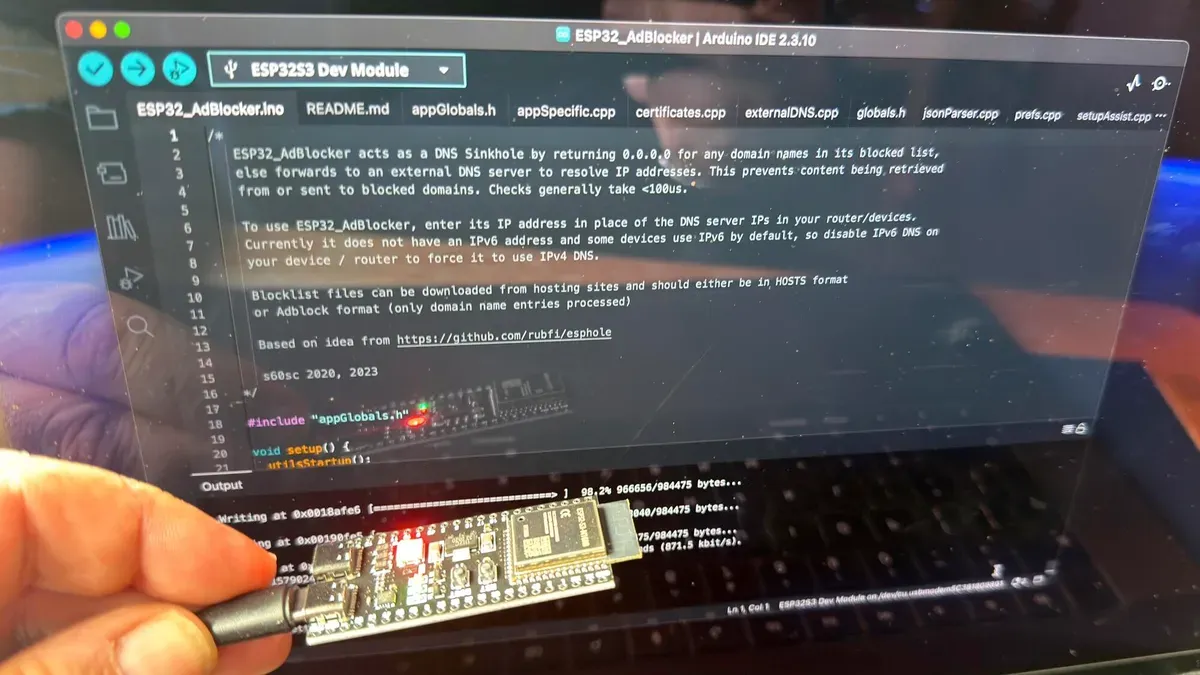
A maker used an ESP32-S3 board, costing just $7, to block web ads on a computer. The implication for decision-makers: cheaper hardware lowers the barrier for privacy and ad-control experiments, forcing teams to rethink what is “possible” on a budget.
Raspberry Pi boards have gotten expensive, and that price pressure is pushing builders to look for cheaper alternatives. In this project, the alternative is a tiny ESP32-S3 board that costs about $7. The result is the headline’s promise: the maker programmed the board to block all computer web ads, and it took just minutes.
That “just minutes” part matters, because ad blocking is usually treated like a bigger, heavier lift than it is. The familiar path is to start with something like a Raspberry Pi because it is easy to prototype on and widely documented. But if Raspberry Pi boards are now costing too much, the real risk is that people give up or delay. This build is a counterexample: you can still get functionality quickly, even with a much smaller and cheaper device.
To understand why this is more than a fun tinkering story, zoom out to what has been happening in consumer and enterprise IT. Web ads are not just a nuisance; they are a pipeline that drives browser traffic, telemetry, and often invasive tracking. Ad blocking tools exist in plenty, but their effectiveness and deployment usually depend on what devices can run the tooling and how much engineering friction teams face. When hardware prices rise, projects that would otherwise be low-risk become “too costly to justify.” That is exactly the kind of decision-making bottleneck this $7 ESP32-S3 sidesteps.
There is also a regulatory and compliance shadow behind “ad blocking.” Around the world, regulators have pushed for tighter controls over tracking, consent, and data processing. Even if your organization is not litigating adtech, privacy requirements shape how security, product, and legal teams think about online tracking. When ad blocking becomes accessible on inexpensive hardware, it can shift internal expectations. People start asking: if blocking can be done quickly with cheap hardware, why does our current setup require larger infrastructure or more complex approvals?
Second-order implications show up in procurement and architecture discussions. The maker explicitly frames the motivation in cost terms: Raspberry Pi boards have gotten expensive, so they look for cheaper alternatives, then find one in the ESP32-S3 board. That is a procurement signal disguised as a hobby project. If a $7 board can be repurposed for ad control, the “default” assumption that you need a more expensive computing platform weakens. Teams planning internal demos, edge deployments, or quick security experiments may revisit device selection and ask whether they can get the same outcome with lower-cost hardware.
There is also a learning curve implication. ESP-class boards are small and often used for IoT experiments, while Raspberry Pi is frequently treated as the go-to for general-purpose prototyping. When a project like this works, it encourages a mental model shift: maybe the boundaries between “IoT device” and “network function” are blurrier than people assume. If you can program a tiny ESP32-S3 board to block web ads in minutes, then future builders may spend less time debating platform choice and more time focusing on the actual policy they want enforced.
For executives and board members, the strategic stakes are not “can an ad blocker be coded,” because obviously it can. The stakes are what this kind of accessibility does to operational risk and competitive behavior. Lower barriers mean faster iteration by smaller teams and individuals. That can pressure larger organizations to move quicker on privacy-aligned tooling, reduce friction in experiment-to-deployment pipelines, and ensure governance does not become a slow-motion bottleneck. In short: when a $7 device can accomplish what people previously associated with pricier hardware, the environment favors speed, and speed changes who wins.
This story's Key Insights and Take-aways are locked.
Create a free account to unlock Executive Actions for one credit.
Register to UnlockAlways free for Executives Club members. Join the Club
More in Technology

Nvidia's $89B data center quarter: the 9 companies cashing in
The AI buildout is minting fortunes beyond GPUs, and memory, cloud, and cooling suppliers are riding the same wave.

Google quietly links your phone number to every Android account on your SIM
Adding a SIM now ties your phone number to all Google accounts - and future accounts inherit it. Here's the security and privacy stakes.

Hijacker AI 'Skynet mode' runs 100,000 attack steps against exposed models
Symantec caught a criminal AI agent that borrows other models, steals data, and mines crypto; the only relief is no confirmed victims yet.