

Inca Capacocha sacrifices: CT scans overturn hypothermia and strangulation claims
New Science Advances forensics reclassify how three sacrificed children died, while hair isotopes redraw their final pilgrimages.
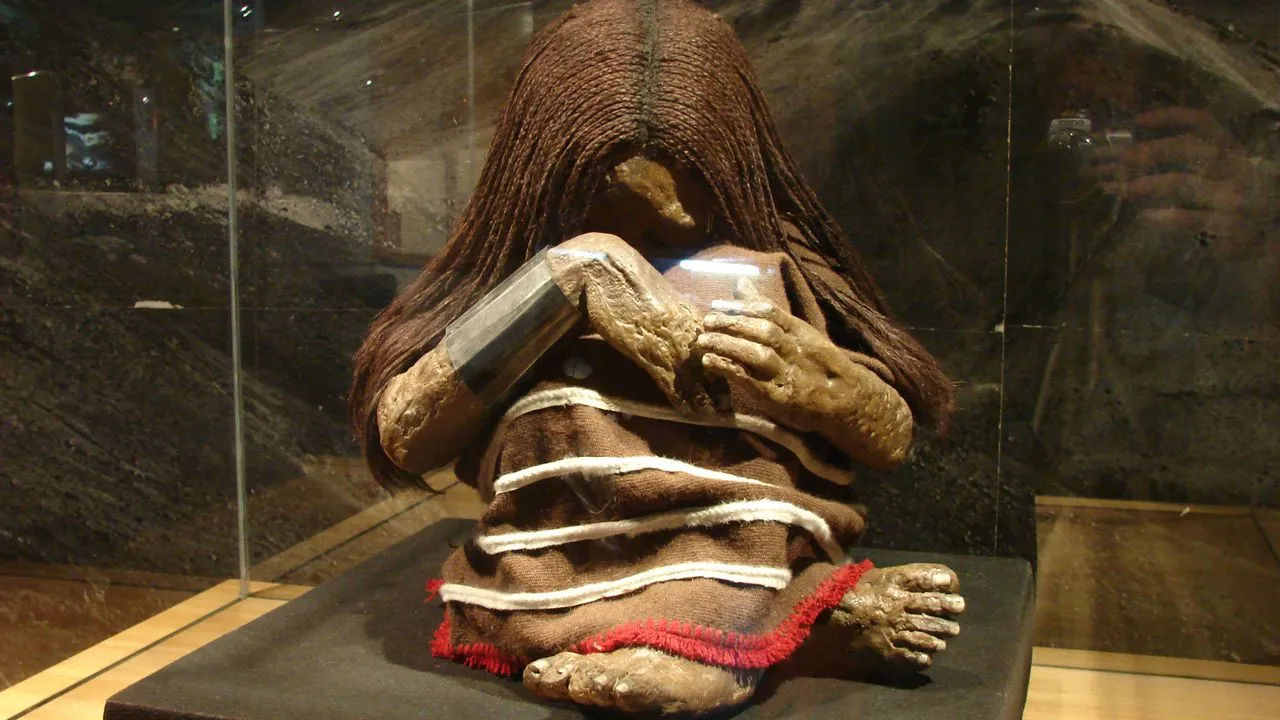
Archaeologist Verónica Silva-Pinto, of Diego Portales University, and colleagues used CT scans, microscopy, chemical hair isotope analysis, and radiocarbon dating on three Capacocha mummies. Their July 15 Science Advances study overturns long-held ideas that El Plomo Boy died from hypothermia and that the two Cerro Esmeralda girls were strangled.
If you grew up hearing that the Inca’s Capacocha sacrifice was basically “die up high, freeze” or “die by strangulation,” this new paper is here to take the plot away. A modern re-examination of three Capacocha mummies, published July 15 in Science Advances, finds none of the children died the way scientists previously thought.
The biggest reversal is the “Niño de El Plomo” (El Plomo Boy). He was long believed to have died from hypothermia, or exposure to freezing temperatures, near the 17,700 foot (5,400 meter) summit of Cerro El Plomo in central Chile. But CT scans and microscopy revealed he was killed with blunt force trauma to the head, an injury that earlier investigators did not see. The Cerro Esmeralda girls were similarly re-written: they had been thought strangled because of marks on their necks, but the new study argues those neck marks were probably caused by clothing after death. And the hyoid bones were not fractured or displaced, which happens in most strangulations. That means their cause of death should now be considered “indeterminate.”
That is the headline-level drama, but the study is even more interesting in the way it connects method to meaning. Silva-Pinto, an archaeologist at Diego Portales University in Santiago, Chile, tells Live Science that “Capacocha was not limited to the final act of offering at the mountain.” In her words, it was an extended ritual process that began months earlier and involved mobility, dietary changes, participation of different communities, and the creation of sacred landscapes. In other words: the deaths may have been the endpoint, but the sacrifice culture was built like a campaign, step by step, across geography.
The case files here are specific. Archaeologists found El Plomo Boy in 1954, and they discovered the two Cerro Esmeralda girls in 1976. Radiocarbon dating shows all three were sacrificed in the 15th century: the Cerro Esmeralda girls in about 1450 and El Plomo Boy in about 1480. The researchers argue this matters because it suggests the practice was not a single isolated event. Silva-Pinto frames the timing as a “practice carried out at different moments,” rather than a one-off tragedy.
Then comes the travel map, reconstructed in an unexpectedly “forensic” way. The team ran chemical studies on tiny samples of hair, using isotopes. Isotopes are different versions of the same element with varying numbers of neutrons, and the core idea is simple: what people eat and drink gets incorporated into their hair, and different regions leave different chemical signatures. So the hair isotopes can show where someone likely lived. The researchers also examined fractured bones for radiocarbon dating.
According to the hair isotope results, El Plomo Boy traveled between 1,615 and 1,740 miles (2,600 and 2,800 kilometers) over his last nine months. The study suggests this likely started from the Inca capital Cuzco, at the heart of the Inca Empire. For the Cerro Esmeralda girls, the estimate is shorter but still far: they probably traveled between 560 and 745 miles (900 and 1,200 km) in their final three months. Silva-Pinto says these pilgrimages connected ecologically distinct regions with high mountains and other ceremony sites where the ritual culminated.
She also points to logistics and social participation: along the routes, local communities would have received the pilgrims and participated in ceremonies involving the sharing of food and beverages. The routes themselves, in this interpretation, became sacred landscapes, while the central Inca state could consolidate presence in incorporated territories by weaving outlying regions into the ritual pathway.
But just when you think we have a clean story, the study itself includes guardrails, and other experts add more. Bioarchaeologist Dagmara Socha from the University of Warsaw, who was not involved, cautions that conclusions from isotope analysis might be flawed. In her view, “Isotopic analyses alone do not allow us to reconstruct the potential route taken during the journey.” She also notes that in some cases, the isotopic changes were not statistically significant and may reflect seasonal variation in diet. Archaeologist Pablo Mignone of Argentina’s Institute for Research in Social Sciences and Humanities similarly warns that the paper leans toward a centralized, top-down narrative, describing children brought to Cuzco and then dispatched as instruments of “biopolitical conquest.” He argues that “Cuzco as the sole engine of conquest” is an interpretive choice that neither the study nor broader comparative evidence on Capacocha unequivocally supports, since earlier work suggested some Capacocha individuals started treks in Inca regions, not only at the capital.
So what does this mean beyond the thrill of overturning a classic cause-of-death explanation? It’s a reminder that forensics can change not just medical details, but historical narratives. If you treat ritual as a sequence of acts, changing what actually happened at the end can reshape how you interpret the whole system: preparation, community involvement, geography, and the way empires project power through ceremonies.
For decision-makers in any field that deals with high-stakes interpretation, the analogy is immediate. New tools can invalidate old assumptions, and even when the data are strong, the jump from “what happened” to “why it happened” must pass the integrity test of the evidence. In this study, CT scans reclassify trauma. Hair isotopes sketch mobility. Radiocarbon dates anchor timing. Together they build a picture of Capacocha as extended ritual rather than a single summit execution. And the dissenting cautions matter just as much: they show where the evidence supports answers and where it cannot yet carry the weight of certainty.
This story's Key Insights and Take-aways are locked.
Create a free account to unlock Executive Actions for one credit.
Register to UnlockAlways free for Executives Club members. Join the Club
More in Science
2026 Nikon Small World Winners Reveal the Hidden Machinery of Everyday Life
A mycologist's frozen Edinburgh garden became the backdrop for vivid views inside cells, a reminder of what advanced imaging now makes visible to researchers and the industries built on biology.

Study: 1 in 4 depression cases may be a body-clock problem, not a chemical one
A 10,000-person study finds standard antidepressants often fail these patients, but melatonin and morning sunlight may hit the real root cause.

Start-Up Says A.I. Designed a Virus to Attack One Patient's Superbug
If the claim holds up, personalized phage therapy could become a new frontline weapon against antibiotic resistance - but proof is far from final.