
Jim Ross captures F-18 flyover images over Washington for NASA’s Freedom 250
A NASA flight photographer turns Fourth of July history into bird-eye evidence of missions spanning decades.
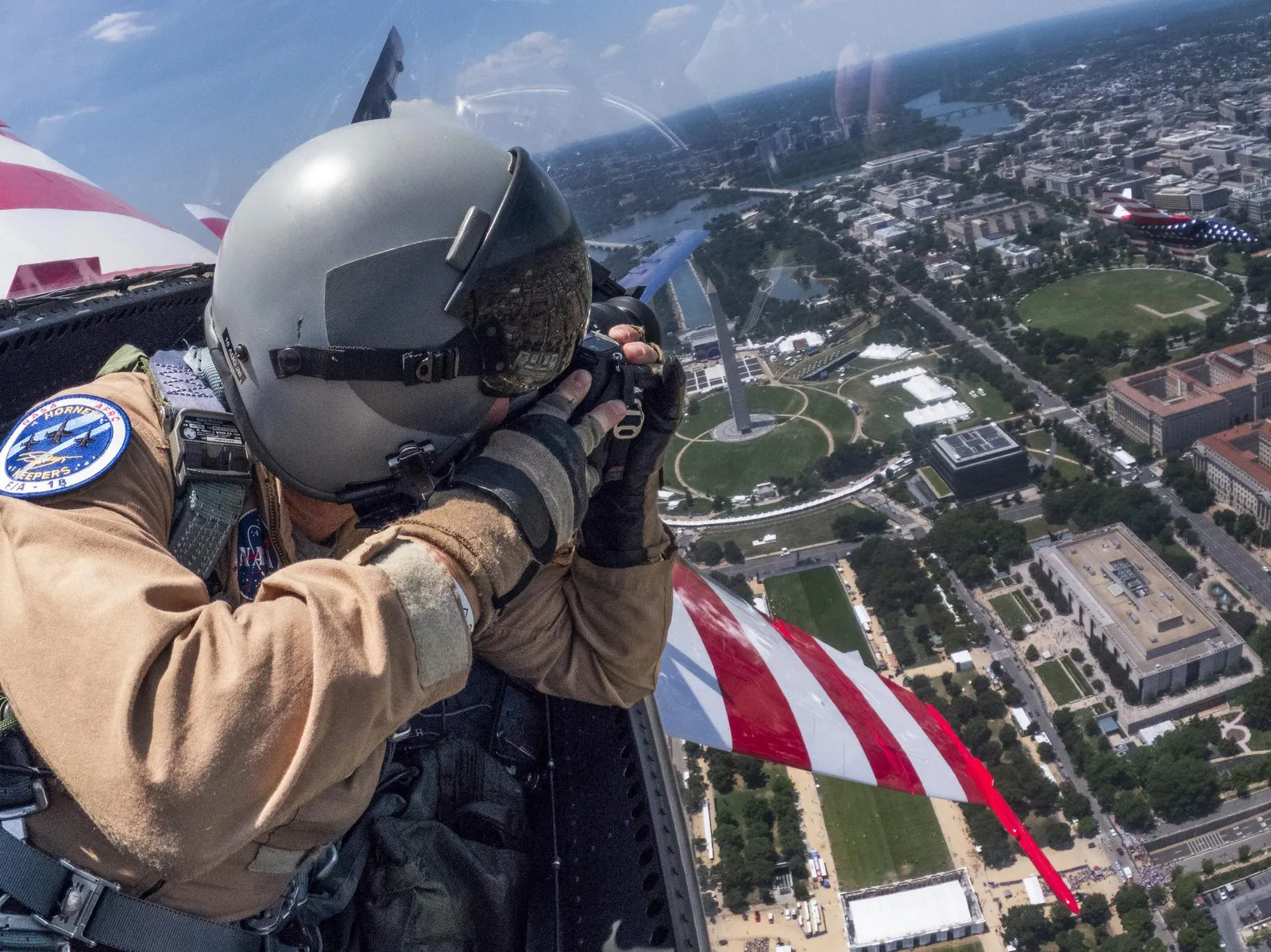
Jim Ross, a photographer at NASA’s Armstrong Flight Research Center in Edwards, California, documented NASA’s Freedom 250 flyover from an F-18 over Washington on Saturday, July 4, 2026. For decision-makers, the images are a reminder that NASA’s “behind the scenes” work still requires operational excellence, documentation discipline, and public-facing credibility.
Jim Ross did not take a casual picture of America’s 250th birthday celebrations. He flew above the Washington Monument in an F-18 aircraft as part of a NASA flyover on Saturday, July 4, 2026, documenting the moment from the perspective few people ever experience. Ross is a photographer at NASA’s Armstrong Flight Research Center in Edwards, California, and the images he captured from the aircraft help the public see NASA missions “in action” while the agency is doing the engineering, testing, and flight operations that usually stay out of frame.
This is more than patriotic window dressing. Ross’s work is designed to capture key NASA research and milestones, giving viewers a front-row seat to the agency’s behind-the-scenes flight history. In the gallery tied to the Freedom 250 flyover, Ross’s photos also point back to other iconic moments he has documented over the years, including early SR-71 flights, the delivery flight of Space Shuttle Endeavour to Los Angeles, and first flights of NASA’s X-59 quiet supersonic research aircraft. If you care about high-performance operations, there is a pattern here: the mission is only as credible as the documentation that proves it happened, where it happened, and what the aircraft actually did.
To understand why this matters for executives, it helps to remember how NASA and flight programs build legitimacy. Aviation testing runs on repeatable processes: planning, configuration, safety checks, communications, and execution, then evidence capture. A photographer is not just taking “nice-to-have” visuals. In Ross’s case, he is documenting from platforms that are part of the mission ecosystem, using the vantage points created by actual flight profiles. That makes the final public record more than marketing. It becomes an operational artifact, the kind of visual trace you can point to when stakeholders ask, “Did the aircraft do what you said it would do?”
Ross’s NASA connection goes deep. He began his aviation photography career in 1989 when he joined the staff at NASA Armstrong, which was then known as Dryden. He later became the photo lead in 1997, a role he retains today. The timeline matters because it highlights institutional memory. In industries where risk is real and schedules are unforgiving, the people who have seen multiple eras of aircraft and test campaigns tend to understand not only how to capture images, but also what those images need to convey. Over almost 37 years, Ross has built a body of work that mirrors NASA’s own evolution, from early reconnaissance-era platforms to modern experimental research aircraft.
The Freedom 250 flyover itself is also telling. According to NASA’s account of the event, Ross’s F-18 aircraft, from Armstrong Flight Research Center in Edwards, joined other NASA aircraft for the flyover. A NASA F-15 flying alongside was visible through the window in a separate NASA photo from a cross-country flight from Spokane, Washington, to Washington, D.C., on Thursday, July 2, 2026. Both aircraft participated in the Freedom 250 flyover on Saturday, July 4, 2026, with other NASA and military aircraft. For decision-makers, that cross-platform mix is a reminder that complex coordination is not optional. It is a systems problem. When multiple aircraft and teams converge on a public-facing moment, the operational coordination has to work, and the documentation has to keep up.
Ross also offered a simple reality check on the cultural weight of the moment. He said he grew up in Bozeman, Montana, when it was still considered a small town, and if someone told him as a kid that he would be flying in an F-18 over the National Mall, he would not have believed it. He added that he loves documenting history, and that having the opportunity to capture flights and launches has kept him doing it for almost 37 years. Translation for operators and boards: mission credibility is partly built by the people who stay, learn, and keep showing up as platforms and requirements change.
The strategic stakes for peers in aeronautics and other regulated, safety-critical domains are straightforward. Public trust is built from evidence. Evidence comes from execution plus documentation. And when NASA uses its flight photographers to create a gallery that traces major milestones, it is reinforcing the idea that the public record of testing and progress matters. For executives watching aerospace, defense, and adjacent tech, the second-order takeaway is that communications is not separate from operations. The best “story” is the one that can be backed by what happened in the air, on the schedule, with the people who know how to capture it.
If you want a clean metric for whether an organization can scale complexity, look at how it handles moments like this: coordinated flights, multi-aircraft participation, and a photographic record that makes the mission legible. Ross’s Freedom 250 documentation is a vivid example of NASA treating visibility as a continuation of operational excellence, not a detour from it.
This story's Key Insights and Take-aways are locked.
Create a free account to unlock Executive Actions for one credit.
Register to UnlockAlways free for Executives Club members. Join the Club
More in Science

2026 Nikon Small World Winners Reveal the Hidden Machinery of Everyday Life
A mycologist's frozen Edinburgh garden became the backdrop for vivid views inside cells, a reminder of what advanced imaging now makes visible to researchers and the industries built on biology.

Study: 1 in 4 depression cases may be a body-clock problem, not a chemical one
A 10,000-person study finds standard antidepressants often fail these patients, but melatonin and morning sunlight may hit the real root cause.

Start-Up Says A.I. Designed a Virus to Attack One Patient's Superbug
If the claim holds up, personalized phage therapy could become a new frontline weapon against antibiotic resistance - but proof is far from final.