
July 12 heat dome smashed Montana, Utah, Wyoming records at 45°C, then spread east
A ridge of high pressure baked the northern Rockies, triggering new all-time highs and a tenfold spike in emergency heat visits.
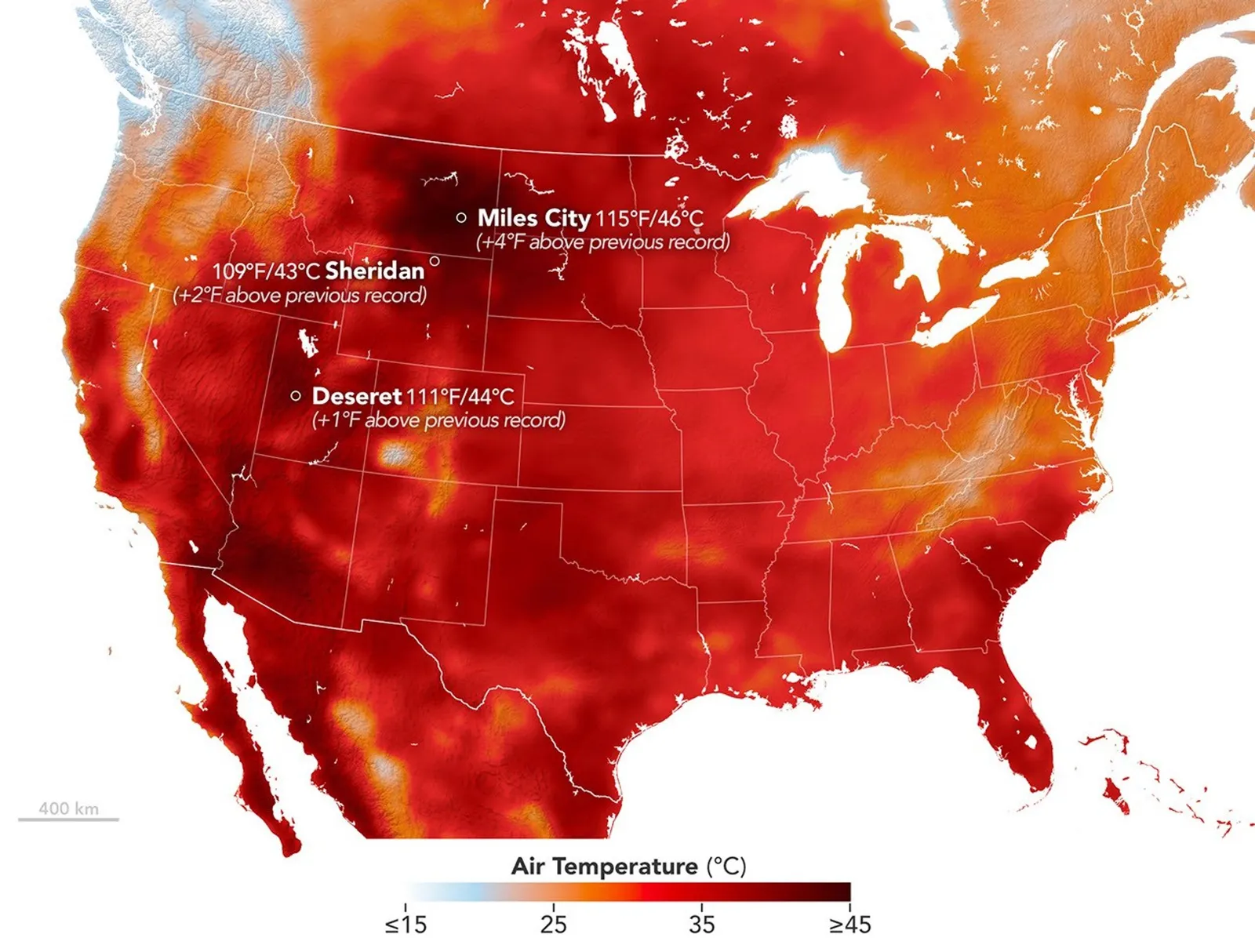
NASA’s Earth Observatory traced a heat dome to record-breaking temperatures across Montana, Utah, and Wyoming on July 12, 2026, using GEOS modeling and station data. For decision-makers, the operational risk is immediate: extreme heat health impacts and forecasted eastward spread are no longer edge cases.
Temperatures surged in the Western U.S. on July 12, 2026, as a heat dome pushed the northern Rockies into an all-time record grind. NASA Earth Observatory reports that the map of modeled air temperatures from GEOS (Goddard Earth Observing System) shows the darkest reds approaching or exceeding 45 degrees Celsius, or 113 degrees Fahrenheit, at 2 p.m. Mountain Time at 2 meters above the ground.
That modeling landed on the ground, too. A preliminary analysis from the National Weather Service office in Billings found that temperature sensors at airports in Billings and Miles City, Montana, recorded new all-time record highs on July 12 at 111°F and 115°F, respectively. Sheridan, Wyoming hit 109°F. Each station topped its previous record by at least 2°F, and Miles City broke its record by a full 4°F, with Montana records dating to the 1930s and the Sheridan record beginning in 1907.
The meteorology behind the catastrophe is as straightforward as it is brutal. A strong ridge of high pressure lingered in the upper atmosphere over the northern Rockies on the weekend of July 11-12, 2026. It shoved hot air toward the surface and trapped it there. Meteorologists call this a heat dome. Heat domes “put the brakes on convection and suppress clouds and precipitation,” which means sunlight reaches Earth’s surface relatively unhindered, further elevating air temperatures. Early in the Northern Hemisphere summer, that combination is like leaving the oven on high with the door sealed.
Montana, Wyoming, and Utah did not just run hot, they shattered benchmarks. In Utah, the National Weather Service office in Salt Lake City reported multiple all-time record breaks, including Deseret at 111°F; Salt Lake City at 109°F, 4°F above the previous record; and Randolph at 100°F, 6°F above the previous record. Utah’s stations have records dating back to the 1890s, making these increases less about a brief blip and more about crossing lines people have been tracking for generations.
And for executives, the key point is that “extreme heat doesn’t just make people uncomfortable.” NASA’s Earth Observatory links the heat dome to serious health consequences, especially for older people. Extreme heat worsens common age-related health conditions like heart, lung, and kidney disease. Health tracking data from the U.S. Centers for Disease Control and Prevention shows the rate of heat-related emergency department visits in the Mountain states spiked tenfold during the July heat. That is the kind of number that moves hospital staffing from “adjust policies” to “rethink capacity,” and it is the kind of demand shock that can ripple across emergency services, insurance claims, workplace safety compliance, and local public health budgets.
This heat wave also sits inside a larger trend line NASA says is worsening. Using a NASA modeling system called MERRA-2 (Modern-Era Retrospective analysis for Research and Applications-2), a NASA team found that summer heat waves in the U.S. roughly doubled in number between 1980 and 2023. The average rose from two to four per month. In other words, what feels like a one-off disaster is increasingly a recurring operating condition. Heat domes are not only a Western U.S. story anymore; parts of Western Europe, Central Asia, and East Asia are also facing heat waves.
The immediate market and planning implication is the forecasted path. Forecasters expect this heat dome to spread east into the Midwest, New England, and the Mid-Atlantic in the coming days, where triple-digit temperatures are likely in some areas. If you run logistics, utilities, construction, retail, or any business that depends on outdoor work and reliable infrastructure, your risk model has to treat heat as an expanding geography, not a local weather quirk. The same goes for regulators and boards: heat drives measurable health system load, and NASA’s modeling and the CDC-backed ED spikes make the link hard to ignore.
This story's Key Insights and Take-aways are locked.
Create a free account to unlock Executive Actions for one credit.
Register to UnlockAlways free for Executives Club members. Join the Club
More in Science

2026 Nikon Small World Winners Reveal the Hidden Machinery of Everyday Life
A mycologist's frozen Edinburgh garden became the backdrop for vivid views inside cells, a reminder of what advanced imaging now makes visible to researchers and the industries built on biology.

Study: 1 in 4 depression cases may be a body-clock problem, not a chemical one
A 10,000-person study finds standard antidepressants often fail these patients, but melatonin and morning sunlight may hit the real root cause.

Start-Up Says A.I. Designed a Virus to Attack One Patient's Superbug
If the claim holds up, personalized phage therapy could become a new frontline weapon against antibiotic resistance - but proof is far from final.