
July 20, 1976: Viking 1’s first Mars image proves touchdown, then rewrites what’s possible
In 40 minutes, NASA’s Viking 1 turns a black screen into rocks, sand, and a lander foot pad.
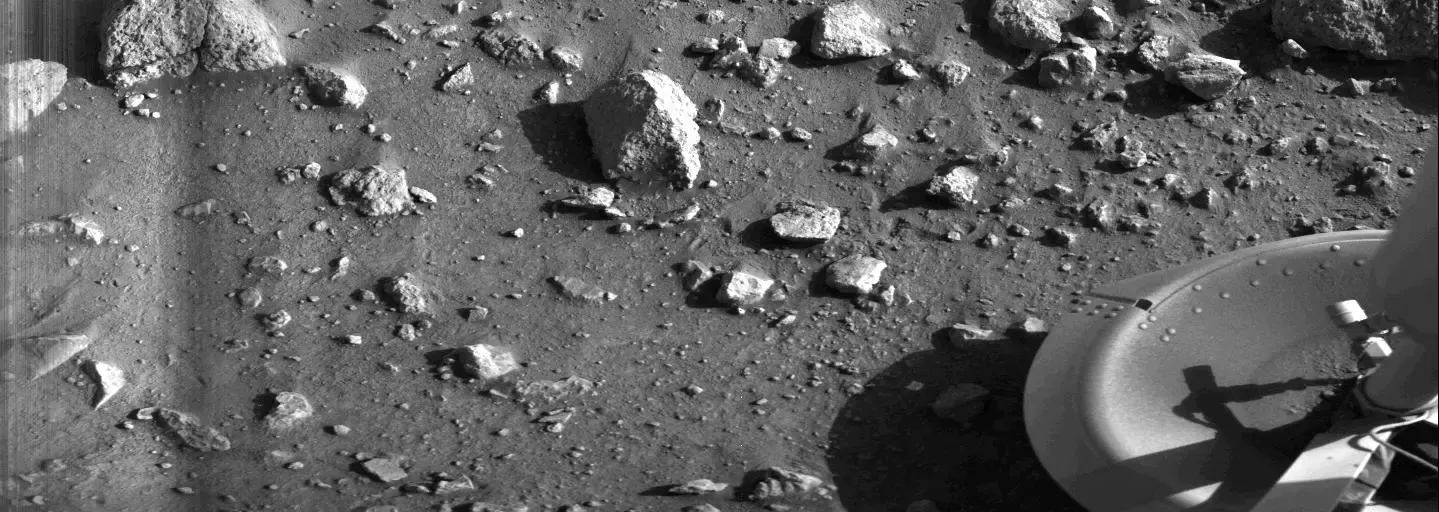
NASA’s Jet Propulsion Laboratory mission controllers cheered on July 20, 1976 as the Viking 1 lander survived descent through Mars’ thin atmosphere. Forty minutes later, the lander’s first line-by-line image began to appear, giving humans their first view of Mars from the surface.
At 5:12 a.m. PDT on July 20, 1976, mission controllers at NASA’s Jet Propulsion Laboratory erupted in cheers after learning that the Viking 1 lander had survived its descent through the thin Martian atmosphere. Forty minutes later, the first image began to appear on their monitors, slowly forming line by line from left to right. For the first time, humans could see Mars’s rocky terrain from the surface.
This wasn’t just a cool picture. It was proof that the mission’s most fragile moment, the landing, had worked in real time. Dr. Thomas Mutch, leader of the Viking lander imaging team, described studying the “black screen,” waiting for “that narrow strip that will signal the first few lines of the first picture.” Then it came. “A sliver of electronic magic,” brightness and darkness building into a scene where “Rocks and sand are visible” and, at the far right, “one of the spacecraft foot pads,” a small but unmistakable sign that the lander was truly there, on Mars.
That distinction matters because it defines the category Viking 1 opened. The mission became NASA’s first robot to explore Mars’s surface and begin the search for signs of life in our solar system. In other words, the image wasn’t just an aesthetic milestone. It was the opening move in a scientific and strategic play: land on a world that’s far beyond direct human reach, deploy instruments, and look for evidence that life might exist beyond Earth.
And the execution was not a single act. Viking 1 was joined six weeks later by its twin lander, Viking 2, which explored a different region of Mars. Meanwhile, two mission orbiters that delivered the landers to the Red Planet continued to collect data from space and helped relay communications to Earth. So the system worked like a stack: landers for surface exploration, orbiters for coverage and communication. When the first picture emerged, it confirmed that the chain was intact all the way back to Earth, not just the landing itself.
For executives and boards, the Viking moment has a familiar shape: high risk, tight timelines, and a dependency web where “success” means many things at once. The cheering at JPL was for touchdown survival. The first image was the next proof point. The follow-on work, Viking 2 and the continued role of the orbiters, shows the longer investment horizon. The operational lesson is blunt: a complex mission doesn’t earn credibility from one milestone. It earns it through a sequence of validated steps that reduce uncertainty, one screen, one line, one subsystem at a time.
There is also a regulatory and governance angle, even if NASA was not operating like a typical regulated industry. Space missions require layers of planning, oversight, and accountability because failure can be irreversible and expensive, and because public money and public trust are always in the room. Viking’s 1976 landing, and the subsequent imaging and communications support, show what that accountability looks like when the work is largely autonomous. Controllers did not “feel” the surface. They received signals, interpreted them, and then watched the picture resolve as the lander confirmed it was stable and functioning.
Second-order, the moment ripples outward into how organizations plan for discovery. Viking 1’s first view from Mars did what many strategies try to do and few accomplish: it turned an unknown into a measurable, visible reality. After that, the search for signs of life became more than a mission slogan, because there was a literal surface context to anchor instruments and observations. That is why NASA frames the legacy as discovery, not just exploration. The immediate win, the first image, becomes the platform for subsequent findings across time, missions, and even public imagination.
Fifty years later, the Viking 1 landing and its first picture remain a reference point for what it takes to expand the frontier. It is a reminder that the most consequential outcomes often arrive in increments, not fireworks. A narrow strip appears. Then brightness and darkness lock into rocks and sand. Then, far right, a foot pad stamps reality into the feed. If you sit in a boardroom deciding how to fund the next leap, that’s the value proposition Viking proved: make the landing work, and the future opens line by line.
This story's Key Insights and Take-aways are locked.
Create a free account to unlock Executive Actions for one credit.
Register to UnlockAlways free for Executives Club members. Join the Club
More in Science
2026 Nikon Small World Winners Reveal the Hidden Machinery of Everyday Life
A mycologist's frozen Edinburgh garden became the backdrop for vivid views inside cells, a reminder of what advanced imaging now makes visible to researchers and the industries built on biology.

Study: 1 in 4 depression cases may be a body-clock problem, not a chemical one
A 10,000-person study finds standard antidepressants often fail these patients, but melatonin and morning sunlight may hit the real root cause.

Start-Up Says A.I. Designed a Virus to Attack One Patient's Superbug
If the claim holds up, personalized phage therapy could become a new frontline weapon against antibiotic resistance - but proof is far from final.