

Juno sees Io’s subsurface heat surge: 40+°F rising just feet down
Two close flybys let NASA measure below Io’s surface, proving tidal heating and reshaping how scientists read volcanoes.
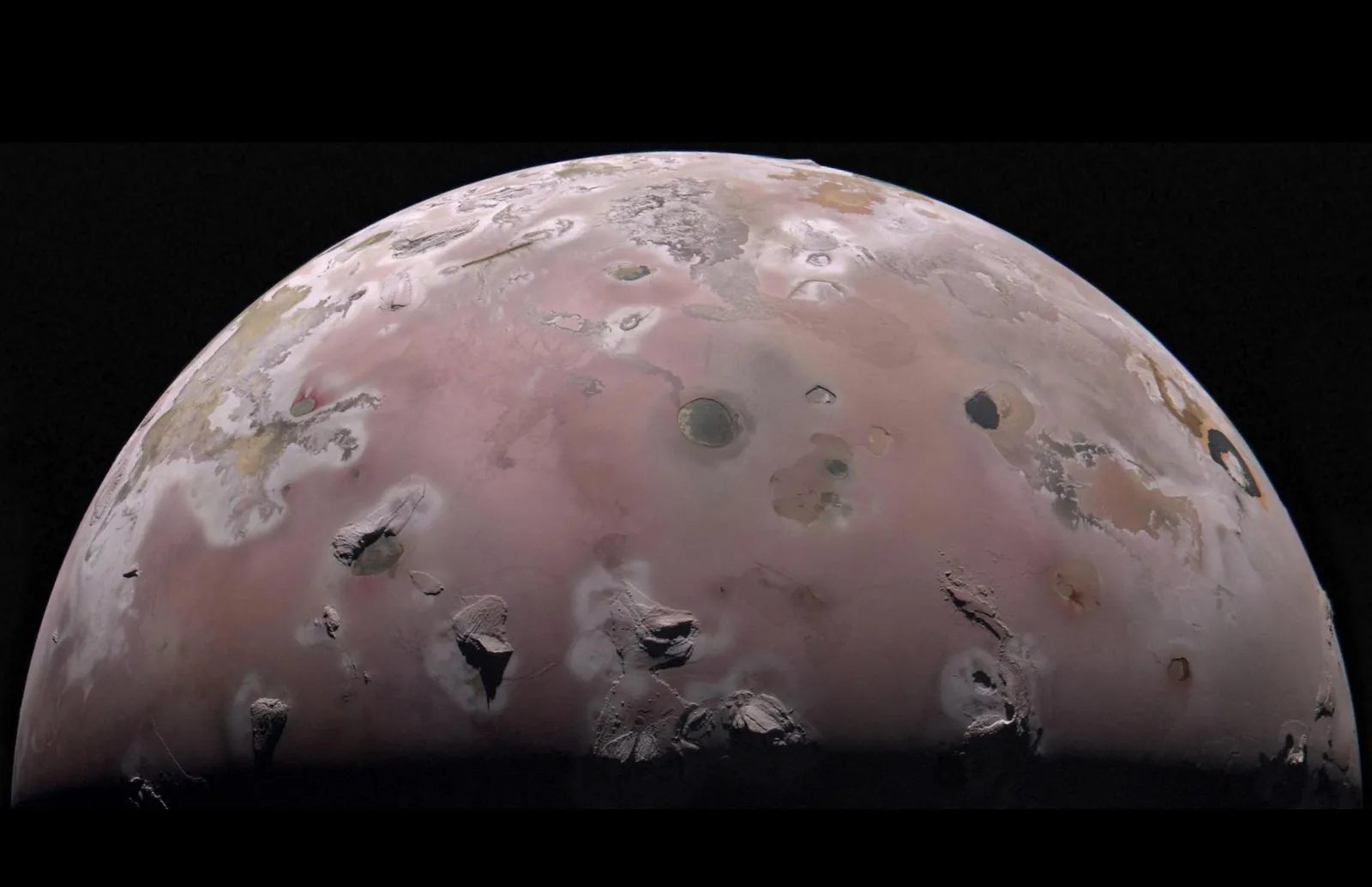
NASA’s Juno mission, using its Microwave Radiometer, captured the first measurements of temperature below Jupiter moon Io’s surface during flybys on Dec. 30, 2023 and Feb. 3, 2024. The finding shows temperatures rising by more than 40 degrees Fahrenheit just several feet into Io, with implications for studying tidal heating and even Earth volcanoes.
NASA’s Juno mission has done something we usually only hand-wave in planetary science: it measured heat below the surface of Io. During flybys on Dec. 30, 2023 and Feb. 3, 2024, the spacecraft’s Microwave Radiometer (MWR) detected a temperature gradient that rises by more than 40 degrees Fahrenheit just several feet into the moon, far steeper than solar heating alone can explain.
That first number matters because it settles a long-running limitation. Before this, “virtually everything known” about Io’s internal heat came from infrared observations that only sense the top surface temperature. Juno’s new approach uses microwaves, which look below the crust. That lets researchers move from “what the surface is doing” to “how heat is moving,” and it does it on the most volcanically active world in the solar system.
The mechanism behind Io’s inferno is tidal heating. Jupiter’s immense gravity constantly stretches and squeezes Io as it travels its slightly elliptical orbit, generating internal heat output many times greater than Earth’s. Juno’s latest results, published Wednesday in the Journal of Geophysical Research: Planets, reveal significant heating within Io’s shallow subsurface. The team describes this as “a distinct temperature gradient across the moon,” with the most extreme, localized heat output highlighted in red on MWR data maps.
So what could cause that steep subsurface rise? The paper lays out two possible explanations, and both are big deals for how you model planetary heat transfer. One possibility is that heat rises steadily through a conductive crust. In that scenario, the background heat flow is measured at 1 to 3 watts per square meter. Locally, that sounds gentle, roughly equivalent to “a small nightlight glowing under every square yard,” but across the entire moon it represents energy release “up to 30 times Earth’s average.” The other possibility is that the signal reflects cooling lava flows, capped by roughly 30 to 35 feet (9 to 11 meters) of solidified crust. Those solid caps cover about 10% of Io’s surface at any given time, so the subsurface readings could be capturing where recent volcanic activity has left heat trapped and leaking out.
The instrument doing the heavy lifting is the Microwave Radiometer, designed by Scott Bolton to peer beneath Jupiter’s cloud tops and investigate the gas giant’s deep atmosphere. The MWR’s six microwave antennas operate as a single instrument, simultaneously detecting microwaves at wavelengths from about half an inch to 20 inches (1.3 to 51 centimeters). In plain English: different microwave wavelengths probe different depths. As Bolton put it, “each wavelength explores different depths,” giving a new way to characterize deep atmospheres and subsurface crusts of icy and rocky moons. The surprising part at Io is that probing into volcanic rock was not just possible, it was the payoff.
Juno’s extended phase has already used the MWR to observe three Galilean moons: Ganymede, Europa, and Io. At Ganymede and Europa, the team explored tens of miles below the surface, assuming their ice shells were mostly pure water. Io was different because the “ability to probe into the volcanic rock at Io was an unexpected discovery.” That difference matters for executives who care about mission data value: instruments that can adapt their depth-sensing “reach” across targets can multiply a mission’s scientific ROI, without needing new hardware launches.
And there’s a second major insight buried in the same flybys: Io is smoother than you might expect. Before these findings, Io was known for tall mountains. But MWR indicates that apart from that visible topography, the surface has expansive smooth patches stretching for 60 miles (100 kilometers) or more. Since Juno flew by overlapping regions at different angles, the team mapped how Io reflects microwaves, “much like an airline passenger might see the ocean flash with sunlight only at specific angles.” Away from mountains, the surface material has a very low density, “more like pumice or a fluffy volcanic ash than solid rock,” according to lead author Shannon Brown at NASA’s Jet Propulsion Laboratory in Southern California.
If you zoom out, the strategic significance is the shift from surface thermodynamics to subsurface plumbing. Bolton frames it as a “unique window into learning how tidal heating works throughout the cosmos,” which is a fundamental process that can drive volcanism on worlds like Io and even fuel subsurface oceans on moons such as Europa and Ganymede. Up to now, scientists could observe heat escaping at the surface or through eruptions. Now they can “characterize how the heat is moving from the interior toward the surface.” For mission planners and research teams, that is a methodological unlock, not just a neat headline.
One more layer worth noting: this is New Frontiers scale. Juno is part of NASA’s New Frontiers Program, managed at NASA’s Marshall Space Flight Center in Huntsville, Alabama for the NASA Science Mission Directorate in Washington. JPL manages the mission for principal investigator Scott Bolton of the Southwest Research Institute, and Lockheed Martin Space builds and operates the spacecraft. That matters because it signals where NASA chooses to spend: high-instrument capability and repeat flybys that can turn one mission into multiple “first measurements.” For executives, investors, and operators watching deep-tech, the playbook is familiar: reuse the core assets, sweat the sensors, and let the data do the talking.
Bottom line: Juno did not just take pictures of Io’s violence. It measured the thermal gradient below the surface and found temperatures rising by more than 40 degrees Fahrenheit within just several feet. That steep signature forces a better accounting of tidal heating and crust heat transfer, and it gives scientists a new template for interpreting volcanism elsewhere, including the potential to look for similar subsurface signatures in Earth volcanoes with an MWR-type instrument near a volcano. The universe just handed the field a new instrument-grade lens, and it’s going to change what “hot” means for rocky worlds.
This story's Key Insights and Take-aways are locked.
Create a free account to unlock Executive Actions for one credit.
Register to UnlockAlways free for Executives Club members. Join the Club
More in Science

2026 Nikon Small World Winners Reveal the Hidden Machinery of Everyday Life
A mycologist's frozen Edinburgh garden became the backdrop for vivid views inside cells, a reminder of what advanced imaging now makes visible to researchers and the industries built on biology.

Study: 1 in 4 depression cases may be a body-clock problem, not a chemical one
A 10,000-person study finds standard antidepressants often fail these patients, but melatonin and morning sunlight may hit the real root cause.

Start-Up Says A.I. Designed a Virus to Attack One Patient's Superbug
If the claim holds up, personalized phage therapy could become a new frontline weapon against antibiotic resistance - but proof is far from final.