
JWST catches NGC 4696 feeding loop: gas cools into filaments that restart black hole jets
New JWST observations link filaments to a self-sustaining cycle of “feast, fast, repeat” at a nearby AGN.
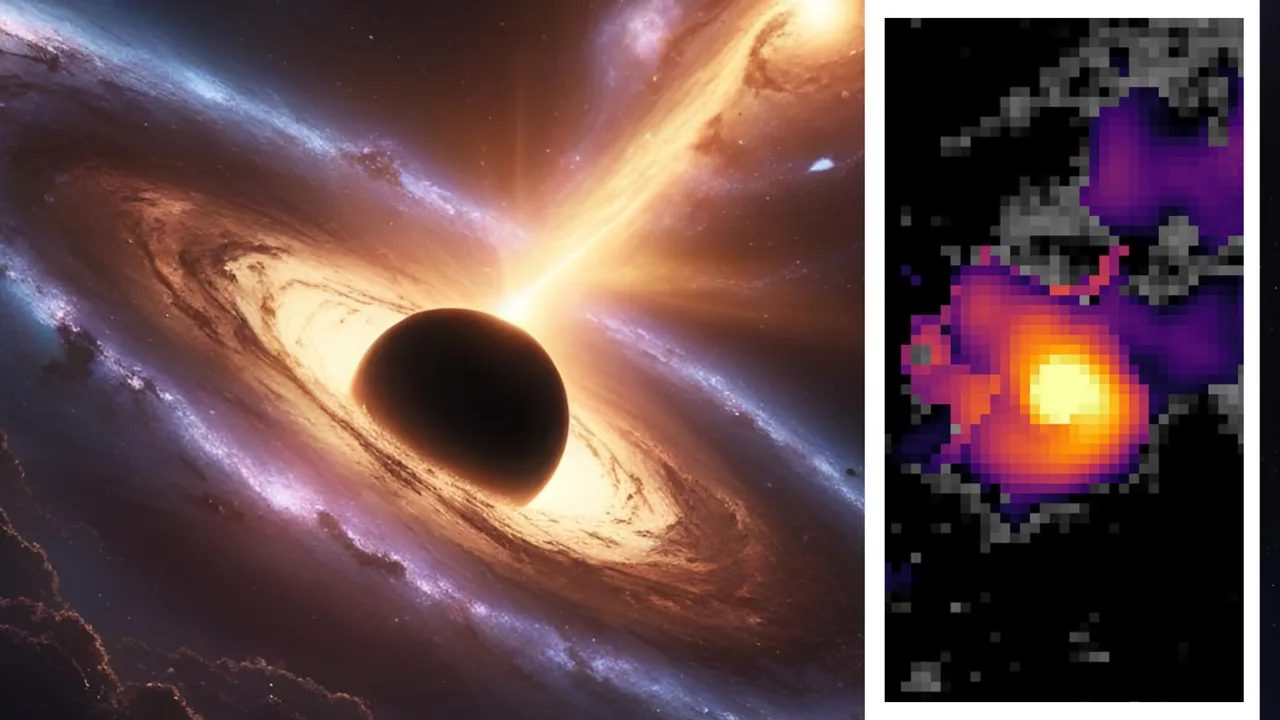
Using the James Webb Space Telescope, astronomers mapped gas flows in the Centaurus Cluster galaxy NGC 4696 and connected them to feeding supermassive black hole filaments. The result, published July 16 in Astrophysical Journal Letters, offers the long-elusive confirmation of a proposed self-regulating black hole fueling cycle.
The James Webb Space Telescope did something rare: it showed a supermassive black hole not just “eating,” but how it might restart its own meal when feedback tries to cut it off. In observations of a nearby active galactic nucleus (AGN) at the heart of NGC 4696 in the Centaurus Cluster, astronomers mapped gas moving at around 1.3 million miles per hour (600 kilometers per second) and found it appears connected to a vast filament of material falling inward to feed the black hole again.
That matters because the “feeding” story has long been stuck on a paradox. Black holes at the centers of large galaxies often appear as slumbering giants consuming little gas and dust, but the most ravenously feeding ones power bright central regions called AGN. Those feeding black holes can also blast matter out their poles in jets that drive gas and dust out of their host galaxies. If jets keep pushing the fuel away, why do the black holes ever keep growing so quickly, especially when JWST sees such activity before the universe was even 1 billion years old? The JWST-linked mechanism offers a way through the contradiction: gas may get heated by the black hole, then later cool, fall back, and re-feed the black hole in a looping cycle.
Here is the new chain of evidence. The team focused on NGC 4696, located 145 million light-years from Earth, a relatively close AGN in the Centaurus Cluster. The Hubble Space Telescope previously studied this galaxy and uncovered a strange, hook-shaped swirl of gas near the central supermassive black hole of NGC 4696. JWST then followed up, producing a detailed map of gas flowing at the heart of the galaxy. The hook-shaped feature is around 800 light-years wide and is composed of gas moving at incredible speeds of around 1.3 million miles per hour (600 kilometers per second). Crucially, the swirl appears connected to a vast filament of material falling toward the central supermassive black hole.
The “self-regulating cycle” hypothesis had existed, but the key connection between these filaments and the black hole had been elusive. The source of the insight is team leader Julie Hlavacek-Larrondo of the Université de Montréal, who said in a statement: “What JWST is revealing is that black holes may be the ultimate cosmic recyclers. They release enormous amounts of energy that heat their surroundings, yet that same gas can later cool into thin filaments that fall back inward and feed the black hole again. We are finally seeing this self-sustaining cycle in action.” That is the headline stake in plain English: instead of feedback just shutting down growth, feedback may temporarily pause it, then set up the conditions for the next feeding episode.
The team then stress-tested what JWST saw. They compared the JWST observations against a computer simulation, finding that gas in the infalling filament scenario would indeed take a shape similar to that seen in NGC 4696. Team member Helen Russell of the School of Physics and Astronomy at the University of Nottingham in the U.K. added, “JWST is now showing us the final link of this closed loop. The vast filamentary network of gas flows ultimately funnels gas down to a disk that fuels the black hole.” In other words, the filaments are not just a pretty structure. They connect the large-scale inflow to a swirling disk around the incumbent black hole, which then fuels the black hole and triggers another period of growth.
This connects tightly to why astronomers care about the early universe. Supermassive black holes with masses millions, often even billions, of times that of the sun grew so fast so soon after the Big Bang that the timeline strains standard expectations. The mechanisms that devour matter and then merge should take at least 1 billion years to achieve supermassive status, yet JWST has spotted puzzling black holes before the universe was even 1 billion years old. On top of that, theories say the fastest-growing black holes should also push away the very matter they use for growth, in effect putting themselves on a diet. The proposed resolution is a cyclical one: gas cools and falls back, forming “streamers,” or filaments, just a few hundred light-years wide but stretching thousands of light-years long. Those filaments fall back to the center, build a swirling disk, feed the black hole, and restart jets, which again cut off the food supply. It is feasting followed by fasting, then feasting again.
Think of it like a feedback system that turns “shut down” into “store and reroute.” When the black hole feeds, it heats the surroundings and drives outflows and jets that remove potential star-forming raw material from the host galaxy. That can effectively kill star formation by cutting off the raw material needed for star birth. But in the self-sustaining cycle, the heated gas does not just vanish. It cools, turns into thin filaments, and returns. That would also explain how black holes can keep growing without requiring an endless, uninterrupted supply. The research was published on Wednesday (July 16) in the Astrophysical Journal Letters.
Why executives and decision-makers in adjacent tech worlds should care: JWST is not just collecting stunning images. It is tightening causal chains in complex systems. The NGC 4696 results are a reminder that “feedback” is not always a dead end. In many engineered and financial systems, feedback loops are treated as purely stabilizing or purely destabilizing. Here, feedback appears to be a regulator that enables episodic growth. For boards funding frontier sensing, for founders building analytics on massive observational datasets, and for investors tracking the next wave of space and deep-tech instrumentation, this is a signal: the biggest breakthroughs increasingly come from mapping dynamics, not just detecting phenomena.
This story's Key Insights and Take-aways are locked.
Create a free account to unlock Executive Actions for one credit.
Register to UnlockAlways free for Executives Club members. Join the Club
More in Science
2026 Nikon Small World Winners Reveal the Hidden Machinery of Everyday Life
A mycologist's frozen Edinburgh garden became the backdrop for vivid views inside cells, a reminder of what advanced imaging now makes visible to researchers and the industries built on biology.

Study: 1 in 4 depression cases may be a body-clock problem, not a chemical one
A 10,000-person study finds standard antidepressants often fail these patients, but melatonin and morning sunlight may hit the real root cause.

Start-Up Says A.I. Designed a Virus to Attack One Patient's Superbug
If the claim holds up, personalized phage therapy could become a new frontline weapon against antibiotic resistance - but proof is far from final.