

JWST’s vanishing Little Red Dots may evolve into globular clusters, not disappear
A new pre-print argues the early-universe dots fade because they transform, likely into ancient star cities.
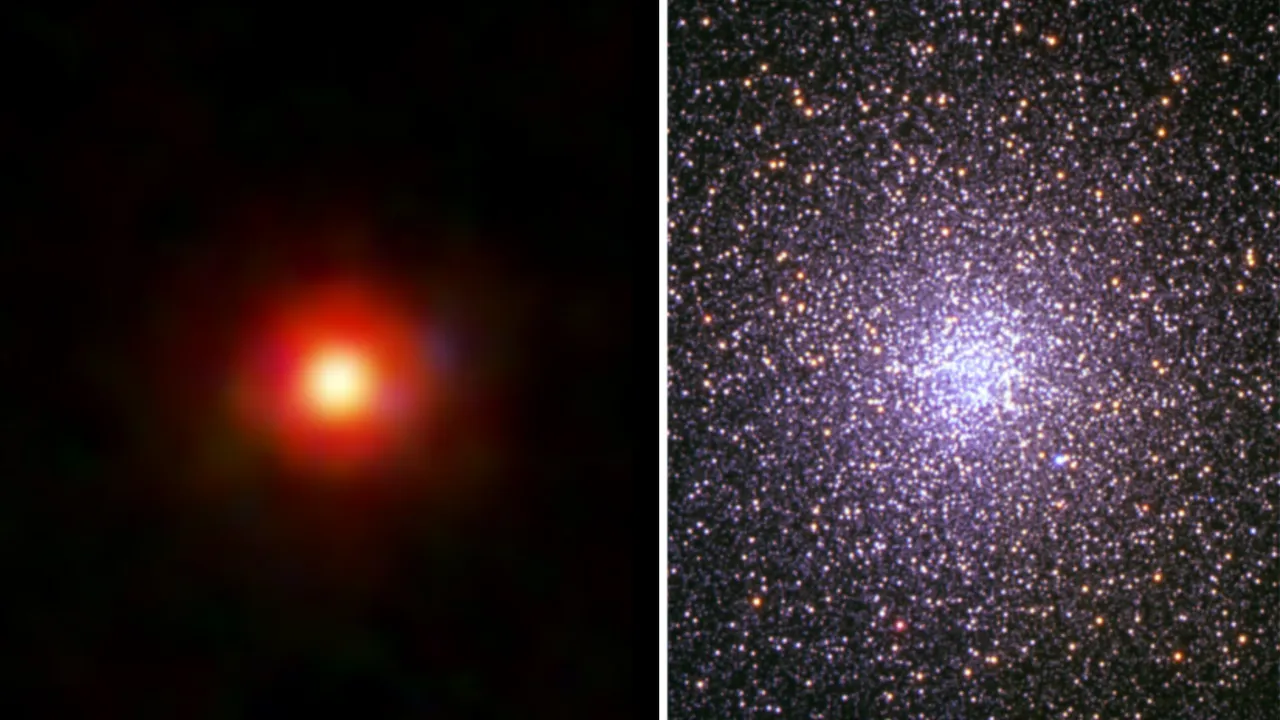
Researchers led by John Chisholm of the University of Texas at Austin propose a new explanation for JWST’s “Little Red Dots.” They argue the objects seen by the telescope around 600 million years after the Big Bang could persist by evolving into globular clusters.
Paleontologists didn’t really watch dinosaurs disappear. They watched them evolve into birds. Now astronomers are trying to pull off the same mental switch for the James Webb Space Telescope (JWST) and its “Little Red Dots.” A new study, available as a pre-print on arXiv, suggests these dots are not a population that goes extinct around cosmic time. Instead, they may evolve into something the universe keeps around for billions of years: globular clusters, densely packed swarms of ancient stars.
The key tension is timing. Astronomers started routinely spotting Little Red Dots in abundance in 2022, about 600 million years after the Big Bang. But they seem to vanish before the universe reaches around 2 billion years old. That apparent disappearance is what makes Little Red Dots such a puzzle. The new work does not deny the “disappearing” pattern. It reframes it as transformation. In their model, an object can stop looking like a Little Red Dot once the short-lived ingredient at its center is gone, even if the broader structure survives.
So what are these dots, exactly? JWST images show compact sources that look like tiny reddish points. Astronomers have proposed multiple explanations, including the idea that Little Red Dots could be “black hole stars,” or black holes wrapped in vast shrouds of dense gas and dust. The new team’s alternative centers on a “forming globular cluster with a supermassive star.” In this scenario, the supermassive star is hypothetical but tuned to what astronomers think those early star-forming environments could produce. The model suggests the supermassive star would have between 1,000 and 10,000 times the mass of the sun, and it would generate a Little Red Dot-like appearance at the cluster’s heart.
John Chisholm, of the University of Texas at Austin, frames the motivation directly in the study’s statement. “These may not be just a strange new JWST population with no connection to the universe around us today,” Chisholm said. “Instead, Little Red Dots may persist past the early universe, evolving into something relatively familiar.” He adds that “Little Red Dots could be galaxies, they could involve black holes, or they could be something even more unexpected,” but that the team’s work “shows that forming globular clusters with supermassive stars should be part of that conversation.” The point matters because it tries to tie an early-universe JWST phenomenon to structures astronomers already see at later times.
For executives and board members, here is why the cosmic detective work is more than just telescope trivia. Science ecosystems run on “fit.” If a new population has no plausible path into known later objects, it stays speculative. If it can be connected to something stable, like globular clusters, it becomes a platform for follow-up. Globular clusters are generally seen in large galaxies and contain densely packed “ancient” stars, sometimes in the many millions range. Our Milky Way hosts at least 150 globular clusters. Yet astronomers still do not fully know how they form, and that uncertainty is part of why Little Red Dots grabbed attention.
The study leans on globular cluster formation problems, because those problems rhyme with the Little Red Dot puzzle. Globular clusters are usually observed after billions of years of evolution, when their massive stars are gone, gas has been cleared out, and dynamical processes have reshaped their masses and structures. Danielle Berg, also of UT Austin, explains in the statement that this makes it “very hard to reconstruct the original conditions they formed in.” On top of the structural uncertainties, globular clusters have a strange chemical pattern. The stars often show unusual abundances of helium and “metals” like nitrogen, sodium, and aluminum, while lacking expected levels of carbon, oxygen, and magnesium. According to the team, that specific pattern indicates nuclear fusion at very high temperatures, higher than what is expected in the cores of even massive normal stars.
That is where the supermassive star enters as the physics lever. Mike Boylan-Kolchin, of UT Austin, says that “A supermassive star is precisely the kind of environment that could produce this combination.” In their picture, such stars could form in the dense environments of early globular clusters where stellar collisions and mergers would be expected to happen repeatedly. The resulting supermassive stars would be short-lived, lasting just around 1 million years. For scale, the study reminds readers the sun is about 4.6 billion years old. A million-year lifetime is tiny on human timescales, but it is long enough, in the model, to forge the elements needed to reproduce the peculiar chemistry seen later.
Then the timing riddle gets a second layer. When these supermassive stars die in supernova explosions, the elements they forged get blasted out as building blocks for the next generation of stars. The team argues this could explain the chemical fingerprints of modern globular clusters. Just as important, it explains why Little Red Dots might stop showing up as Little Red Dots. Chisholm notes that in their model, “the supermassive star that helps make the object look like a Little Red Dot would live for only a short time.” Once that star dies, “the object may no longer look like a Little Red Dot, even if the cluster itself survives billions of years.”
Zooming back out, the team also claims there are additional links beyond chemistry. They propose that the distribution of Little Red Dots in the early universe matches the distribution of modern globular clusters, and that models of Little Red Dot evolution suggest their estimated masses could lead to the masses of globular clusters seen later. There is still a caution built into the paper. Boylan-Kolchin says there is “no single smoking gun at this point that says Little Red Dots are globular clusters,” but he argues it could “explain a lot of diverse and surprising observations.” For now, this idea sits as a pre-print on arXiv, meaning it invites scrutiny and tests.
In other words: the dots may not be disappearing. They may be changing outfits. If the model holds up, JWST’s Little Red Dots become a short-lived observational phase of an early universe structure that later becomes familiar and durable. That is the strategic stake for anyone tracking research ecosystems: when a speculative phenomenon gets connected to a known class of objects with a coherent timeline, it stops being a mystery and starts becoming a roadmap for what to look for next.
This story's Key Insights and Take-aways are locked.
Create a free account to unlock Executive Actions for one credit.
Register to UnlockAlways free for Executives Club members. Join the Club
More in Science
2026 Nikon Small World Winners Reveal the Hidden Machinery of Everyday Life
A mycologist's frozen Edinburgh garden became the backdrop for vivid views inside cells, a reminder of what advanced imaging now makes visible to researchers and the industries built on biology.

Study: 1 in 4 depression cases may be a body-clock problem, not a chemical one
A 10,000-person study finds standard antidepressants often fail these patients, but melatonin and morning sunlight may hit the real root cause.

Start-Up Says A.I. Designed a Virus to Attack One Patient's Superbug
If the claim holds up, personalized phage therapy could become a new frontline weapon against antibiotic resistance - but proof is far from final.