
LOFAR maps Abell 2255's magnetic field end-to-end in record 224 hours
For the first time, astronomers reconstruct how cluster gas formation shapes magnetic fields across millions of light-years.
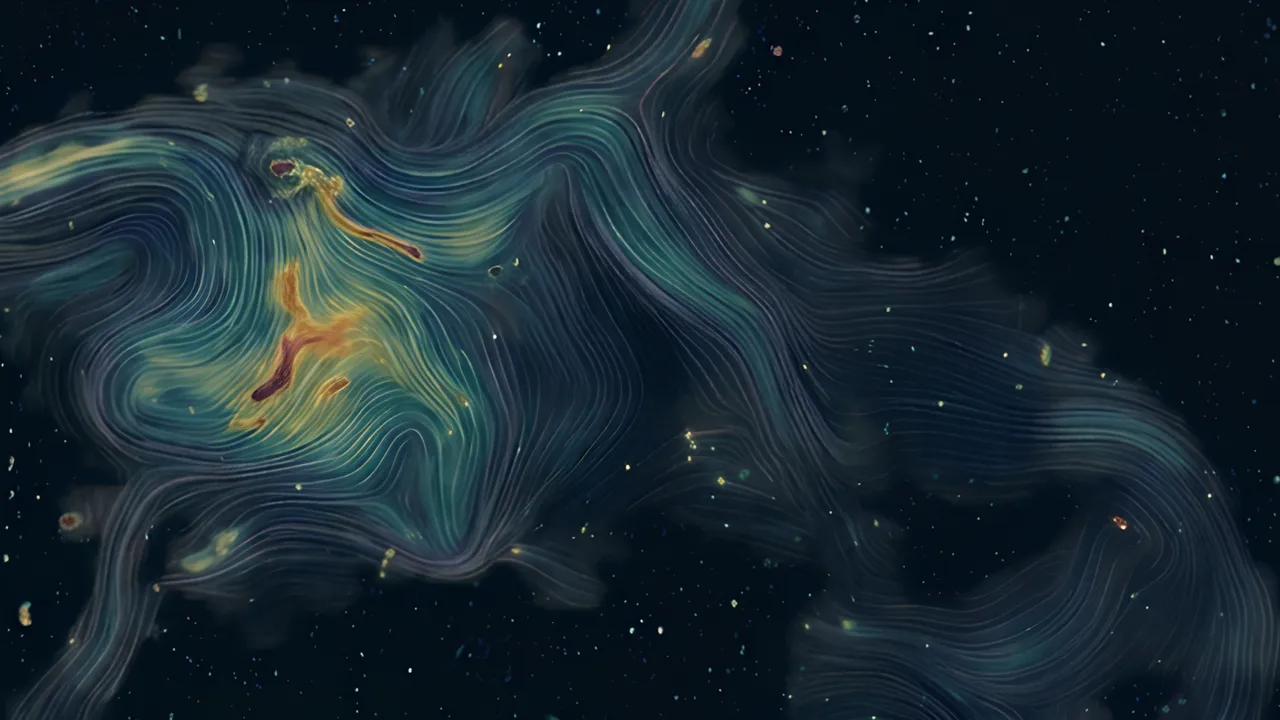
A team using the European radio telescope LOFAR reconstructed the magnetic field of the entire galaxy cluster Abell 2255, from its central nucleus to its outer limits, using the deepest observations so far under the LOFAR Galaxy Cluster Ultra-Deep Field project. The result gives new observational evidence that the same gas dynamics that build clusters also organize their magnetic fields.
Astronomers just pulled off a first-of-its-kind cosmic imaging feat: they reconstructed the magnetic field of an entire galaxy cluster, from the central nucleus out to its outer limits, using LOFAR. The target was Abell 2255, a complex cluster about a billion light-years away, and the work leaned on 224 hours of radio image collection as part of the LOFAR Galaxy Cluster Ultra-Deep Field project. In plain English, they mapped a thing we usually treat as “invisible background” by using radio emissions that are actually produced by high-speed electrons spiraling and interacting with magnetic fields.
Why this matters is in the word “reconstructed.” The study did not just detect that Abell 2255 glows at radio wavelengths. It built a picture of how the cluster’s magnetic field is arranged across “several million light-years,” and then connected that arrangement to cluster formation. The deep takeaway: the distribution of large-scale magnetic fields is not random. It appears organized by the motion of gas that occurred during the formation process of this galactic cluster.
If you have been tracking astrophysics, you already know galaxy clusters are messy at the scale that counts. Abell 2255 has long been known for its complexity in radio waves, driven by vast, diffuse radio emissions from relativistic electrons moving through weak magnetic fields. Those electrons are racing near the speed of light, and as they do, the magnetic environment in the cluster affects what their radio signatures look like. The catch is that the signal is elusive, because the magnetic fields involved are very weak, and separating the underlying magnetic structure from the noise is not trivial.
That difficulty is exactly why the project’s method is the story. The team combined “the deepest radio observations ever made” with an innovative data analysis technique that allowed them to reconstruct the shape of a galaxy cluster’s magnetic field for the first time. Team leader Andrea Botteon, of the Italian National Institute for Astrophysics (INAF), emphasized in a statement that obtaining very sensitive images of galaxy clusters at radio wavelengths is crucial to understanding how electrons are accelerated to relativistic speeds and how magnetic fields are amplified on large cosmic scales. He also called out the core problem plainly: these studies are complex because the radio signal from electrons moving in very weak magnetic fields is hard to see.
Now for the concrete result that turns this from “cool space science” into “new leverage for how we think clusters work.” The analysis revealed specific alignment patterns, not just a general glow. In some regions of Abell 2255, magnetic fields show coherence, and the field lines follow very specific directions, stretching radially along extended radio emissions. Elsewhere, especially in regions dominated by shock waves, magnetic fields orient tangentially. In other words, the field geometry changes depending on the local physics, and it does so in a way that tracks how gas is moving.
That pattern is where Botteon’s interpretation lands. “The coherence of the magnetic field lines observed in some regions of the cluster suggests that the morphology of the field is intimately linked to the dynamics of the gas in which it resides,” Botteon said, noting that the field can be “stretched” or “compressed” by motions associated with cluster formation. He added: “We believe that the mechanism that 'turns on' these gigantic radio emissions is linked to the formation process of galaxy clusters.” The study ultimately suggests magnetic fields in Abell 2255 are “carved out” by the same dynamics that allow clusters to accrete gas and grow.
Zoom out and you get the second-order consequence: this is presented as the first observational evidence that the mechanisms enabling galaxies and clusters to grow, creating the largest structures in the universe, also shape their magnetic fields. If you are used to treating magnetic fields as an upstream or background variable, this is a reminder that magnetic structure might be downstream of the same formation dynamics that build the mass distribution. And that matters because clusters are often used as laboratories for broader questions about the universe’s evolution, including how hot gas behaves and how enormous cosmic structures assemble. The work also aims to “paint a picture of the dynamics of hot gas in galaxy clusters,” which could reveal how the largest structures are constructed.
From an executive mindset, there is a familiar governance angle here too: when research hinges on “deepest-ever” data and novel analysis, the credibility bottleneck is peer review. The team’s research has been accepted for publication in the journal Astronomy & Astrophysics, and the paper is available as a pre-peer-reviewed report on arXiv. That split path matters for how fast the signal moves through the community, because preprints accelerate discussion while formal publication adds the slower, more formal validation layer. In other words, this is both a scientific claim and a process update, and both can influence what gets funded, built, and replicated next.
Strategically, for leaders in adjacent science and tech domains, the meta-lesson is about measurement. The study turns a weak-signal, low-visibility phenomenon into a reconstructed structure, using deep integration time (224 hours), targeted instrumentation (LOFAR), and a reconstruction method that makes the invisible legible. If you run a program where you care about mapping hard-to-observe systems, this is a blueprint for how to turn faint signals into directional knowledge: spend time, improve the analysis, and then tie the output back to the underlying dynamics. In astronomy terms, Abell 2255’s magnetic field is now readable enough to argue that cluster formation does not just assemble matter. It also organizes the magnetic texture that shapes the radio universe.
This story's Key Insights and Take-aways are locked.
Create a free account to unlock Executive Actions for one credit.
Register to UnlockAlways free for Executives Club members. Join the Club
More in Science
2026 Nikon Small World Winners Reveal the Hidden Machinery of Everyday Life
A mycologist's frozen Edinburgh garden became the backdrop for vivid views inside cells, a reminder of what advanced imaging now makes visible to researchers and the industries built on biology.

Study: 1 in 4 depression cases may be a body-clock problem, not a chemical one
A 10,000-person study finds standard antidepressants often fail these patients, but melatonin and morning sunlight may hit the real root cause.

Start-Up Says A.I. Designed a Virus to Attack One Patient's Superbug
If the claim holds up, personalized phage therapy could become a new frontline weapon against antibiotic resistance - but proof is far from final.