
MSI’s 40th anniversary Titan 18 HX costs $7,000 with RTX 5090 and 18-inch MiniLED
A $7,000 gaming laptop bundles an RTX 5090, 96GB DDR5, and a 3840x2400 18-inch MiniLED. Here’s what executives should read into it.
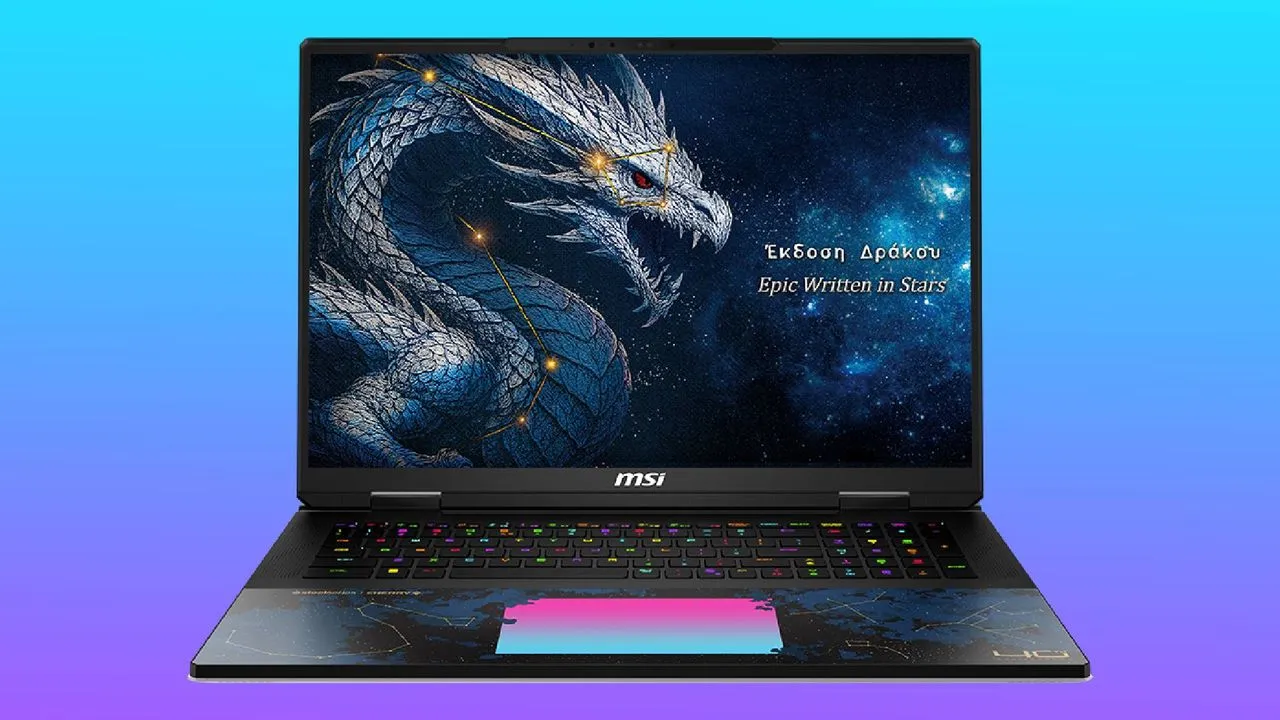
MSI marked its 40th anniversary by unveiling the Titan 18 HX Dragon Edition, priced at $7,000. The consequence for decision-makers is a clear signal about how flagship hardware is being positioned, priced, and packaged as luxury.
MSI didn’t just mark its 40th anniversary with a product launch. It unveiled the Titan 18 HX Dragon Edition, a gaming laptop priced at $7,000, and the headline feature is its Nvidia RTX 5090 GPU paired with a max 18-inch MiniLED display at 3840x2400 resolution and a 120 Hz refresh rate.
The rest of the spec sheet reads like a dare to your bank account. MSI is pairing that GPU with an Intel Core Ultra 9 290HX Plus processor, 24 GB of GDDR7, and a very roomy 96 GB of DDR5, plus the “oodles of SSD storage” that likely contributes heavily to the cost. If you buy directly from MSI, the company also throws in a free code for Lego Batman: Legacy of the Dark Knight. On its face, it’s a premium gaming system. In practice, it’s also a pricing and positioning statement.
To understand why $7,000 is the real story, you have to zoom out. The piece notes that while RTX 5090 desktop cards can cost a couple of grand on their own, you typically do not see a slimmer laptop form factor reach that same level of cost. So the Titan 18 HX Dragon Edition is not competing only on gaming performance. It is competing on scarcity, narrative, and configuration density. MSI is effectively packaging “the most expensive possible” into one SKU, then asking a small segment to treat it like a collectible.
That matters for executives watching the broader hardware market because it intersects with two pressure points: component pricing and customer expectations. The story explicitly calls out the role of memory pricing, saying the “whopping 96 GB of DDR5 might have something to do with it (thanks, memory crisis).” Even if you do not track every DRAM cycle, the executive-level takeaway is straightforward. When supply and pricing for key components are volatile, flagship SKUs can absorb cost through high-margin bundling rather than fighting to win the mass market. The $7,000 price also gives MSI room to include luxury-level details without needing to justify every dollar to a price-sensitive buyer.
There is also an ecosystem play hiding in plain sight. The article notes that direct purchases from MSI include a free code for Lego Batman: Legacy of the Dark Knight. That is not a random perk. It suggests MSI is trying to create a buy-direct funnel, reducing reliance on channel margins and potentially improving visibility into demand for this sort of ultra-premium configuration. When you sell something this expensive, distribution strategy becomes part of the product experience, not just logistics.
The Titan 18 HX Dragon Edition is not alone in this “anniversary equals extravagance” pattern. The story compares MSI’s launch with other costly anniversary hardware: it mentions Asus’s ROG sub-brand, which celebrated two decades by launching an aluminum-dressed-up-as-copper motherboard back in May. It also references the Astral ROG Astral GeForce RTX 5090 and a China-exclusive DRAM kit as anniversary editions. In other words, MSI is participating in a broader industry behavior where brands use milestone moments to release premium, design-forward, higher-priced hardware. Sometimes it’s about revenue. Sometimes it’s about marketing theater. Most of the time, it’s both.
From a governance and capital allocation standpoint, this kind of product line is easy to misunderstand if you only look at unit volume. The key is that these launches can function like brand “proof of capability.” MSI is showing it can source and integrate an RTX 5090 with high-bandwidth memory and a MiniLED display at 3840x2400 and 120 Hz. Even if only a few hundred or a few thousand people buy, the signal can matter to partners, retailers, component suppliers, and the talent pipeline. It tells everyone in the value chain that the company can execute on high complexity builds during expensive supply conditions.
So who is the target customer, exactly? The article calls it out with humor: beyond an MSI super fan, it effectively reads like “a scaly fan with deep pockets and terrible taste in dragon art.” Executives should translate that into business language. This category is likely built for enthusiasts, collectors, and brand devotees who want a one-of-one feel. The strategic stake for peers is whether ultra-premium SKUs will increasingly become the escape hatch when mainstream demand is harder to predict, especially amid “memory crisis” dynamics. If flagship products keep getting pricier, boards and leadership teams will want clarity on what they are optimizing for: margin stability, brand heat, or future component leverage.
This story's Key Insights and Take-aways are locked.
Create a free account to unlock Executive Actions for one credit.
Register to UnlockAlways free for Executives Club members. Join the Club
More in Technology

Google quietly links your phone number to every Android account on your SIM
Adding a SIM now ties your phone number to all Google accounts - and future accounts inherit it. Here's the security and privacy stakes.

Hijacker AI 'Skynet mode' runs 100,000 attack steps against exposed models
Symantec caught a criminal AI agent that borrows other models, steals data, and mines crypto; the only relief is no confirmed victims yet.
Nvidia's AI-financier shift faces its first big test as neoclouds stumble
A rout in neocloud stocks is forcing investors to weigh Nvidia's hidden exposure as both supplier and lender to the AI buildout.