
Music Soup founders Sean Lewow and Max Motley built a label with Darkroom and Interscope
A new-school joint venture signs artists early, then leans on partners for PR and distribution, not scale.
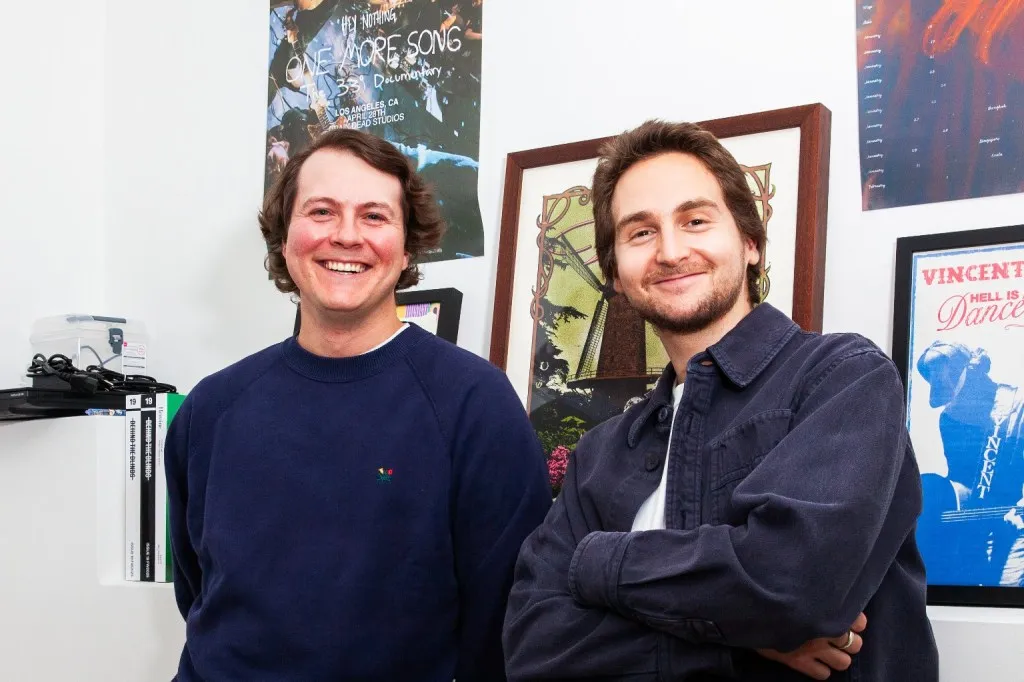
Sean Lewow and Max Motley, co-founders of Music Soup, launched the joint venture in February 2022 with Interscope and Darkroom and built a roster around artists they believed might get lost at major labels. For decision-makers, their model is a playbook for competing on attention and rollout craft while partners supply the infrastructure.
If you think “record label strategy” is just spreadsheets and sign-on bonuses, Music Soup is here to spoil the fun. Co-founders Sean Lewow and Max Motley started the label in February 2022 as a joint venture with Interscope and Darkroom, and now, with an expanded roster and a headquarters in Los Angeles, they say they “haven’t remotely scratched the surface” of what they want to build. Their pitch is simple in concept but precise in execution: take bets on artists that may otherwise get lost in a massive major-label structure, then give those artists bespoke rollouts and real partnership support.
The key operational tell is how the company is organized around collaboration. Music Soup is not a fully walled garden. Lewow and Motley describe Darkroom CEO and founder Justin Lubliner as a “third partner,” involved “in everything we do” and offering mentorship, with Lubliner’s team supporting PR, international, and other needs. On the Interscope side, Lewow says it often acts as a distributor, and Music Soup can “lean on the Interscope team” when it needs resources. In other words, the label is small by headcount, but it is not small on capabilities. The company currently boasts six employees and includes Lewow and Motley, and their approach is to keep “more people on our team than artists we’re working with,” so artists can always “pick up the phone” to reach the team.
To understand why this matters, you have to remember the incentive problem major labels often have. When organizations get big, the system starts optimizing for predictability and volume. That can leave talented artists stuck in a funnel where promotion is standardized and timelines are driven by internal throughput. Music Soup’s founders explicitly reject that “roster as throughput” mentality. Motley says they are not guided by genre or even pure metrics, focusing instead on potential and stressing that “you can’t rest on your laurels.” Lewow adds that the model forces new strategies each time, because every artist’s rollout has to be “bespoke,” not templated. That matters even more when streaming and attention cycles move fast, because the window to convert discovery into sustained momentum is brutal.
The origin story also helps explain why their process is built like a scouting loop, not a bureaucracy. Lewow, 27, traces his obsession back to the early 2010s in the Atlanta-area radio world, where he says he was the same middle schooler “winning all of their ticket giveaways” via a system so persistent that stations eventually called him out and told him to stop. He later worked his way up at a student radio station and concert committee, then built a creative studio and management company, Ourros, from the “bunk bed in his bedroom.” Motley, 28, came from the Bay Area and worked as a former general manager of his college radio station and an intern at Paradigm (now part of THE·TEAM). But after graduating in 2020 at the height of the pandemic, he struggled to break into live music and described applying to “50 to 100 different jobs” without landing a first-round interview.
So Motley used TikTok to build a scouting audience instead, posting as @mostleymusic with content that adapted the blog model into short-form. The page ballooned to more than 200,000 followers and led to A&R consultancies at multiple major labels. Both Lewow and Motley eventually landed in scouting circles that connected with Darkroom CEO Justin Lubliner and Interscope CEO/chairman John Janick, where Motley says he met Sean. They then joined forces on Music Soup in February 2022, with an initial roster that started “basically by accident” with country artist Vincent Mason and pop singer Katherine Li.
From there, the roster becomes the proof point. Lewow points to Wisp, a shoegaze/alt-rock artist who has featured on a song with American Football, opened for System of a Down and Deftones in stadiums, and charted at No. 10 on the Billboard Hard Rock Songs chart with “Your face.” Country artist Vincent Mason brings RIAA platinum-certified “Hell Is a Dance Floor” and recently logged two Billboard Hot 100 entries in the last year, including “Damned If I Do” and a collaboration with Stella Lefty called “Something to Lose.” Waylon Wyatt fits the same “it’s about story and fit, not checkboxes” logic, with the founders describing their love for country, folk, and Americana as a driver for what made sense to sign.
Now comes the next pressure test: timing and scale, not just taste. The founders spoke just days before Wyatt takes the stage at the Grand Ole Opry for the first time and Mason impacts country radio with “Damned If I Do.” Lewow and Motley say they want to “take Music Soup to the moon.” Lewow frames Mason’s ongoing work as continuity, saying they have been “in the trenches” with him “every single release since release one,” and calling radio impact a “turning point.” But they also insist they are not chasing volume by signing lots of artists at once. Their guardrail is resource allocation: always aiming to have more team members than artists, to protect the phone-call intimacy that comes with real attention.
For boards, investors, and operator-types, the second-order implication is this: partnership structures are becoming the new advantage in music. Music Soup is effectively building a hybrid engine, where small-team intimacy and bespoke strategy get paired with partner-scale capabilities like PR support and distribution via Interscope, and mentorship plus cross-functional help via Darkroom. In an industry that still prizes taste but now runs on fast cycles of discovery, the winners increasingly look like operators who can match artists to the right attention infrastructure, not just operators who can fill a roster. Music Soup’s founders are betting that hunger and execution can outgrow the label size they started with.
This story's Key Insights and Take-aways are locked.
Create a free account to unlock Executive Actions for one credit.
Register to UnlockAlways free for Executives Club members. Join the Club
More in Entertainment

Ali G's 'stooge' says he was in on joke, outplayed Sacha Baron Cohen
A 54-year-old aspiring actor says he recognized Sacha Baron Cohen mid-shoot, kept his MAGA act up, and let the film-makers think they had fooled him.

Entertainer Russell Brand denies 7 sex charges amid accuser's 'couldn't breathe' claim
The alleged victim's account sharpens the reputational and legal stakes for Brand, his platforms, and any business tied to a public figure under criminal scrutiny.

Russell Brand's accuser 'bewildered and confused' as he denies 7 sex charges
The criminal case against the comedian is a live test of how media companies manage talent risk when serious allegations go public.