
NASA astronauts Chris Williams and Jessica Meir replace a Canadarm2 wrist joint June 30
The 6.5-hour ISS spacewalk swaps a 200-pound robotic arm part after a May 27 malfunction, live.
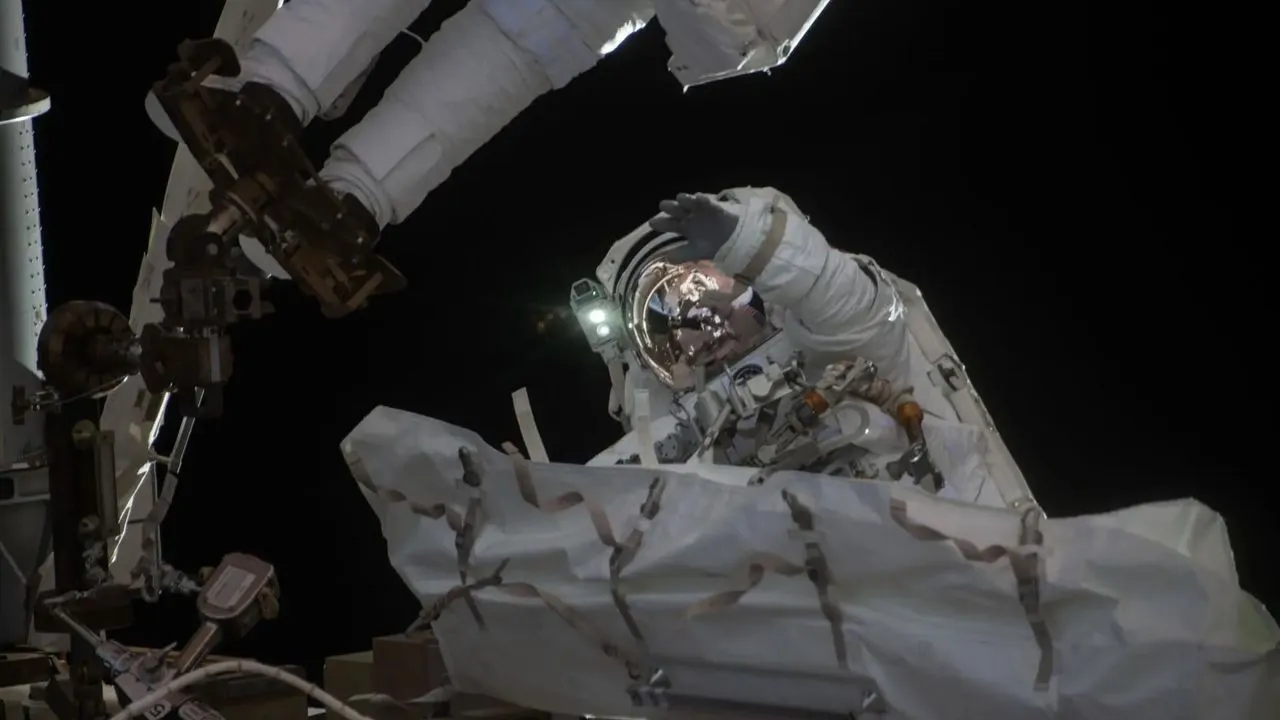
NASA astronauts Chris Williams and Jessica Meir will complete a roughly 6.5-hour spacewalk on June 30 to replace a malfunctioning Canadarm2 wrist joint. The repair follows an elevated-motor-current issue on May 27 that prevented the arm from moving as expected, with a spare already on the ISS.
Chris Williams and Jessica Meir are stepping outside the International Space Station today, June 30, to fix Canadarm2 in a roughly 6.5-hour spacewalk that starts at about 8:35 a.m. EDT (1235 GMT). Coverage begins at 7:00 a.m. EDT (1100 GMT), and the action is being broadcast live through Space.com courtesy of NASA, with a direct stream via NASA’s site.
The mission is specific because the problem was specific. NASA says the astronauts will replace a 200-pound (90-kilogram) wrist joint after it malfunctioned during normal Canadarm2 operations on May 27. According to NASA officials in a June 22 spacewalk preview, the arm drew elevated motor current and “did not move as expected.” That combination matters: it is not just a “mechanical nuisance,” it is an operational reliability event that can interrupt how the ISS handles robotics tasks.
From a systems perspective, this is also what separates good spaceflight operations from chaos. Canadarm2 is designed for replaceable components and planned maintenance. NASA officials explicitly framed the repair as normal for a system that has already logged more than 25 years of continuous operations. Translation: the ISS is aging, but the planning assumes aging. Today’s EVA is the mechanism that keeps that assumption true in the real world.
There is a second reason this repair is worth watching, even if you never plan to read a robotics fault tree. Canadarm2 is nearly as old as the station itself. The 56-foot-long (17-meter-long), 3,300-pound (1,500-kg) robot arrived at the orbiting lab aboard the space shuttle Endeavour in April 2001, and the ISS has been continuously occupied by rotating astronaut crews since November 2000. In other words, this is not an experiment running on hope. It is a long-running industrial process in space, where something will eventually wear, drift, or fail, and your job is to have the right spare part in the right place at the right time.
NASA says the spare wrist joint was already on board the ISS. That logistical detail is easy to gloss over, but it is the difference between “repairable” and “mission-limiting.” When the station has a replacement ready, you can execute a planned EVA rather than waiting for resupply or improvising with constraints you cannot relax. It also reflects how ISS operations treat robotics as mission-critical infrastructure, not decorative tech.
The day’s EVA roles are also set, down to the spacesuit stripes. Today will be the second spacewalk for Williams, who will be “spacewalk crewmember 1” and will wear a spacesuit with red stripes. It will be the fifth for Meir, who will be “spacewalk crewmember 2” and will wear a suit with no stripes. Williams and Meir also share recent EVA experience together: the pair performed an EVA this past March, spending seven hours prepping the orbiting lab for a new solar array.
If you zoom out further, this becomes part of a broader operational ledger. Astronauts have performed a total of 279 spacewalks outside the ISS to date. That number is not just trivia. It is a reminder that the ISS is maintained through repeated, high-precision interventions, where the “plan” is only half the story. The other half is performing the plan under real conditions: constrained movement, limited time, and equipment that has lived through years of harsh exposure.
So what is the strategic stake for executives, investors, and operators watching from Earth? It is the discipline of uptime in extreme environments. Canadarm2 may be old, but the station is not gambling on it staying perfect. NASA is treating maintenance as expected work and responding with a planned joint replacement after a clearly described fault on May 27. For anyone responsible for long-life systems on the bleeding edge, today’s EVA is a live demonstration of how reliability engineering actually plays out: monitor, detect, diagnose, have the spare, and execute under schedule. That is the blueprint, and it is being followed right now.
This story's Key Insights and Take-aways are locked.
Create a free account to unlock Executive Actions for one credit.
Register to UnlockAlways free for Executives Club members. Join the Club
More in Science

2026 Nikon Small World Winners Reveal the Hidden Machinery of Everyday Life
A mycologist's frozen Edinburgh garden became the backdrop for vivid views inside cells, a reminder of what advanced imaging now makes visible to researchers and the industries built on biology.
Study: 1 in 4 depression cases may be a body-clock problem, not a chemical one
A 10,000-person study finds standard antidepressants often fail these patients, but melatonin and morning sunlight may hit the real root cause.

Start-Up Says A.I. Designed a Virus to Attack One Patient's Superbug
If the claim holds up, personalized phage therapy could become a new frontline weapon against antibiotic resistance - but proof is far from final.