
NASA picks 2026 NIAC Phase I studies, from “DimSun” dust to Saturn ring probes
See the specific concepts NASA selected for NIAC Phase I in 2026, and why they matter for future missions.
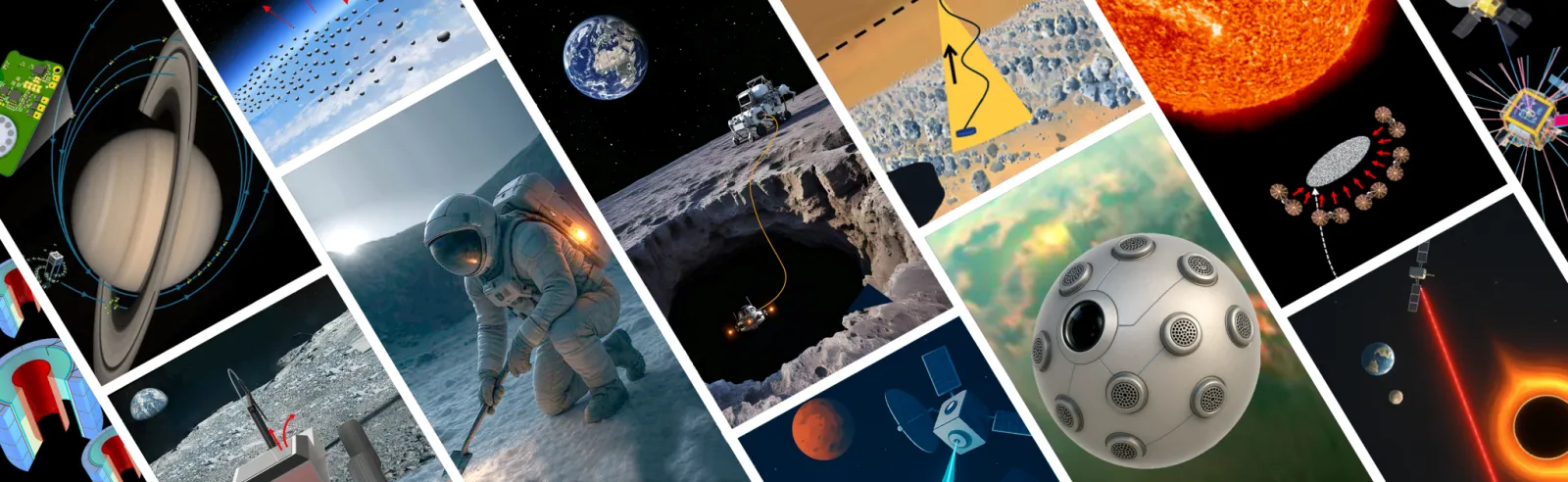
NASA’s NIAC program is funding Phase I studies in 2026, including Saptarshi Bandyopadhyay’s “Dimming the Sun (DimSun)” using a controllable dust cloud, and teams tackling deep-space power, propulsion, and in-situ science. For decision-makers, these selections are a roadmap of where NASA (and the broader space ecosystem) is betting R&D attention next.
NASA’s NIAC 2026 Phase I selections read like a greatest-hits mixtape of “how do we do the impossible” questions. The list includes Saptarshi Bandyopadhyay’s “Dimming the Sun (DimSun)” concept, which aims to use a controllable dust cloud to reduce solar insolation. It also includes David Bugby’s “CANVAS,” an architecture built around neomobility, on-Venus adaptability, and survivability. Those aren’t incremental tweaks. They are mission-level gambles on new ways to manage power, environment, and movement across hostile destinations.
This is Phase I, meaning the point is exploration, not immediate deployment. But the concepts tell you where technical risk and opportunity are stacking up inside NASA’s research pipeline. NIAC studies, funded through NASA’s Innovative Advanced Concepts program under the Research and Technology Mission Directorate, often serve as early scaffolding for later mission concepts. In plain English: the agency uses NIAC to sanity-check ambitious ideas early enough that a small team can still pivot fast, before money and schedules get locked in.
So what did NASA actually select for 2026 Phase I? Starting with the “DimSun” line of thinking at NASA Jet Propulsion Laboratory in Pasadena, CA 91109-8001, Bandyopadhyay’s study is paired with other power, sensing, and propulsion directions. David Bugby’s “Combinatory Architecture offering Neomobility, on-Venus Adaptability, and Survivability (CANVAS)” is also at NASA JPL in Pasadena, CA 91109-8001. Anish Damodaran’s “PS21: Transforming Submillimeter Space Interferometry with Photonic Technologies” lands at the University of Central Florida in Orlando, FL 32826-2933.
Then NASA spreads the bets across radically different mission problems. Artur Davoyan’s “Coilable Stacked Solar Sails for Very High delta-V Missions” is at the University of California Los Angeles, CA 90024-0001. A.C. Charania’s “EARENDIL: Extended Astronaut Radioisotope-EVA in Nighttime and Deep-space Icy Landscapes” is at Zeno Power Systems, Inc. in Washington, DC 20001-3701, leaning into extreme environment operations and communications/power realities. Daniel Drew’s “Solid-state Propulsion for Autonomous Reconnaissance of Karst (SPARK)” is at the University of Hawaii in Honolulu, HI 96822-2303. Gilly Elor’s “Power-over-Fiber to Enable a Lunar Underground eXplorer (LUX)” comes from Stone Aerospace, Inc. in Del Valle, TX 78617-3017, which signals how quickly “underground” becomes a first-class mission target rather than a sci-fi aside.
The sensing and science themes keep stacking. Zhaoyan Liu’s “Quantum Wind Lidar Applications for Planetary and Earth Science Missions” is at NASA Ames Research Center in Moffett Field, CA 94034-0001. Jeff Nosanov’s “OBLIVIAN: Observing Black hole LIght Via Intensity cOrrelatioN” runs through Orbital Velocity, LLC in Decatur, GA 30033-4151, pointing to instrumentation strategies for one of the most challenging targets in astrophysics. Keunhan Park’s “Plasmon-Enhanced Radioisotope Thermophotovoltaic (PRTPV) Power Generation for Interstellar Missions” is at the University of Utah, Salt Lake City, UT 84112-1109. Austin Phoenix’s “ECLIPSE - Efficient variable Conductivity Lunar Insulator for Passive Surveyor Environmental Control” is at Virginia Polytechnic Institute & State University, Blacksburg, VA 24060-5605.
If you’re looking for the “how do we explore where we cannot easily land” signal, NASA also picked missions oriented toward extreme terrains and remote sampling. Marco Quadrelli’s “PRAXIS: Planetary Rings Autonomous EXploration with In-situ Sampling” is at NASA JPL, Pasadena, CA 91109-8001. Michael Rubenstein’s “Actively Steerable Femtosat Constellations for In-situ Exploration of Saturn's Rings, Atmosphere, and Magnetosphere” is at Northwestern University, Chicago Evanston, IL 60208-0001. Benjamin Schafer’s “Photophoretic Tracers for Near-Space Remote Sensing at 30-100 km Altitudes” is at UCLA, CA 90024-0001. Pablo Sobron’s “Interworld Slingshot Resource Surveys” is at the SETI Institute in Mountain View, CA 94043-5203, which hints at the growing overlap between exploration logistics and resource-oriented thinking.
A second wave of entries doubles down on optics and precision measurement, which is often where breakthroughs start because instrumentation improvements cascade everywhere else. David Smith’s “Robotically Assembled Electromagnetic Metamaterials for Long-Range Space Situational Awareness” is at Duke University in Durham, NC 27708-9976. Paul Stankus appears twice: “Mapping Alien Continents: Achieving Optical VLBI for Exoplanet Imaging” and “Precision Astrometry Using Optically Independent Spacecraft for Gravitational Wave Detection,” both at Brookhaven Science Associates in Upton, NY 11973-0001.
Taken together, these selections sketch a portfolio that is unusually broad, but coherent in one way: each concept attacks a bottleneck that stops missions from scaling. Whether it is power generation, propulsion, autonomy, or the ability to measure phenomena at the edge of what current instruments can resolve, the common thread is capability expansion. For executives and boards, the second-order takeaway is straightforward. NIAC Phase I is not just “research for research’s sake.” It is a pipeline filter. It shapes what universities, startups, and established aerospace partners gear up to prototype, publish, and eventually commercialize or integrate into government programs.
And that matters now because space R&D is increasingly competitive and time-sensitive. Concepts like controllable dust clouds for solar insolation, coilable stacked solar sails for very high delta-V, and new power or sensing approaches are exactly the kind of early-stage work that can become the backbone of later mission architectures. If you operate in space tech, investor or operator alike, NIAC selections are a clue to where NASA thinks the next moonshot breakthroughs are most likely to be engineered into something real.
This story's Key Insights and Take-aways are locked.
Create a free account to unlock Executive Actions for one credit.
Register to UnlockAlways free for Executives Club members. Join the Club
More in Technology

Google quietly links your phone number to every Android account on your SIM
Adding a SIM now ties your phone number to all Google accounts - and future accounts inherit it. Here's the security and privacy stakes.

Hijacker AI 'Skynet mode' runs 100,000 attack steps against exposed models
Symantec caught a criminal AI agent that borrows other models, steals data, and mines crypto; the only relief is no confirmed victims yet.

Nvidia's AI-financier shift faces its first big test as neoclouds stumble
A rout in neocloud stocks is forcing investors to weigh Nvidia's hidden exposure as both supplier and lender to the AI buildout.