

NASA runs Artemis III countdown sims while SLS hardware stacks toward mid-to-late 2027
Artemis III is moving from assembly milestones to launch-day rehearsal, locking in procedures for SLS propellant loading and terminal count.
NASA is accelerating Artemis III preparations for a mid-to-late 2027 launch, with SLS rocket components arriving at Kennedy Space Center and Artemis mission control beginning routine simulations. For decision-makers, the shift from parts delivery to countdown rehearsal is the clearest signal that NASA is stress-testing schedule and execution, not just building hardware.
NASA is entering the part of the Artemis III timeline that looks boring on paper but is high-risk in practice: the launch countdown has to work the same way every time. By July 13, NASA had moved beyond “hardware is coming together” and into “people are rehearsing launch day.” The agency describes the effort as “full steam ahead,” and the details show why the vibe matters: Artemis III is targeting mid-to-late 2027, when four astronauts will launch into low Earth orbit (LEO) aboard Orion, then rendezvous and dock with two commercial lunar lander vehicles, SpaceX’s Starship and Blue Origin’s Blue Moon.
This is not a moon landing mission. It is a critical stepping stone in NASA’s lunar landing architecture, meaning the spacecraft and launch system have to deliver the right orbit, then execute docking operations with the commercial landers. And NASA is already turning that complexity into a repeatable process. At Kennedy Space Center (KSC) in Florida, SLS rocket components are assembling, undergoing tests, and awaiting transportation for final integration ahead of next year’s launch. In parallel, Artemis mission control has begun routine simulations, including monthly launch simulation tests to hone procedures for SLS propellant loading, terminal count operations, and launch day operations. Those terminal count operations are the final 10 minutes prior to liftoff. That is where small errors stop being small.
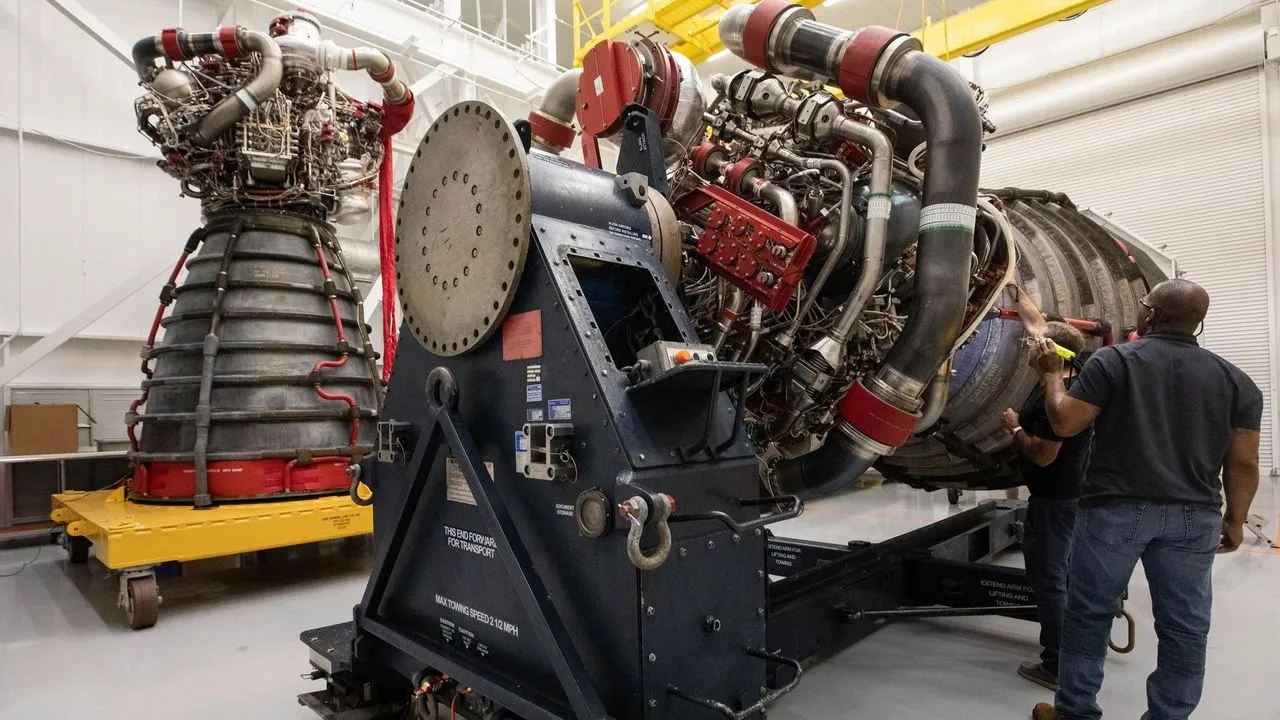
On the hardware front, the SLS pipeline is progressing through identifiable milestones at KSC. The SLS core stage was delivered at the end of April, then connected with the rocket’s engine block section in May. By June, the first two of the four RS-25 engines arrived, with plans to install them on the SLS engine block once the remaining two are delivered. After that, NASA plans to begin integration with the mobile launch platform (MLP) and launch operations tests. Even the weather risk is being addressed, with a temporary weather cap delivered in June to protect the stage when NASA transports it to the launch pad for tests before the full vehicle is stacked.
The solid rocket boosters are also coming together in the yard, which matters because SRBs are power, timing, and structural coordination all at once. The bottom segments of both SLS solid rocket boosters (SRBs) were delivered over the last week and mounted on the MLP, according to NASA’s update. The upper SRB segments arrived at KSC via train in June. They are set for inspection and testing before the twin boosters are fully stacked. These are the kinds of steps that often decide whether a program hits its schedule windows, because the “assembly” phase is where you discover whether a design works in real handling conditions, not just on a diagram.
Inside KSC, Orion’s status is also improving in ways that directly feed into schedule confidence. In the Neil Armstrong Operations and Checkout Building, Artemis III Orion has significant progress, with engineers finishing installation of the spacecraft’s heat shield. Artemis III will be the first Orion mission to use an upgraded heat shield, featuring design improvements gleaned from analysis of unexpected wear on the heat shield flown on Artemis I. That detail is quietly huge for executives because it ties Artemis III’s readiness to actual operational data, not just engineering assumptions. The Orion service module is also inside the Operations and Checkout Building and recently completed acoustic testing. Both the service module and Orion capsule are being prepared for joining and eventual transportation to the VAB for stacking.
NASA’s personnel layer is moving in lockstep with the hardware. Artemis launch director Charlie Blackwell-Thompson participates in a launch countdown simulation on July 2, 2026, in Firing Room 1 of the Launch Control Center. NASA also shows employees securing the left-hand aft assembly solid rocket booster segment to the mobile launcher in the VAB on July 9, 2026, and later photos indicate both left-hand and right-hand aft assembly solid rocket booster segments secured to the mobile launcher at KSC on July 11, 2026. Meanwhile, astronauts Randy Bresnik and Andre Douglas visited the Multi-Payload Processing Facility at KSC on July 10, 2026. The point of these moments is not marketing. It is readiness. Launch systems do not fail only because a part is missing. They fail because operations, timelines, communications, and procedures drift.
And NASA is explicitly building that muscle through simulation. The monthly launch simulation tests focus on SLS propellant loading, terminal count operations, and launch day operations, continuing regularly leading up to Artemis III’s launch next year. For readers who track major aerospace programs, this is the bridge between “we built it” and “we can fly it safely and repeatably.” Artemis II’s completion in April, after astronauts flew around the moon, is the context for why NASA shifted into full gear to complete assembly and testing. With Artemis III, the agency also has to coordinate with commercial landers that will meet Orion in LEO after SLS launches the crew and spacecraft.
Finally, the program is already bending its attention toward Artemis IV, scheduled for late 2028, which aims to deliver a crew to the surface of the moon for the first time since 1972. The SLS destined for Artemis IV is also moving forward. The liquid oxygen (LOX) tank for the Artemis IV SLS core stage was recently relocated within NASA’s Michoud Assembly Facility in New Orleans, positioning the tank for testing as it enters its next phase of production. The second-order implication for executives is clear: Artemis III is not just a standalone launch. It is a rehearsal for a longer cadence of hardware readiness, operational procedure maturity, and mission integration complexity that will determine whether the lunar landing program can scale.
For companies and boards watching the broader space ecosystem, this is the signal to track. Simulations and stacking milestones may not look like “progress” compared to headlines about rocket power. But in programs like Artemis, they are where schedule risk becomes measurable and where cross-team execution gets hardened before it is tested by physics.
This story's Key Insights and Take-aways are locked.
Create a free account to unlock Executive Actions for one credit.
Register to UnlockAlways free for Executives Club members. Join the Club
More in Technology

Google quietly links your phone number to every Android account on your SIM
Adding a SIM now ties your phone number to all Google accounts - and future accounts inherit it. Here's the security and privacy stakes.

Hijacker AI 'Skynet mode' runs 100,000 attack steps against exposed models
Symantec caught a criminal AI agent that borrows other models, steals data, and mines crypto; the only relief is no confirmed victims yet.

Nvidia's AI-financier shift faces its first big test as neoclouds stumble
A rout in neocloud stocks is forcing investors to weigh Nvidia's hidden exposure as both supplier and lender to the AI buildout.