

NASA’s Paul Stankus advances a visible-light VLBI design to image Earth-like exoplanets
A new nulling interferometer and a 100 km space baseline aim for 10^10 star-planet contrast and surface-feature resolution.
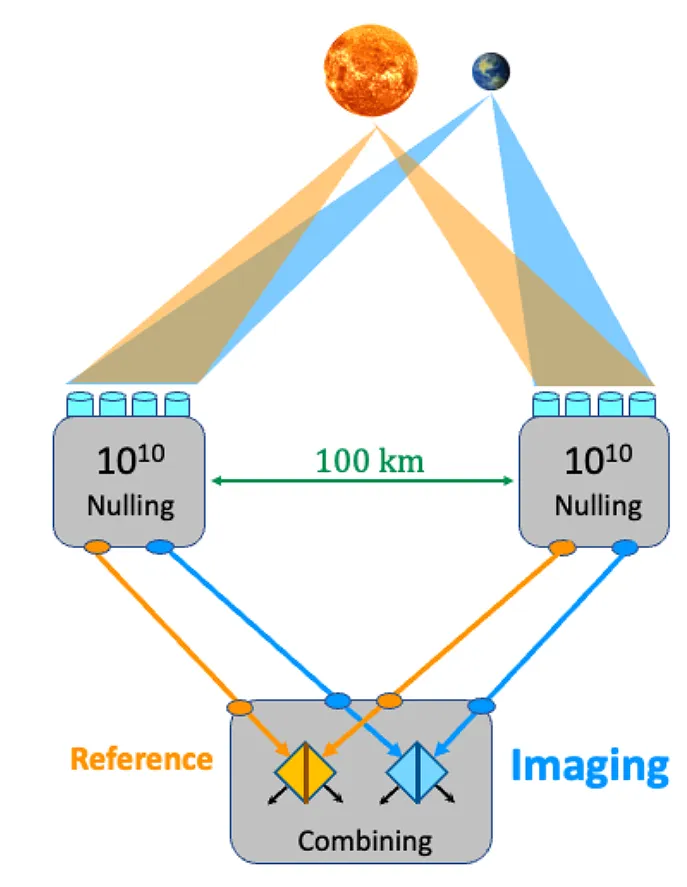
NASA’s Paul Stankus, via Brookhaven Science Associates, is advancing a two-stage optical VLBI approach for visible-light imaging of an Earth-like exoplanet around a nearby star. The work’s consequence for decision-makers is clear: it targets the technical path to separate star light from planet light and turn interferometry into real surface maps.
Paul Stankus of Brookhaven Science Associates is pushing a specific, hard-to-get capability into NASA’s pipeline: reconstructing the image of an Earth-like exoplanet in visible light, down to surface features. The core goal is not just to detect a planet, but to resolve it, meaning the system would separate what’s coming from the star from what’s coming from the planet well enough to make actual “mapping alien continents” possible. In Stankus’s framing, the innovation is built in two stages, both aimed at a critical bottleneck in optical astronomy: contrast.
The first stage tackles contrast head-on. The plan is a new kind of nulling interferometer called “dynamic hierarchical nulling.” It combines inputs from multiple apertures and is intended to separate star light from planet light with contrast of 10^10 or better in the visible. That 10^10 target is the headline number in plain terms: without it, the planet’s signal is drowned by the star. With it, the remaining light can be shaped for imaging rather than just hunting. This matters for leaders because it reframes the mission from a “nice-to-have” viewing experiment into an engineering problem with a measurable performance bar.
Stage two then uses that output to reach angular resolution. The concept is to combine the output beams from two such nullers on spacecraft stationed about 100 km apart to achieve the required angular resolution using Michelson interferometric imaging. That distance is not a random gimmick. In interferometry, the farther apart the elements, the finer the effective angular detail you can resolve, because the system samples spatial information more aggressively. Here, the 100 km baseline is the mechanism that turns the nulling system from a star-planet contrast tool into a true imaging instrument.
There’s also a clever structural detail that helps phase control, which is usually where interferometry gets messy. The hierarchical nuller preserves the star’s light in a separate beam, which can then be used as an interference phase reference. In other words, the system is designed not only to suppress star light in the science channel, but to keep enough star information in a reference channel so the imaging process knows how to align the phases. For executives and board members, that is a second-order indicator of maturity: the design is not pretending that “nulling” automatically solves the whole problem. It anticipates how to reference and stabilize the interference needed for reconstruction.
From a market and portfolio perspective, the work sits inside a NASA innovation pathway. The page ties it to NASA priorities and calls out alignment with NASA’s “Innovative Advanced Concepts (NIAC) Program” and “NIAC Funded Studies,” under the NASA Office of Technology and Mission Directorate structure shown on the page. This is the kind of program framing that decision-makers often watch closely, because NIAC studies are meant to de-risk or prove concepts that are too early for traditional mission lanes. The stated “scientific goal” is broad and inspirational, but the architecture is concrete: two stages, a named interferometer approach, a contrast target, and a spacecraft separation scale.
The public-interest angle is explicit too, and it’s not hard to see why this concept would land with a wide audience. The capability to survey the features of Earth-like exoplanets is a cultural magnet, and NASA notes it would “excite public interest.” For leadership, that matters even beyond optics and press. High-signal public engagement can influence sustained funding, stakeholder attention, and long-horizon support for technical experiments that might otherwise struggle to compete with nearer-term deliverables.
Strategically, the stakes for peers in similar roles are straightforward. If visible-light optical VLBI imaging can be pushed from concept to validated architecture, it expands the toolset available for characterizing nearby worlds, and it changes what “exoplanet imaging” means in practice. Instead of only indirect measurements, systems that can separate star light and reconstruct surface features could shift the conversation toward more direct questions about planetary geology, atmospheres, and habitability in an observational sense. Leaders should treat this as a signal that NASA is trying to solve a specific, quantified problem, not just chase an aspirational headline. And if the engineering pieces hold together, “mapping alien continents” stops being a metaphor and starts looking like a method.
This story's Key Insights and Take-aways are locked.
Create a free account to unlock Executive Actions for one credit.
Register to UnlockAlways free for Executives Club members. Join the Club
More in Science

2026 Nikon Small World Winners Reveal the Hidden Machinery of Everyday Life
A mycologist's frozen Edinburgh garden became the backdrop for vivid views inside cells, a reminder of what advanced imaging now makes visible to researchers and the industries built on biology.

Study: 1 in 4 depression cases may be a body-clock problem, not a chemical one
A 10,000-person study finds standard antidepressants often fail these patients, but melatonin and morning sunlight may hit the real root cause.

Start-Up Says A.I. Designed a Virus to Attack One Patient's Superbug
If the claim holds up, personalized phage therapy could become a new frontline weapon against antibiotic resistance - but proof is far from final.