

NASA’s X-59 starts supersonic tests aiming to kill the sonic boom, not the speed
Lockheed Martin’s Quiet Supersonic Technology jet is proving whether overland supersonic travel can be quieter enough to fly.
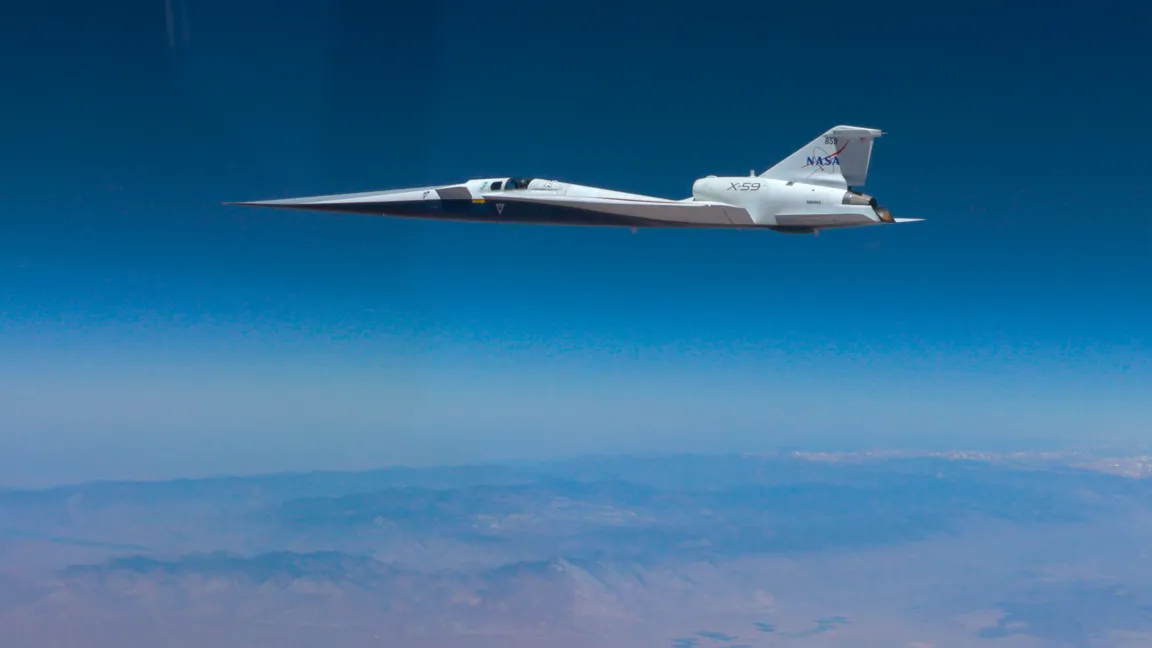
NASA is flying the Lockheed Martin X-59 Quesst, an experimental aircraft built to replace the sonic boom with a quieter “thump.” If the test program works, it could shape future supersonic airliners designed for overland routes without rattling communities.
NASA’s X-59 Quesst has started supersonic test flights, and the whole point is brutally specific: fly faster than sound while avoiding the loud sonic boom that has historically shut down most overland supersonic travel. The aircraft is designed to convert that expected boom into a quieter sound described as a “thump” roughly equivalent to a car door slamming shut 20 feet away. It is a small sensory promise. But for anyone thinking about aircraft certification, passenger demand, or route economics, it is the difference between “cool demo” and “deployable business.”
The program’s timeline matters too. More than two decades after Concorde last flew commercially, NASA is now testing an approach aimed at making supersonic travel less hostile to people on the ground. The X-59, described as Quiet SuperSonic Technology, first took flight late last year, and “recently began supersonic test flights.” This is not just a physics experiment in a lab. NASA’s plan, if the data holds up, is to take the X-59 on a national tour around the United States so residents of different cities and towns can provide feedback on the quieter sonic “thumps” it produces.
That last part is where the strategy gets interesting for executives. In the X-plane ecosystem, a lot of experimental aircraft are intentionally constrained. Ars notes that unlike many other X-planes that may never leave restricted airspace near Edwards Air Force Base in California, NASA intends to operate in ways that surface real-world human reactions. In other words, the project is building not only aerodynamic and acoustic data, but also the social license that regulators and airlines eventually need. A smoother noise profile is a technical target. Public perception and local tolerance become the practical gating item.
NASA is also making a distinction that goes beyond “can it fly?” Jim “Clue” Less, a NASA test pilot and aerospace engineer, explains in an Ars interview that X-planes are often “bare-bones,” assembled from parts of other airplanes to demonstrate a single thing. NASA still wants to demonstrate one thing, but it also needs “a plane that's robust enough that we can fly it all over the place and gather that data.” Translation: the X-59 is being treated as a measurement tool for how supersonic events land in communities, not as a one-off engineering flex.
For the broader market, this is a key second-order bet. Supersonic aircraft, in the commercial imagination, are about speed and premium routes. But historically, speed has been limited by the boom, because the boom is not just loud, it is disruptive. A quieter signature could make overland routes more feasible, which changes the economics of where supersonic aircraft can go and how airlines might design their networks. Ars frames the potential impact directly: a successful NASA flight test program could influence the design of future supersonic airliners capable of flying overland routes without rattling buildings and people’s nerves. That is the path from experimental craft to next-generation fleet design.
Regulatory reality is the missing middle executives watch closely. Even if engineers nail the hardware, certification and operational approval require evidence. NASA’s approach seems calibrated to produce that evidence in a form that matters to both government and the public: measurable acoustic behavior paired with feedback from people who actually hear it. The national tour component is essentially a large-scale usability study for the “thump” concept, designed to replace an unignorable experience with something that sounds more tolerable. If you are on a board evaluating aerospace programs, this is a reminder that in aviation, the hardest constraints are often not in the air, but on the ground and in the paperwork.
There is also an industrial incentive alignment worth noting. The X-59 is a Lockheed Martin build, and NASA is using it to generate information that could inform how future aircraft are shaped. For aerospace suppliers and primes, that means programs like this can become reference points for design choices and compliance strategies. The faster the data loop, the faster other teams can iterate. And if the noise outcomes support a quieter approach, the project could become a signal to the market that overland supersonic travel is moving from speculative to testable.
Finally, there is a community and brand layer, even for executives who are not in the supersonic business. The idea of taking an experimental plane on tour signals that the program expects scrutiny. It is not aiming for a single controlled test window. It is building toward repeated experiences across locations. In a world where aviation controversies can travel faster than aircraft, showing that supersonic can be quieter and manageable is a credibility play as much as an engineering one. For peers working on high-noise operations, next-generation propulsion, or route expansion, the X-59 is a case study in how to trade a headline-grabbing boom for measurable, human-centered data.
In short: NASA’s X-59 has moved from first flight toward supersonic test flights with a specific outcome in mind, and it is already planning the next step where that outcome will be judged by actual people. If the “thump” works as described and the feedback supports it, the implications reach well beyond one aircraft and one test range. It could help shape the design of future supersonic airliners that can cross land without turning every overflight into an earthquake in the sky.
This story's Key Insights and Take-aways are locked.
Create a free account to unlock Executive Actions for one credit.
Register to UnlockAlways free for Executives Club members. Join the Club
More in Technology

Nvidia's $89B data center quarter: the 9 companies cashing in
The AI buildout is minting fortunes beyond GPUs, and memory, cloud, and cooling suppliers are riding the same wave.

Google quietly links your phone number to every Android account on your SIM
Adding a SIM now ties your phone number to all Google accounts - and future accounts inherit it. Here's the security and privacy stakes.

Hijacker AI 'Skynet mode' runs 100,000 attack steps against exposed models
Symantec caught a criminal AI agent that borrows other models, steals data, and mines crypto; the only relief is no confirmed victims yet.