
Nasdaq CFO Sarah Youngwood turns AI skills into belts for her finance team
Her “embedded capability” playbook ties AI training, workflow speed, and ROI to how finance runs today.
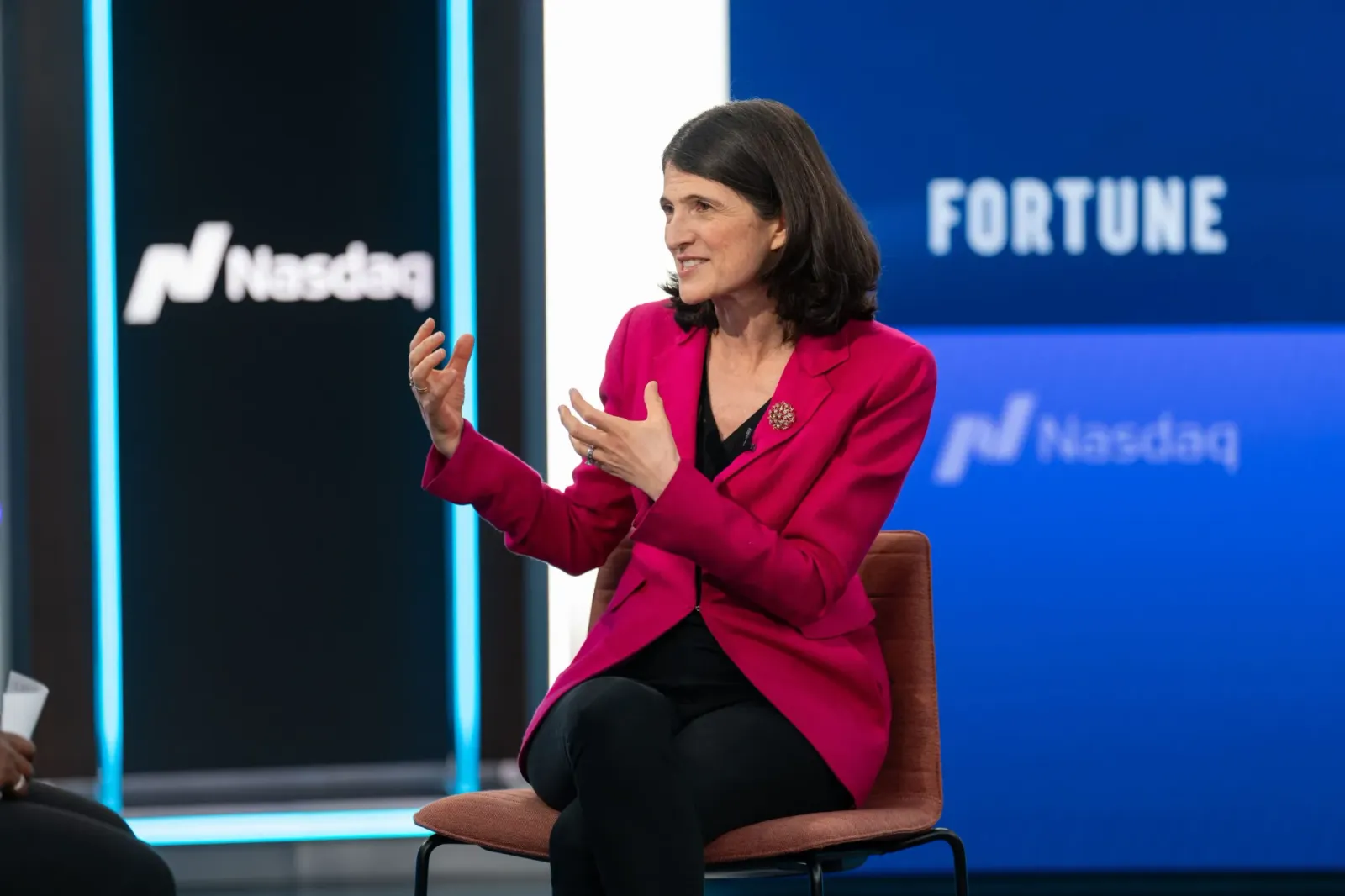
Nasdaq EVP and CFO Sarah Youngwood is rolling out an AI “belt” ranking system across Nasdaq’s finance function. The consequence for decision-makers: AI investment becomes measurable, governed, and tied to forecasting, operations, and capital allocation.
Sarah Youngwood, Nasdaq’s EVP and CFO, has turned AI proficiency into something you can visibly earn. Inside Nasdaq’s finance function, employees now receive belts for AI proficiency, moving from white belt for foundational knowledge to higher levels that require hands-on delivery and the ability to teach others. Youngwood has mandated that everyone on the finance team reaches at least white belt, and her longer-term goal is for 20% of the team to reach black belt status.
This is not a policy memo about “being innovative.” It is a structured training and accountability system designed around what she calls an “embedded capability - not a standalone initiative.” “If we are Nasdaq, it is our role to lead the charge,” Youngwood told Fortune earlier this month, speaking from her 26th-floor corner office above Times Square. Her point is straightforward: Nasdaq should show what AI can do, and what it takes to become an AI-first finance function, including the cultural muscle needed to use it responsibly in real workflows.
That framing matters because finance does not get to experiment for fun. Finance is in charge of a large share of corporate data, and Youngwood’s conviction is that “AI is all about the data.” In other words, AI adoption is only as real as the quality and usefulness of the underlying information, plus the discipline to measure whether it is actually creating value. Nasdaq, which landed at No. 470 on the Fortune 500 this year (returning to the ranking five years after its 2021 debut), is explicitly treating AI as core to its strategy rather than as a side quest.
Nasdaq currently centers its strategy on three pillars: architecting modern markets, powering the innovation economy, and building trust across the financial system. Youngwood argues AI sits at the core of all three, partly because Nasdaq is no longer just a stock exchange. It is a large-scale software and technology provider for the financial industry, with roughly 10,000 employees worldwide and about half in product and technology. “We are the trusted fabric of the financial system,” Youngwood said. “Where we apply AI is in everything we do.” That “everything” includes forecasting, cash allocation, invoice processing, and more, but it also includes governance. She emphasizes that human oversight is essential, because finance decisions still need accountability even when the models are doing the heavy lifting.
To keep the AI spend from becoming vibes, Youngwood applies a familiar financial investment lens: return on invested capital. Her measurement framework works in three stages. First, employee engagement: are people completing AI training and actually using the tools? Second comes velocity: is AI improving throughput, accelerating workflows, or enabling faster development cycles? Only after that does Nasdaq measure financial impact, translating gains into revenue growth, cost efficiency, or productivity. That sequencing is an important governance move. It forces teams to prove adoption and operational improvement before claiming business outcomes.
She also uses time-horizon budgeting discipline to structure capital allocation. Nasdaq categorizes investments into “horizon zero” for foundational needs like cybersecurity, then short-term return initiatives, medium-term bets, and longer-term R&D. AI spending is not treated as a separate budget category. Instead, it is evaluated as a lens applied across the whole portfolio. But the whole system depends on groundwork that typically cannot be skipped: over the past two years, Nasdaq has focused on standardizing data definitions, centralizing information, and building dashboards capable of supporting more advanced AI applications. “You need your data in tip-top shape,” Youngwood said. “Once you have that, you’re prepared for generative AI.”
The payoff is visible in where Nasdaq’s AI capabilities show up inside and outside finance. Youngwood says Nasdaq uses AI across her function for administrative tasks and for forecasting and financial planning, with more advanced initiatives integrating AI into core systems and workflows. She also made a structural change to break the wall between finance and technology, making sure her top technology leaders sit at the same table as the finance team. Externally, the approach is similar: “What we’re doing with AI is putting it everywhere-in every process for our clients and for ourselves.” One concrete example is Nasdaq Verafin’s Agentic AI Workforce platform, launched last year and now used by 650 financial institutions. Adoption is not portrayed as magic, but as implementation-friendly, a factor Youngwood points to in explaining why it is spreading.
Set against today’s debate over whether AI will disrupt traditional software business models, the stakes get bigger. On June 12, SpaceX went public on Nasdaq, marking the largest IPO in history, as questions grow about how AI will impact software economics. Nasdaq CEO Adena Friedman has argued that AI will accelerate software innovation rather than replace it, and Youngwood’s job is to make the financial case for that bet. That means determining how aggressively Nasdaq invests in AI and shaping the investor narrative around results. For leaders in similar roles, her belt system is the signal: AI success is not only about model capability. It is about building an organization that can use AI, measure it, govern it, and scale it across processes where the cost of being wrong is real.
This story's Key Insights and Take-aways are locked.
Create a free account to unlock Executive Actions for one credit.
Register to UnlockAlways free for Executives Club members. Join the Club
More in Business

SK Hynix jumps 11% after seeking up to $29.4B in Nasdaq listing
The chip giant filed for a Nasdaq listing plan that could raise $29.4 billion, instantly reshaping investor expectations.

Micron revenue hits nearly $42B as AI memory lifts gross margins above 81%
Fiscal Q3 results crush estimates, prove AI memory is rewriting Micron's margins, and change the momentum math for the whole chip stack.

SpaceX sells $25B in debt under two weeks after IPO, despite $90B in orders
The satellite and rocket company’s quick $25 billion borrowing move signals how it plans to finance scale after going public.