

Nature: Two super-puff planets are among the least dense ever detected
Gas giants around the same star come in lighter than candy floss, forcing new thinking on planet formation models.
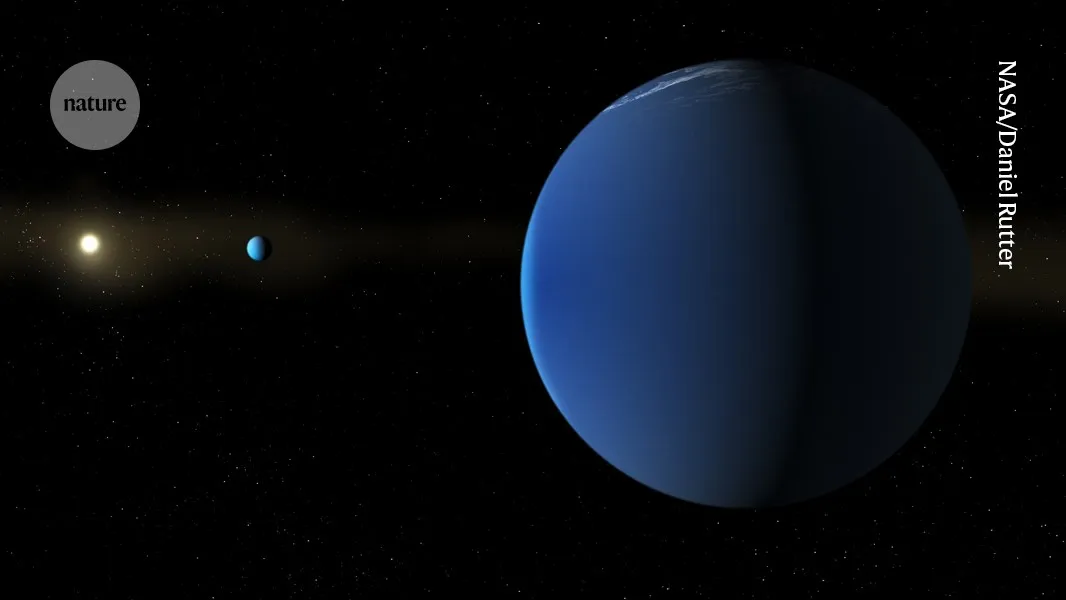
Nature reports that two gas giants orbiting the same star are among the least dense planets ever found. The finding matters for decision-makers because it tightens constraints on how planetary systems form and evolve.
Nature published an update on 09 July 2026 (doi:10.1038/d41586-026-02114-2) describing a pair of “super-puff” planets that are lighter than candy floss. The headline fact in the brief is simple, but it is also a big deal for anyone tracking exoplanet science: two gas giants circling the same star rank among the least dense planets ever detected.
If “super-puff” is already a fun phrase, the real sting is what it implies. Gas giants are usually expected to have substantial mass packed into a relatively compact size, which translates into higher density. Instead, this pair of planets lands at the opposite end of the spectrum. In other words, these planets look bloated, but they are not just fluffy in a vague way. Nature frames them as some of the least dense planets ever found, and the “candy floss” comparison is doing more work than a metaphor. It is signaling an extreme density regime that planetary models have to explain.
Why should an executive care about a cosmic density problem? Because the entire exoplanet pipeline, from telescope strategy to data-processing spend to the long-term roadmap for missions, depends on knowing what kinds of worlds exist. When Nature highlights planets that sit at the far end of “least dense,” it is not merely reporting a cute oddity. It is adding a data point that can reshape priors, which means it can influence how teams interpret future detections. In practical terms, “super-puff” planets test the limits of assumptions behind how atmospheres behave, how planets accrete gas, and how they evolve after formation.
There is also an investor and board-dynamics angle, even if it is indirect. Companies and research programs that build hardware, algorithms, or mission concepts typically allocate budgets based on expected yields and learnings. When peer-reviewed outlets identify extreme cases, it tends to change what stakeholders consider a “likely” distribution. That can affect partnership decisions, funding timelines, and how teams communicate scientific risk. Boards often worry about whether projects are chasing hype or targeting measurable milestones. Findings like this provide measurable constraints, because “least dense ever found” is a benchmark you can track against future surveys.
On the science side, “two planets around the same star” matters because it reduces the number of moving variables. If one super-puff planet appeared in isolation, the story could be about a one-off history. With a pair orbiting the same host star, the system-level context becomes central. That matters for formation scenarios because planet-to-planet differences still need to be explained, but the shared environment can tighten the range of explanations. For models, shared stellar properties provide a common backdrop, forcing theorists to focus on how the planets themselves ended up with such low density.
The regulatory background is not about space agencies enforcing candy-floss compliance, obviously. It is about the broader governance of scientific data, research funding, and scientific integrity. Nature being the publication venue signals peer review and a standard of evidence that is typically trusted by downstream researchers. That matters because once a result enters the canon, it becomes part of how grant reviewers justify next steps and how mission proposals frame scientific value. When a paper reports that two worlds are among the least dense ever found, it tends to become a reference point that can be cited in proposals and technical roadmaps.
Second-order implications follow fast. Extreme low-density planets can challenge how scientists infer composition from observed mass and size, especially when the planet is mostly gas. That means follow-on observations, improved measurement methods, and refined atmospheric models become more important, and teams may prioritize certain follow-up strategies over others. For executives connected to the science ecosystem, the strategic stake is that “super-puff” outcomes can shift what problems look solvable. When models have to be redone to accommodate new extremes, the field may accelerate around better instrumentation and more robust data analysis.
So the strategic takeaway is this: Nature’s 09 July 2026 report puts two super-puff planets into an ultra-low-density bracket that sits near the record edge. These planets are not just another detection in the archive. They are constraints, and constraints shape budgets, roadmaps, and the questions that get funded next. If you are leading in the space, data, or research commercialization orbit, this is a reminder that “outliers” are often where the next wave of breakthroughs is hiding.
This story's Key Insights and Take-aways are locked.
Create a free account to unlock Executive Actions for one credit.
Register to UnlockAlways free for Executives Club members. Join the Club
More in Science

2026 Nikon Small World Winners Reveal the Hidden Machinery of Everyday Life
A mycologist's frozen Edinburgh garden became the backdrop for vivid views inside cells, a reminder of what advanced imaging now makes visible to researchers and the industries built on biology.

Study: 1 in 4 depression cases may be a body-clock problem, not a chemical one
A 10,000-person study finds standard antidepressants often fail these patients, but melatonin and morning sunlight may hit the real root cause.

Start-Up Says A.I. Designed a Virus to Attack One Patient's Superbug
If the claim holds up, personalized phage therapy could become a new frontline weapon against antibiotic resistance - but proof is far from final.