

Nneka Ogwumike warns prediction markets are 'not a safe place' for WNBA players
The WNBA players union chief says $22.2 billion in weekly prediction-market volume is fueling vitriol and safety threats athletes cannot escape.
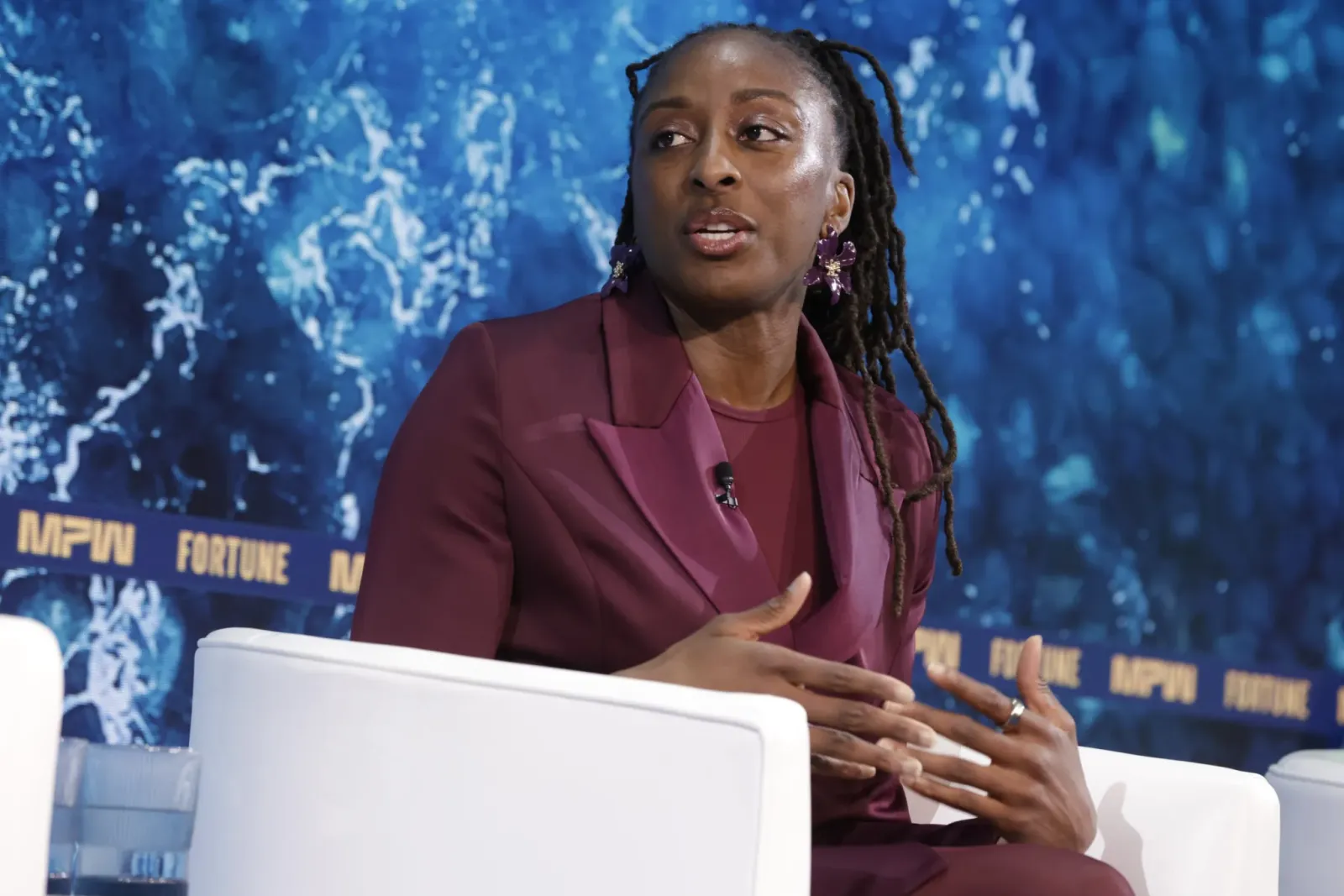
Nneka Ogwumike, WNBA Players Association president and 11-time All-Star, told Fortune at the Most Powerful Women Summit that prediction markets are creating an unsafe environment for athletes due to performance-linked vitriol. With Kalshi and Polymarket hitting a combined $22.2 billion weekly volume, executives across sports, finance, and media should expect athlete-safety pressure to become a regulatory and reputational flashpoint.
WNBA Players Association president Nneka Ogwumike issued a blunt warning on Tuesday: prediction markets are pushing athletes into an unsafe corner. Speaking at Fortune's Most Powerful Women Summit in Santa Barbara, the 11-time All-Star and former Los Angeles Sparks forward said players are absorbing 'vitriol' tied directly to how they perform. 'It's not a safe place for athletes,' she told Fortune's Emma Hinchliffe. 'I don't think I ever want to say that something is outrightly bad unless it absolutely is, but players are definitely having a hard time dealing with the vitriol that comes with prediction markets as it relates to our performance.' Ogwumike, who also serves as president of the WNBA Players Association, connected that hostility not to ordinary fandom but to the rise of platforms where financial outcomes are pinned to player output on the court.
The timing of her warning matters. According to Dune Analytics data, Kalshi and Polymarket hit a combined weekly volume of $22.2 billion last week, fueled by NFL and NCAA-trading volumes. That record figure is not a niche curiosity. It is a signal that prediction markets have become a mainstream financial flow, and athletes are now caught in the crosshairs. The surge demonstrates how quickly these platforms have scaled beyond political event contracts into sports-driven trading, where the underlying asset is often a player's live performance. For the WNBA, Ogwumike's comments make clear that the emotional and psychological toll on players has moved from whispered concern to a public safety warning.
The structural problem is that prediction markets are classified as financial exchanges, not gambling platforms. That classification lets them bypass the regulations and restrictions applied to online sportsbooks, even when the activity is functionally a wager on an athlete's performance. In plain terms, a user can buy a contract that rises or falls based on whether a player scores, rebounds, or wins, and the platform can call it a trade rather than a bet. For players, the line between a derivatives trade and a personal attack has effectively disappeared. When a position loses value because a player misses a shot, the user has a direct financial incentive to vent anger at the athlete, and social media gives that anger a public, often vicious outlet.
The human cost is already visible in college sports, which often foreshadows professional dynamics. The 2025 NCAA Growth, Opportunities, Aspirations and Learning of Students in College study found that more than half of Division 1 men's basketball players reported social media abuse based on their on-court performance, and 46% said the highest rate of negative or threatening messages came from someone who placed a bet on a game they played in. College athletes are reporting harassment associated with sports betting, and Ogwumike says the same pattern is playing out at the professional level. She noted that the WNBA and the players association have resources to help, but those resources do not stop the incidents. 'There's been a lot of safety issues and concerns that haven't necessarily been publicly displayed,' she said. 'Through the [players association] and through the WNBA, there's resources that are available to try and mitigate those things, but it doesn't mean that it stops players from experiencing things that could potentially and have potentially affected their performance.'
The leagues are aware of the optics and the risk. On Tuesday, the same day Ogwumike spoke, the NBA and WNBA announced a responsible gaming campaign with the National Council on Problem Gambling to educate fans about sports betting risks. That partnership is a positive step, but Ogwumike argued more is required to mitigate abuse tied to betting and trading. Her point is that public education campaigns do not address the direct, targeted harassment players receive from users who have money on the line. The safety concerns she describes range from the psychological weight of constant abuse to broader threats that players may face offline, even if those threats have not been fully publicized.
For executives across sports, media, and finance, Ogwumike's comments should read as a flashing indicator. Athlete unions are watching how platforms monetize performance, and unions historically respond with collective pressure when safety is at stake. For Kalshi and Polymarket, the reputational risk is no longer just regulatory or legal; it is now a human story with a named, credible spokesperson. For teams and leagues, the next collective bargaining conversation will likely put player protection from prediction-market abuse on the table. The $22.2 billion weekly volume is the reward these platforms are capturing, but the cost of inattention is a public safety narrative that no exchange classification can defuse.
This story's Key Insights and Take-aways are locked.
Create a free account to unlock Executive Actions for one credit.
Register to UnlockAlways free for Executives Club members. Join the Club
More in Business
A flaw in PHP just forced governments to pull their own sites offline
European agencies from Belgium to Germany took websites dark to patch a critical weakness in the language behind almost 70% of the web, and the blast radius extends far beyond government portals.

BioWare shuts down, Mass Effect 5 dead after $55B EA buyout
The legendary RPG studio's closure lands months after a $55 billion investment group buyout of EA, raising tough questions for gaming's biggest acquirers.
Musk barred from the room as Tesla, SpaceX boards weigh $3.5 trillion merger
The CEO of both companies is a 'conflicted party' watching independent directors negotiate a tie-up that would create a $3.5 trillion giant he would own about a third of.