
Northrop Grumman’s MRV launches this week for decade-long robotic servicing in GEO
The flexible-arm satellite and 3 Mission Extension Pods are headed to a 22,000-mile equator orbit, starting year-long maneuvering.
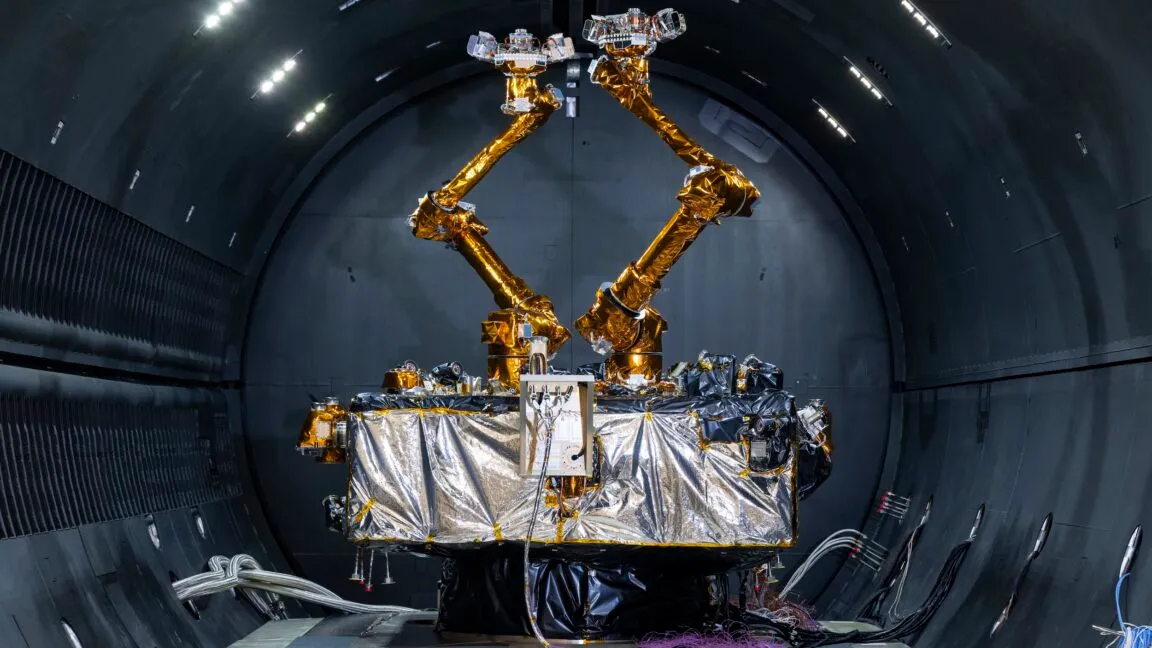
Northrop Grumman’s Mission Robotic Vehicle (MRV) launched Tuesday on a SpaceX Falcon 9 and is now en route to geosynchronous orbit as part of a planned decade-long satellite servicing mission. For decision-makers, this is a credible step toward extending the operational life of communications and defense satellites, potentially reshaping how long assets stay “in use.”
A spacecraft designed for on-orbit repairs and maintenance just got real: Northrop Grumman’s Mission Robotic Vehicle, or MRV, launched Tuesday on a SpaceX Falcon 9 and is now heading to geosynchronous orbit for a planned decade-long satellite servicing mission. The mission is explicitly about doing things that are hard, and it is hard in a very specific way. Instead of just delivering a satellite and walking away, MRV brings flexible robotic arms and a set of attached “servicing companions” to carry out operations in the same orbital neighborhood where many of the world’s communications and surveillance assets live.
This launch matters because MRV and its Mission Extension Pods are not headed to some distant, experimental corner of space. They will maneuver into a circular orbit more than 22,000 miles (nearly 36,000 kilometers) over the equator, then travel in lockstep with Earth’s rotation. In plain English: they will sit in the geosynchronous region where numerous civilian and military communications satellites, missile warning platforms, and spy satellites already operate, making the mission relevant to the most valuable “keep it working” problem in satellite operations.
The hardware arriving in that region is split into four payloads deployed by Falcon 9 within about an hour of liftoff. MRV, owned and built by Northrop Grumman, is the main platform fitted with two flexible robotic arms. Those arms are paired with three Mission Extension Pods, abbreviated as MEPs, which the mission design treats as independent spacecraft by giving each of them its own propulsion. Ars Technica’s description is clear that these three small propulsion pods are standalone spacecraft, not just passive add-ons. That distinction matters because standalone propulsion implies they can be maneuvered and operated as their own orbital assets while still working toward the mission’s shared objective.
Notably, the mission does not become “operational” immediately after launch. It will take about a year for the satellites to maneuver from their initial elliptical drop-off orbit into the targeted circular orbit. That one-year period is when the operational math gets tested. Getting from an initial elliptical deployment to the precise kind of geosynchronous regime described in the source requires disciplined orbital planning and execution, and those are the moments where complex space architectures earn or lose credibility.
Once in the circular orbit over the equator, the MRV and the three MEPs will operate in the same kind of orbit as that existing portfolio of geosynchronous communications, missile warning, and spy satellites. The source frames this as “lockstep with Earth’s rotation,” which is the key phrase for executives who have to think in terms of service windows and lifecycle. If you are a satellite operator, your value proposition is often tied to how long a spacecraft can remain useful before fuel limits or other issues force replacement. A servicing mission that can operate alongside these assets in the same orbital plane is, at minimum, an approach to buying time.
This is also where regulatory and governance realities start to matter, even if the source does not list specific regulators or filing details. In geosynchronous orbit, operators have to coordinate around crowded operational regimes and long-lived assets. A decade-long mission that performs servicing activities in a shared orbital environment raises the practical question of how servicing activities are authorized, tracked, and constrained, and how responsibilities are divided between the servicing spacecraft and the client satellite. For boards, the decision is not just “can it work in space,” it is also “can it work in the real rulebook that governs orbital conduct.”
There is an economic second-order implication here too. Today, many satellites become replacements not because the mission ended, but because the spacecraft reaches operational limits. If MRV and MEP-like systems prove they can effectively extend or support satellites in the geosynchronous environment, the industry could move from a world where operators treat end-of-life as a hard stop, toward one where lifecycle management includes servicing as a planned feature. That changes procurement timing, contracting models, and potentially how investors underwrite long-term cash flows tied to asset uptime.
For peers looking at satellite operations, manufacturing, or space services, the strategic stakes are obvious: this launch is the start of a long-duration attempt to turn robotic servicing into something routine. The source makes the “we know about” part explicit by grounding the mission in a specific platform, owned and built by Northrop Grumman, launching Tuesday on a SpaceX Falcon 9, with deployment of four payloads within about an hour, followed by about a year of orbital maneuvering into a circular orbit more than 22,000 miles over the equator. If MRV meets its mission timeline, it will not just demonstrate a robot arm. It will challenge how the market thinks about keeping high-value satellites alive in GEO, for longer than planned.
This story's Key Insights and Take-aways are locked.
Create a free account to unlock Executive Actions for one credit.
Register to UnlockAlways free for Executives Club members. Join the Club
More in Technology

Google quietly links your phone number to every Android account on your SIM
Adding a SIM now ties your phone number to all Google accounts - and future accounts inherit it. Here's the security and privacy stakes.

Hijacker AI 'Skynet mode' runs 100,000 attack steps against exposed models
Symantec caught a criminal AI agent that borrows other models, steals data, and mines crypto; the only relief is no confirmed victims yet.

Nvidia's AI-financier shift faces its first big test as neoclouds stumble
A rout in neocloud stocks is forcing investors to weigh Nvidia's hidden exposure as both supplier and lender to the AI buildout.