
Penn State’s paint-on e-tattoos turn conductive ink into functional electrodes after drying
E-tattoos have struggled on curved or hairy skin. This new conductive ink aims to fix that by becoming the electrode itself.
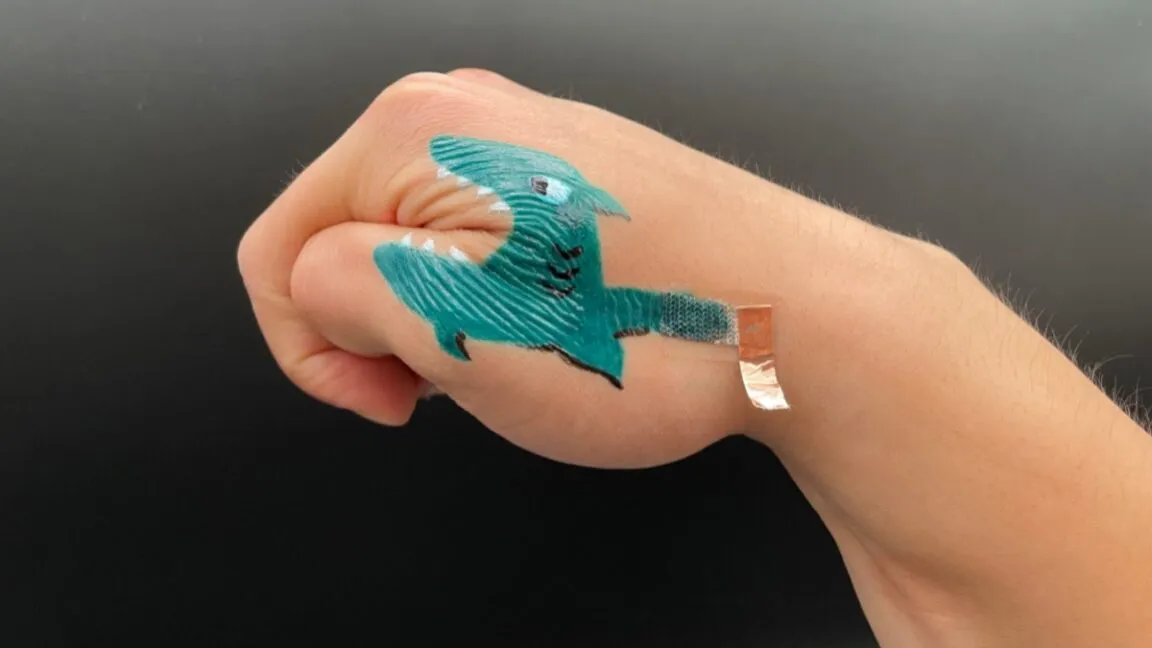
Researchers at Pennsylvania State University developed a conductive ink that can be painted onto skin in custom designs, then dries into working electrodes for biomonitoring. The approach could make wearable biosensors easier to deploy outside labs, where skin shape and real-world placement are the enemy.
Scientists at Pennsylvania State University have built a workaround for one of wearable biosensors’ most annoying problems: skin is not a flat circuit board. In a new paper published in the Proceedings of the National Academy of Sciences (PNAS), the team describes a conductive ink that can be painted directly onto the skin in colorful custom designs, then dries into a functional electrode for biomonitoring.
The key twist is that this is not just a “pretty display” layer. The ink is conductive, and after drying it functions as an electrode. That matters because the current generation of epidermal electronics, often marketed as temporary tattoo-style “e-tattoos,” have real advantages (no adhesives, nearly unnoticeable on the skin), but they also have well-known limitations, especially on curved and/or hairy surfaces. If your biosensor depends on a flat electrode geometry and perfect placement, the real world will absolutely ruin your day.
To understand why this is a big deal, it helps to zoom out on how e-tattoos typically work. These epidermal electronics attach via temporary tattoos, which means they connect to the skin without adhesives. That adhesive-free setup is part of the appeal. Ultra-thin polymer layers with embedded circuit elements can capture electrical measurements, and sometimes other measurements like temperature and strain. In practice, that means an e-tattoo can enable biosignals to be measured while staying thin and hard to notice, which is a better user experience than bulky wearable hardware.
But biology refuses to cooperate with product design. Biosignals are spatially distributed across the body, so electrode placement is not one-size-fits-all. Traditional e-tattoo workflows often require personalized electrode placement design to cover larger areas. And even when electrode placement is right, curved or hairy surfaces can degrade performance because electrodes do not always make consistent electrical contact where you want it. So researchers have been getting creative, and they are not alone. The field has spent years chasing the same goal: make sensing work reliably on messy skin in messy environments, not just on ideal, lab-controlled surfaces.
This is where the new paint-on conductive ink approach fits. By turning ink into an electrode after it dries, the system can potentially treat “electrode placement” more like an application step than an expensive, pre-designed patch problem. Custom designs painted directly onto the skin could allow the electrode geometry to adapt to the wearer, rather than forcing the wearer to adapt to the electrode. The source is specific about what the researchers demonstrated: conductive ink painted in custom designs, then dried into working electrodes for biomonitoring. That direct path from “applied material” to “electrical functionality” is the product-market bridge the field keeps trying to build.
There is also clear momentum behind the idea of conductive materials that work on difficult body locations. The source points to prior work from 2024, where researchers developed polymer-based conductive inks designed to be printed onto a person’s scalp to measure brain waves, even with hair. That earlier effort suggested a future where mobile EEG monitoring could happen outside a clinical setting. The business implication is straightforward: if you can sense brain activity, temperature, strain, and other signals without expensive clinical equipment and without fighting hair and curvature, you open up a broader market for consumer-adjacent health monitoring, remote care, and research-grade data collection.
Now add the new PNAS development to that trend. A conductive ink that becomes an electrode on skin could reduce friction in deployment, whether that means simplifying manufacturing, speeding application, or improving performance on the exact body surfaces where typical e-tattoos struggle. In regulatory terms, any move that makes biosensing more practical raises the stakes for clinical validity and safety, since wearable biomonitoring often touches regulated health territory depending on intended use. Even if the source does not specify regulatory status for this specific work, decision-makers should assume that making sensors easier to deploy will bring scrutiny from the same direction: accuracy, reliability, biocompatibility, and how the technology behaves across different skin types and conditions.
For executives, the second-order question is not “can it conduct?” It is “does this reduce the operational and deployment complexity enough to scale?” Wearables are as much a logistics and user experience business as a science business. If electrode placement design can be less personalized, and if performance can improve on curved or hairy surfaces, then adoption hurdles shrink. That is the strategic fork in the road for boards and investors watching epidermal electronics: the winners will be the ones who make sensing robust in real life, not just impressive on a bench.
And that is the stake embedded in this PNAS paper. E-tattoos have been around for more than a decade, but their limitations have constrained their impact. This new paint-on conductive ink strategy aims to rewrite the rules by making the skin application itself part of the electrode system. If it holds up as the technology matures, it could turn “hard-to-measure surfaces” into just another normal day, and that is how wearables finally escape the pilot-to-scale trap.
This story's Key Insights and Take-aways are locked.
Create a free account to unlock Executive Actions for one credit.
Register to UnlockAlways free for Executives Club members. Join the Club
More in Science
2026 Nikon Small World Winners Reveal the Hidden Machinery of Everyday Life
A mycologist's frozen Edinburgh garden became the backdrop for vivid views inside cells, a reminder of what advanced imaging now makes visible to researchers and the industries built on biology.
Study: 1 in 4 depression cases may be a body-clock problem, not a chemical one
A 10,000-person study finds standard antidepressants often fail these patients, but melatonin and morning sunlight may hit the real root cause.

Start-Up Says A.I. Designed a Virus to Attack One Patient's Superbug
If the claim holds up, personalized phage therapy could become a new frontline weapon against antibiotic resistance - but proof is far from final.