

PLATON replaces millions of detectors with one light block, rebuilding particle tracks in 3D
A light-field camera, photon sensors, and AI could match top detectors and scale faster, with potential impact on PET scans.
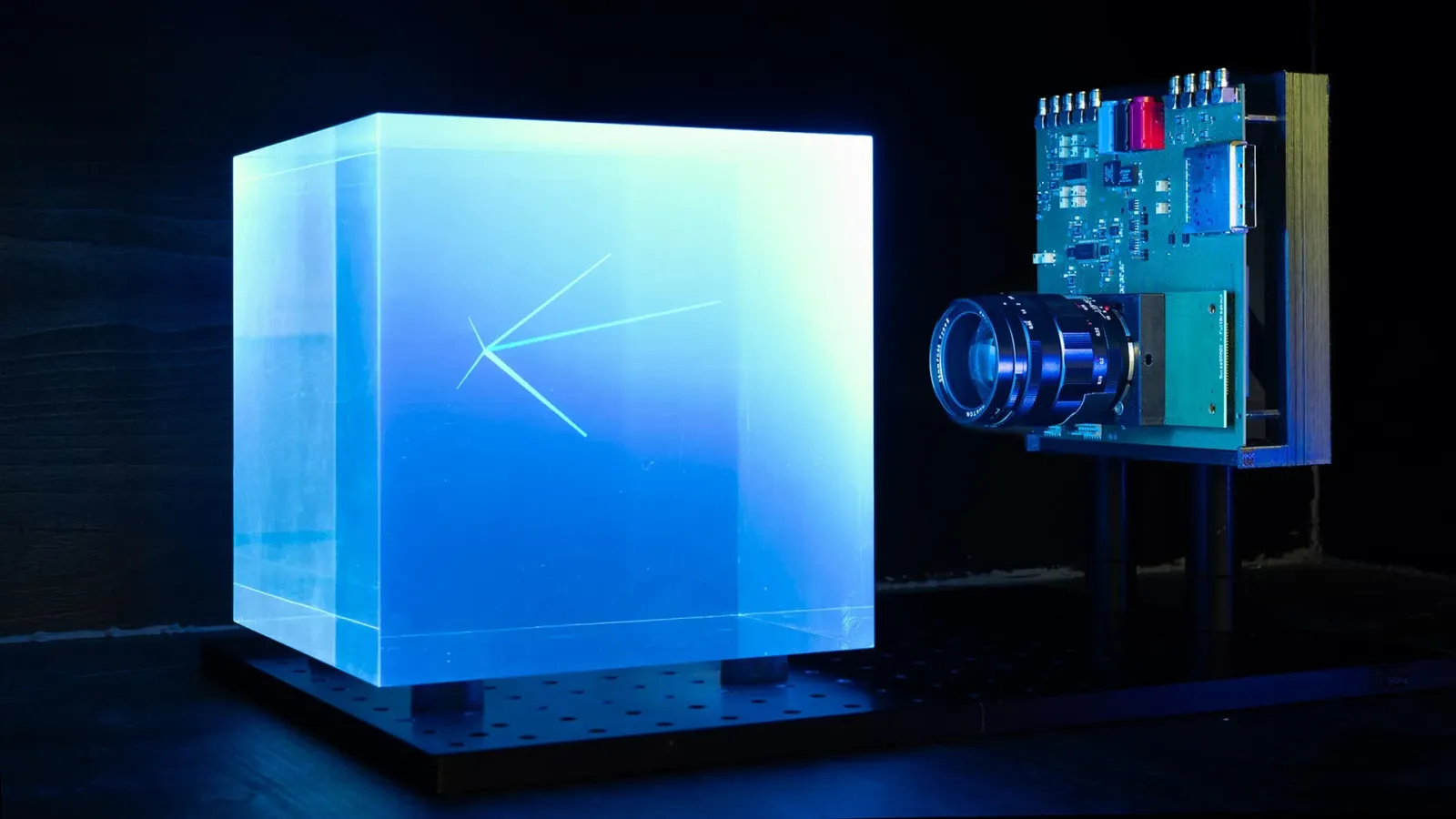
Scientists built PLATON, a new particle detector that uses a single block of light-producing material instead of millions of tiny detector components. It reconstructs particle paths in fast, detailed 3D using a light-field camera, highly sensitive photon sensors, and AI, with simulations suggesting performance that could match or surpass today’s best detectors.
A new particle detector called PLATON could replace millions of tiny detector components with a single block of light-producing material. Instead of treating every small sensor element like a separate job, PLATON tries to do the whole task with one consolidated light-emitting material plus smart optics, sensitive photon sensors, and AI reconstruction. The payoff, at least in simulations, is a detector that can rebuild particle paths in fast, detailed 3D.
Here is the core mechanism: PLATON uses a light-field camera alongside highly sensitive photon sensors to capture the light signals produced by particle interactions, then relies on AI to reconstruct the trajectories in three dimensions. The team’s simulations suggest PLATON could match or surpass today’s best detectors. And because it can be made as a simpler block of material rather than an assembly of millions of components, the approach may be far easier to scale.
Why executives should care is not just “cool physics.” Particle detectors sit behind a lot of research and applied systems, which means detector performance and scalability directly affect project timelines, cost, and the ability to expand capabilities. When a design requires millions of tiny components, scaling is rarely a smooth linear problem. It becomes a manufacturing and integration challenge: more parts mean more failure modes, harder calibration, and more complexity when you want to deploy at scale. PLATON’s pitch, using one light-producing material block instead of millions of detector components, targets exactly those practical bottlenecks.
The technology stack matters too. A light-field camera is essentially a way to capture how light propagates through space, giving richer information than a basic snapshot. Pair that with highly sensitive photon sensors, and you have the raw data needed to infer what the particle did. Then AI fills in the reconstruction gaps, turning patterns in sensor readouts into 3D tracks. If this performs as simulations suggest, the innovation shifts the heavy lifting away from brute-force hardware replication and toward better sensing plus computation.
There is also a business angle in the “match or surpass” claim. In detector land, top performance is usually expensive and difficult to reproduce. If PLATON really can keep pace with today’s best detectors while reducing complexity, it changes the economics of future systems. Even without a stated timeline in the source, the direction is clear: easier scaling could mean faster iteration cycles, more feasible upgrades, and potentially broader adoption of particle tracking in settings that cannot justify the overhead of highly component-heavy detectors.
One more reason this could ripple beyond laboratories: medical imaging. The source notes that the technology may lead to sharper PET medical scans. PET, or positron emission tomography, relies on detecting signals produced by positron annihilation events, then reconstructing where those events occurred. Better 3D reconstruction from particle tracks is the kind of improvement that can translate into higher image resolution, potentially sharper scans. For decision-makers in healthtech and research hospitals, the prospect is less about replacing everything overnight and more about offering a path to incremental improvements in scan quality and diagnostic clarity.
For boards and investment committees, the strategic stakes are straightforward. PLATON represents a detector architecture that could reduce component count, shift complexity toward software and sensing, and potentially improve both research performance and medical imaging outcomes. If the simulation-backed promise holds up in real-world deployments, the competitive landscape for particle detection hardware could look different. The people who fund accelerators, detector development programs, and imaging innovation will want to understand whether this block-of-light approach can deliver consistent, scalable performance. Because if it can, it is not just a new camera or a new algorithm. It is a different way to build the instruments that measure the invisible.
This story's Key Insights and Take-aways are locked.
Create a free account to unlock Executive Actions for one credit.
Register to UnlockAlways free for Executives Club members. Join the Club
More in Science

2026 Nikon Small World Winners Reveal the Hidden Machinery of Everyday Life
A mycologist's frozen Edinburgh garden became the backdrop for vivid views inside cells, a reminder of what advanced imaging now makes visible to researchers and the industries built on biology.

Study: 1 in 4 depression cases may be a body-clock problem, not a chemical one
A 10,000-person study finds standard antidepressants often fail these patients, but melatonin and morning sunlight may hit the real root cause.

Start-Up Says A.I. Designed a Virus to Attack One Patient's Superbug
If the claim holds up, personalized phage therapy could become a new frontline weapon against antibiotic resistance - but proof is far from final.