
Project Poltergeist used a 10-ton detector to catch neutrinos near Savannah River’s reactor
A 70-year-old chase for an almost undetectable particle demanded industrial-scale hardware, and it still shapes today’s neutrino playbooks.
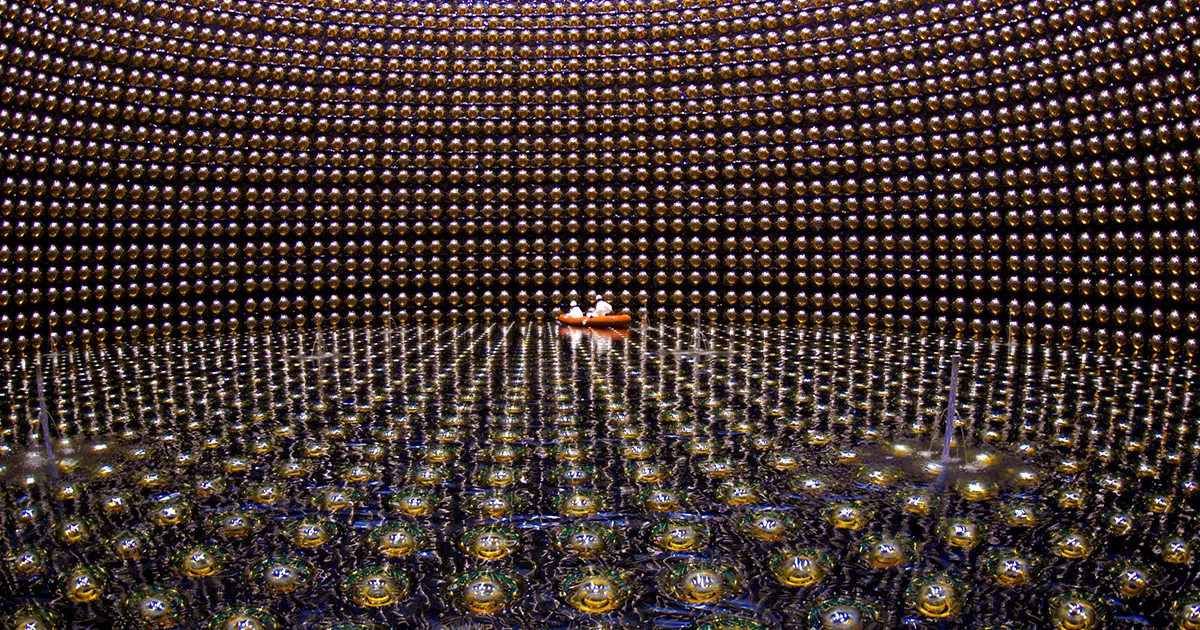
Clyde Cowan and Frederick Reines built a custom 10-ton neutrino detector in what they called Project Poltergeist, placing it near a powerful nuclear reactor at the Savannah River Plant in South Carolina. For decision-makers, the experiment is a reminder that neutrino breakthroughs are capital, construction, and risk-management stories as much as science stories.
Seventy years ago, Clyde Cowan and Frederick Reines did something that sounds almost cartoonish, until you remember the target. They built a custom 10-ton detector, wrapped it in thick lead walls and wet sandbags, and stationed it near a powerful nuclear reactor at the Savannah River Plant in South Carolina. They called the effort “Project Poltergeist,” and the goal was to catch a ghost: the elusive neutrino. The punchline is simple. This particle is so hard to observe that the experiment had to be designed around one brutal constraint, shielding and background control at an industrial scale.
That 10-ton detector was not an upgrade or a minor iteration. It was the entire point of the setup. The surrounding lead and wet sandbags were meant to protect the detector from other signals that could drown out neutrinos, because any experiment trying to “track and trap” something that rarely interacts has one enemy more than anything else: noise that looks like the thing you want. In other words, the hardware was the filter, and the reactor was the source. Cowan and Reines placed “Project Poltergeist” where the neutrino flux would be highest, then engineered the environment so the remaining events could be interpreted as neutrino interactions.
If you zoom out, neutrino hunting has always been shaped by incentives that are familiar to anyone who runs a company, governs a lab, or allocates risk. The “product” is not a consumer device with a clear market pull. It is evidence. Evidence that has to survive skepticism from the broader community, because extraordinary claims require extraordinarily clean signals. That is why the experiment read like a defensive fortress. Thick shielding and heavy buffering are effectively the scientific equivalent of tightening access controls in a high-security system. You are not making the target more cooperative. You are making the world around the detector less confusing.
There is also an infrastructure logic here that modern executives will recognize. The experiment depended on a major industrial asset, the nuclear reactor at the Savannah River Plant. That matters because neutrino work is rarely done in isolation. It typically lives at the intersection of scientific ambition and facility availability, where timing, access, and operational constraints are negotiated. In today’s terms, you can think of it like a “co-location strategy,” except the co-located partner is a power-producing reactor, and the integration challenge is radiation environment management and experimental timing. The second-order effect is organizational. Projects like this force scientists, engineers, and facility operators to behave like a single delivery team, because the detector does not function on a lab bench timeline.
From a regulatory framing perspective, using a nuclear reactor as an experimental partner adds layers of oversight and compliance that are not optional. The original description already anchors the setting in South Carolina, at the Savannah River Plant, and it places the detector in that operational context. Even if the source excerpt does not spell out the compliance mechanics, the implication is clear: anyone leading or funding neutrino experiments has to plan for safety, licensing, and operational boundaries alongside the physics schedule. That is part of the cost structure and part of the governance structure. It is also why projects in this space tend to be long-cycle. The “build the evidence” timeline is constrained by external rules and external facilities, not just internal enthusiasm.
The “Project Poltergeist” name is a reminder that the scientific goal was not metaphor. Neutrinos were being treated like an elusive signal buried in a haystack of other interactions. When you build a system that heavy, you are making a bet that your background rejection strategy will hold up in the real world, not just on paper. The lead walls and wet sandbags suggest the experiment’s philosophy: isolate, protect, and observe long enough to let the faint pattern emerge. For modern leaders, that translates into a broader governance lesson. When success depends on detecting extremely rare events, the relevant KPIs are not only output metrics like “data collected,” but also quality metrics like “how confident are we the detector is seeing the intended phenomenon.”
Finally, consider why this 70-year-old origin story still matters to decision-makers today. Neutrino research still requires ambitious detector engineering, large-scale shielding, and facility-dependent operations, which means boards and executive teams face the same strategic questions: How do we fund infrastructure-heavy bets? How do we manage safety and compliance risk without choking progress? And how do we align stakeholders when the “return” is credibility and discovery rather than a near-term product launch? In that sense, Cowan and Reines did more than hunt a ghost. They modeled how to build, defend, and execute a long-shot measurement that other people will only believe after it survives hard reality.
This story's Key Insights and Take-aways are locked.
Create a free account to unlock Executive Actions for one credit.
Register to UnlockAlways free for Executives Club members. Join the Club
More in Science
2026 Nikon Small World Winners Reveal the Hidden Machinery of Everyday Life
A mycologist's frozen Edinburgh garden became the backdrop for vivid views inside cells, a reminder of what advanced imaging now makes visible to researchers and the industries built on biology.

Study: 1 in 4 depression cases may be a body-clock problem, not a chemical one
A 10,000-person study finds standard antidepressants often fail these patients, but melatonin and morning sunlight may hit the real root cause.

Start-Up Says A.I. Designed a Virus to Attack One Patient's Superbug
If the claim holds up, personalized phage therapy could become a new frontline weapon against antibiotic resistance - but proof is far from final.