
Psyche mission made Mars a thin crescent, then overfilled its view (May 2-15, 2026).
NASA’s Psyche stitched a real-time Mars encounter into a time-lapse, turning approach optics into operational proof.
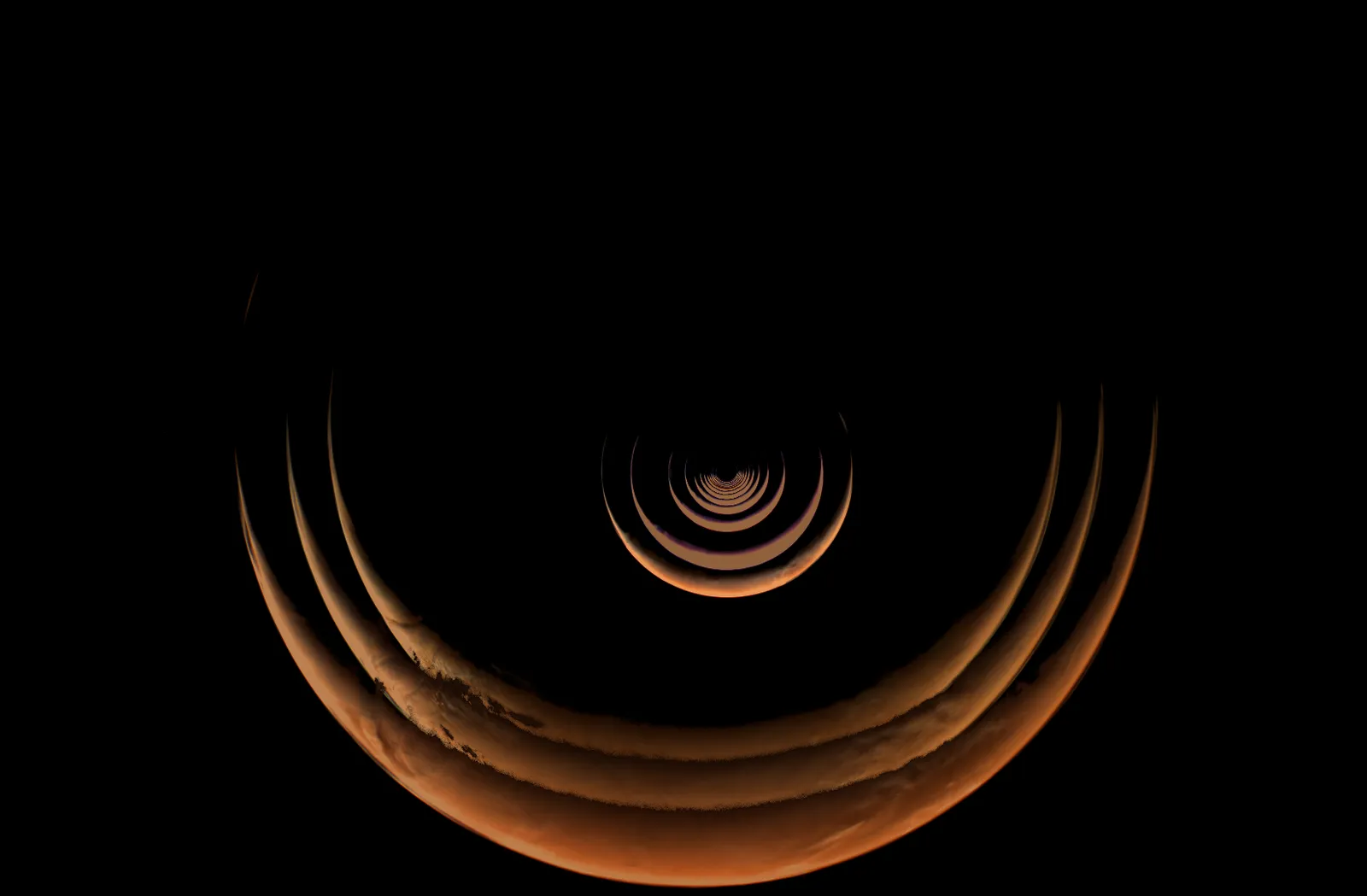
NASA’s Psyche mission captured a composite sequence showing Mars’ crescent growing as the spacecraft approached for a gravity assist from May 2 to May 15, 2026. The encounter provides decision-makers a clear, visual readout of instrument performance and encounter planning during close approach.
NASA’s Psyche mission has a new set of images that do something oddly valuable: they turn orbital mechanics into something you can actually see. In a composite taken during Psyche’s approach, Mars’ crescent steadily grows as the spacecraft closes in for a gravity assist scheduled from May 2 to May 15, 2026.
Here is the key operational moment the sequence reveals. The series starts with the smallest crescent at the center of the image when Mars is farthest from the spacecraft, then progressively expands as Psyche gets closer. And once those views were captured by the spacecraft’s multispectral imager instrument, Mars began to overfill the field of view as Psyche made close approach, prompting a run of high-resolution surface images.
For anyone who funds space missions, runs them, or governs them, this is more than pretty imagery. Psyche is using approach geometry to manage what instruments can see, and then it transitions those limits into an advantage at the moment that matters. The source describes that Psyche approached Mars from a high phase angle, which is why the planet appeared as a thin crescent in the days leading up to close approach, lit by sunlight reflecting off its surface.
That detail matters because “high phase angle” is basically an optics story. It affects how much of the illuminated surface is visible, and it shapes the brightness and contrast patterns that imagers use for navigation and science. As the spacecraft nears, the view changes not because the mission team changed the universe, but because the relative geometry changed. The image sequence is effectively a visual log of that geometry shift, culminating in close approach when Mars becomes so large in the frame that it no longer fits neatly in the instrument’s field of view.
Then the sequence hits the second operational milestone: the instrument still delivers. After the approach views, Mars overfilled the field of view as Psyche made close approach, and Psyche captured a series of high-resolution images of the surface. That is the transition most mission teams live for. You do not just want “a view,” you want the right view at the right time, with enough resolution to support the mission objectives while the spacecraft is executing a gravity assist and navigating tightly around a target planet.
NASA says that using these views of the approach, close approach, and departure, the Psyche team compiled a time-lapse of its entire Mars encounter. That end-to-end timeline matters because it lets engineers and analysts compare what they expected to happen with what actually happened, across the phases of the encounter. Even if you never see the raw engineering telemetry, the composite gives a straightforward confirmation that the encounter unfolded in the planned arc: approach geometry, close approach imaging, then departure.
Second-order implications are where executive attention tends to land. Boards and senior leadership in space and deep tech are increasingly judged on execution risk, not just ambition. This kind of imagery acts like an “earned trust artifact.” It is not a regulatory document, but it is tangible evidence that planning assumptions about encounter timing, instrument behavior, and observational conditions held up long enough to produce both approach context and high-resolution close approach data.
And there is a timing stake that should resonate beyond space. The date window is specific: May 2 to May 15, 2026. In regulated, capital-intensive environments, schedule drift can cascade into budget pressure, procurement timing changes, or rework. Here, the source describes a clean approach-to-close-approach sequence captured over that defined interval, which is exactly what decision-makers want to see when missions are juggling risk, performance, and optics.
If you are a founder, investor, or operator in adjacent sectors, the lesson is portable. Instrument limitations are not automatically failures. If you design for them, you can turn them into an operational transition, like “overfill the field of view” becoming “move into high-resolution imaging when the target is large enough.” For the Psyche team, the strategic stake is clear: get the encounter right, capture usable data across phases, and leave the planet on schedule, supported by evidence you can compile into a complete time-lapse of the whole Mars moment.
For more information about NASA’s Psyche mission, NASA points readers to https://science.nasa.gov/mission/psyche/.
This story's Key Insights and Take-aways are locked.
Create a free account to unlock Executive Actions for one credit.
Register to UnlockAlways free for Executives Club members. Join the Club
More in Science
2026 Nikon Small World Winners Reveal the Hidden Machinery of Everyday Life
A mycologist's frozen Edinburgh garden became the backdrop for vivid views inside cells, a reminder of what advanced imaging now makes visible to researchers and the industries built on biology.

Study: 1 in 4 depression cases may be a body-clock problem, not a chemical one
A 10,000-person study finds standard antidepressants often fail these patients, but melatonin and morning sunlight may hit the real root cause.

Start-Up Says A.I. Designed a Virus to Attack One Patient's Superbug
If the claim holds up, personalized phage therapy could become a new frontline weapon against antibiotic resistance - but proof is far from final.