

Robert Downey Jr as Doctor Doom is a make-or-break bet on the MCU’s next era
Marvel’s Doom casting could be genius or a costly nostalgia move, and the Doom we get will decide the tone.
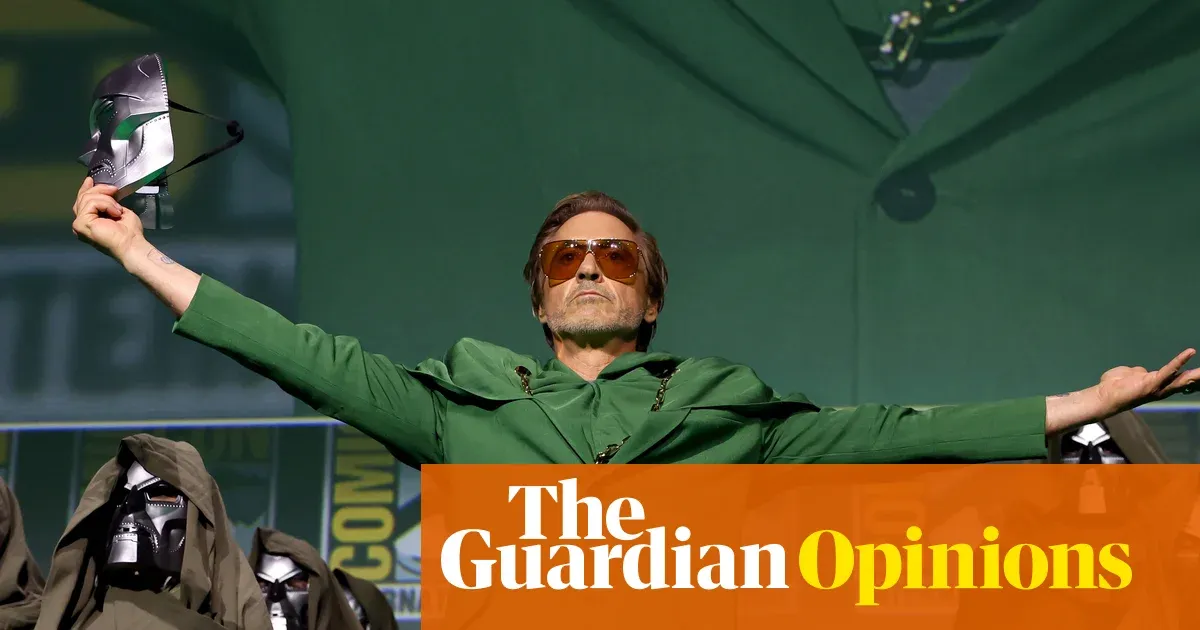
The Guardian frames Doctor Doom as Marvel’s next franchise hinge, especially after the post-Thanos masterplan reportedly collapsed when Jonathan Majors, who played Kang, was dropped. The casting of Robert Downey Jr, previously Marvel’s Iron Man, in the role creates a high-stakes question for decision-makers: is Doom the next iconic villain, or watered-down Tony Stark reborn?
Doctor Doom is supposed to be everything. The hooded supervillain is a scientist, a sorcerer, a monarch, and, in the phrasing The Guardian uses, a “mummy’s boy.” That mix matters because it is the point. Doom, as a character, is meant to radiate history, magic, and the kind of ego that can fill a room before he even speaks. The problem is that the MCU only gets one shot at making its next big villain stick, and right now nobody knows which Doom Marvel is building.
That uncertainty is now centered on Robert Downey Jr. The Guardian notes that Doom’s arrival in the forthcoming Avengers: Doomsday depends on Marvel’s original post-Thanos masterplan, and that plan did not survive contact with reality. According to the source, Doom was not something we would be getting if Marvel’s masterplan had not collapsed when Jonathan Majors, who played Kang, was dropped from the franchise. In other words, Doom is not just “next.” Doom is a pivot. And pivots, especially when you involve a character as iconic as Doom, create an uncomfortable decision question: does the audience get a full-bodied evolution of the universe, or a safer bridge built from memory?
The Guardian points directly at the fear that is lurking behind all this: no one wants a “watered-down Tony Stark” version of Doom. That is a very specific anxiety, and it is easy to see why. Downey Jr is not just any actor. He previously starred as Marvel’s Iron Man, which means his screen history is attached to a particular brand of charisma, tech swagger, and personal myth. If this casting works, it can also look like Marvel is deliberately bending Doom toward something familiar. If it fails, the franchise risks turning Doom into an imitation, not a conquest.
So what does “making Doom work” actually demand? The Guardian lays out the two main paths the geekosphere is scanning for. One possibility is a flamboyant, comics-accurate take on the Latverian dictator, which would keep Doom’s identity intact, rich with power, theatrics, and the historical weight associated with his rule. The other possibility, implied by the Tony Stark comparison, is that Marvel dips into the “multiverse of convenience” and delivers an iteration that is “little more than Tony Stark in eastern Europe.” That phrase may sound dramatic, but it captures a real entertainment risk: when a studio uses multiverse mechanics as a smoothing tool, audiences can feel the creative math has been optimized for comfort rather than character specificity.
This is where business incentives and corporate dynamics start to matter, even if the story is about villains. After a major masterplan collapses, the replacement has to do more than entertain. It has to protect the franchise’s momentum and keep investor confidence from turning into “pause and reassess.” In film and streaming ecosystems, where long-running universes are built on scheduled payoffs, delay or tonal drift can be expensive. A pivot is not automatically bad, but it raises the cost of getting the next installment “right enough” rather than “right.” In that environment, casting decisions become a kind of risk hedging. Bringing back a recognizable superstar with proven box-office and franchise chemistry can stabilize near-term expectations. The Guardian frames the counter-argument as equally real: that it could be an “expensive nostalgia panic button.”
There is also the question of what Doom signals to the MCU’s creative pipeline. Doom should not just be another enemy. He should reshape the playing field, pulling the universe toward larger stakes, darker magic, and politics, not just more battles. The Guardian’s description of Doom as scientist, sorcerer, monarch, and “mummy’s boy” is doing heavy lifting. Each label points to different narrative ingredients. A scientist portion suggests rational menace and inventions. A sorcerer portion suggests supernatural rules and intimidation that tech cannot fix. A monarch portion suggests power through governance and statecraft. The mummy’s boy angle suggests personal baggage and psychological control. If Marvel leans too far on any one facet, the character can feel incomplete, like a costume stitched from recognizable parts.
Even without any regulatory story in the source, the broader second-order implication for decision-makers is the same as any high-profile corporate bet: reputation and continuity risk. In entertainment, the “regulator” is the audience, and they enforce standards through churn, backlash, and reduced tolerance for visible shortcuts. If Doom ends up feeling like a reshuffled Iron Man rather than the Latverian dictator, the backlash is not just about taste. It becomes about trust. And trust is what keeps a universe’s long arcs from turning into episodic filler.
So the stake is not just whether Avengers: Doomsday will be fun. The stake is whether the MCU’s next era has a villain who can carry weight across storylines and subplots, rather than one who can only compete with his own predecessor’s shadow. The Guardian’s framing makes it clear that the audience is already trying to decode which Doom is coming by “delving into every possible clue, no matter how fleeting.” That level of attention is a sign of urgency. Marvel’s peers, too, should notice: when a franchise loses its original path, the replacement must either deliver a clean identity shift or risk being mistaken for a costly recycling of what already worked.
This story's Key Insights and Take-aways are locked.
Create a free account to unlock Executive Actions for one credit.
Register to UnlockAlways free for Executives Club members. Join the Club
More in Entertainment

Christopher Nolan’s “The Odyssey” posts his biggest Tuesday haul, surpassing “The Dark Knight’s” record
The film’s Tuesday breakout reframes Nolan’s box-office ceiling and forces competitors to rethink timing, budgets, and release strategy.

Kacey Musgraves cancels Aug. 20, 29, Sept. 2 Middle of Nowhere shows
Ticketmaster emails are telling fans refunds are coming, while the tour still starts Aug. 21 in Chicago.

Billie Joe Armstrong launches Epiphone Les Paul Junior and Marshall 1959BJA signature gear
Two limited releases turn decades of Green Day’s tone into branded hardware, including Marshall’s first artist amp in 14 years.