
Robert Downey Jr’s Doom risks becoming Tony Stark again in Avengers: Doomsday
Marvel’s Doom casting could either unlock comics-grade history and magic or trigger a Tony Stark-shaped sequel problem.
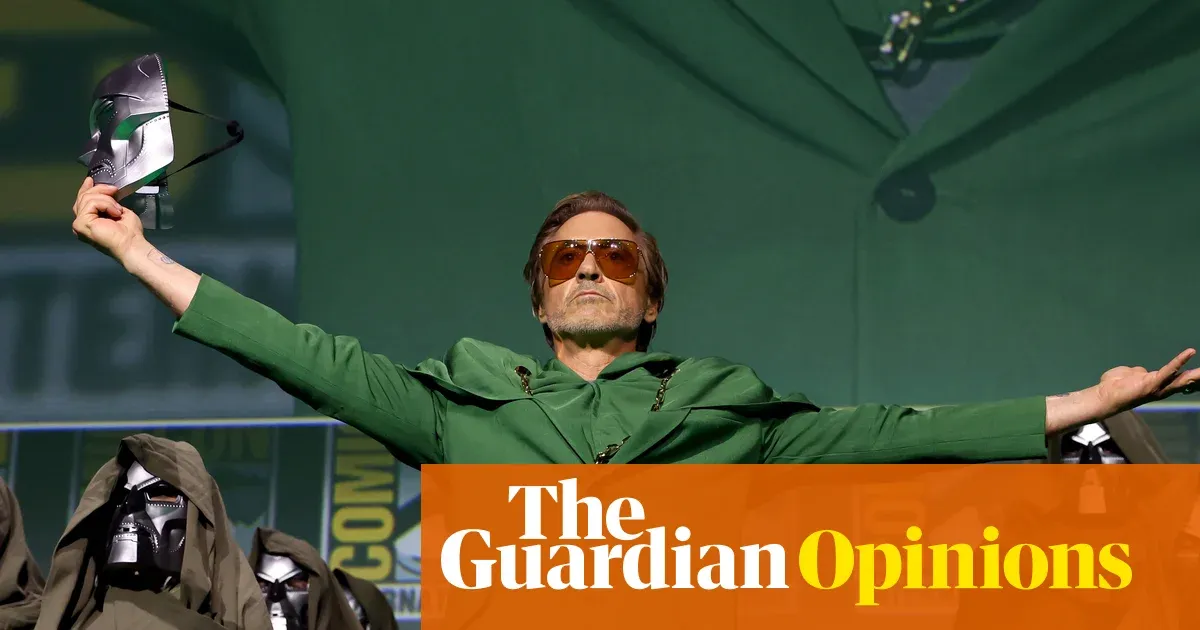
The Guardian frames Marvel’s Doctor Doom shift, ahead of Avengers: Doomsday, around Robert Downey Jr playing Doom after the prior post-Thanos plan collapsed when Jonathan Majors (Kang) was dropped. The consequence for decision-makers is clear: the MCU’s next franchise pivot lives or dies on whether Doom lands as a distinct villain or a nostalgia remix.
Doctor Doom was supposed to be the next big, nasty idea for the MCU. But the new reality, as The Guardian lays it out, is that nobody can say with confidence whether Doom will look like Marvel’s version of Darth Vader or just a disguised rerun of Tony Stark. And that uncertainty is not academic. It goes straight to whether Avengers: Doomsday becomes a decisive sequel-era reckoning or a watered-down, “we need the old magic back” detour.
The core tension is front and center: Robert Downey Jr, previously Marvel’s Iron Man, is now cast as Doom, and The Guardian describes that decision as potentially either an “ingenious masterstroke” that will make sense when the finished film arrives, or an “expensive nostalgia panic button.” In other words, the same actor linked to the MCU’s biggest modern icon is also the bet for its next era’s signature villain. If Doom ends up reading as an ego-forward Stark variant set in eastern Europe, the franchise risks losing the very difference it needs at this moment.
The stakes get even higher because Doom was not the plan that always happened. The Guardian says we wouldn’t even be getting Doom in the forthcoming Avengers: Doomsday if Marvel’s original post-Thanos masterplan had not collapsed when Jonathan Majors, who played Kang, was dropped from the franchise. That detail matters because it reframes Doom from a long-designed narrative endpoint into a pivot. When a studio’s roadmap fractures like that, every subsequent casting becomes more than a creative choice. It becomes a risk-management choice, with all the power and all the fear that implies.
So, what version of Doom are we actually going to see? The Guardian highlights the “geekosphere” digging through every clue, no matter how fleeting, trying to determine whether this will be a flamboyant, comics-accurate take on the Latverian dictator. Or whether Marvel will use the multiverse of convenience to deliver an iteration that is, in practice, little more than Tony Stark in a new costume. This is an unusually pointed dilemma for an MCU that built its audience on continuity and internal logic. If the villain is too close to the hero, the story can start to feel like the same machine, just running different settings.
The Guardian also pins Doom’s ideal identity to a specific creative checklist: he is a scientist, a sorcerer, a monarch, and “a mummy’s boy,” meaning he should radiate history, magic, and the “biggest ego.” That list is doing work. It implies Doom is not just a threat, he is an ecosystem of traits. A “make-or-break” Doom is the one that can carry all those dimensions without flattening into a single note. If Doom loses that multi-lens complexity, the MCU doesn’t just get a weaker villain. It loses the chance to establish a new archetype for its next franchise stage.
There is also an implicit business subtext in all this uncertainty. When a franchise retools after a dropped star, it typically leans into recognizable anchors. Casting Robert Downey Jr could plausibly function as an anchor. But anchors come with a curse: audiences may demand that the anchor behaves like the anchor they already love. The Guardian’s framing of the decision as either masterstroke or nostalgia panic button captures that dilemma precisely. In investor- and board-speak, it is a classic tradeoff between differentiated IP storytelling and short-term certainty.
And because the source emphasizes “no one really knows,” this is not a settled question about production. It is a question about how Marvel will manage narrative expectations under constrained conditions, after the Kang plan broke. In that context, the Doom casting becomes a strategic communications problem as much as a filmmaking problem. What the audience expects to see in Doom will collide with whatever Marvel chooses to deliver. If the collision is messy, the backlash is fast, loud, and sticky, especially in fandom spaces that parse meaning frame by frame.
For peers who run entertainment brands, this is the lesson: your next era is either a launch or a compromise. If Marvel gets Doom right, it can set up a villain that is unmistakably his own character, not a re-skinned variation of Tony Stark. If it gets Doom wrong, the second-order implication is bigger than one movie. It threatens to train audiences to treat future “event” casting as a familiarity engine rather than a story engine. Avengers: Doomsday, in The Guardian’s words, is therefore make-or-break not just for Doom, but for the MCU’s confidence that it can evolve beyond the last decade’s signature hero energy.
This story's Key Insights and Take-aways are locked.
Create a free account to unlock Executive Actions for one credit.
Register to UnlockAlways free for Executives Club members. Join the Club
More in Entertainment

June 5, 2026: Taylor Swift’s “I Knew It, I Knew You” breaks Spotify’s female country record
Swift’s Toy Story 5 tie-in hits Spotify with the most-streamed country-song-by-a-female milestone in a day.

Masters of the Universe reboot opens with a $55M weekend projection and big nostalgia risk
While Backrooms and Obsession keep the domestic box office hot, Masters of the Universe and Scary Movie reboot vie for the new weekend crown.

Scary Movie hits $56M opening while Masters of the Universe faces a $30M flop
A Miramax-financed spoof revival outruns an Amazon MGM tentpole with a $170M+ price tag, tightening summer risk math.