

Runway launches Media Router, betting developers will route crowded generative models
The move turns Runway from a model vendor into generative-media infrastructure, using Runway Dev to connect third-party APIs.
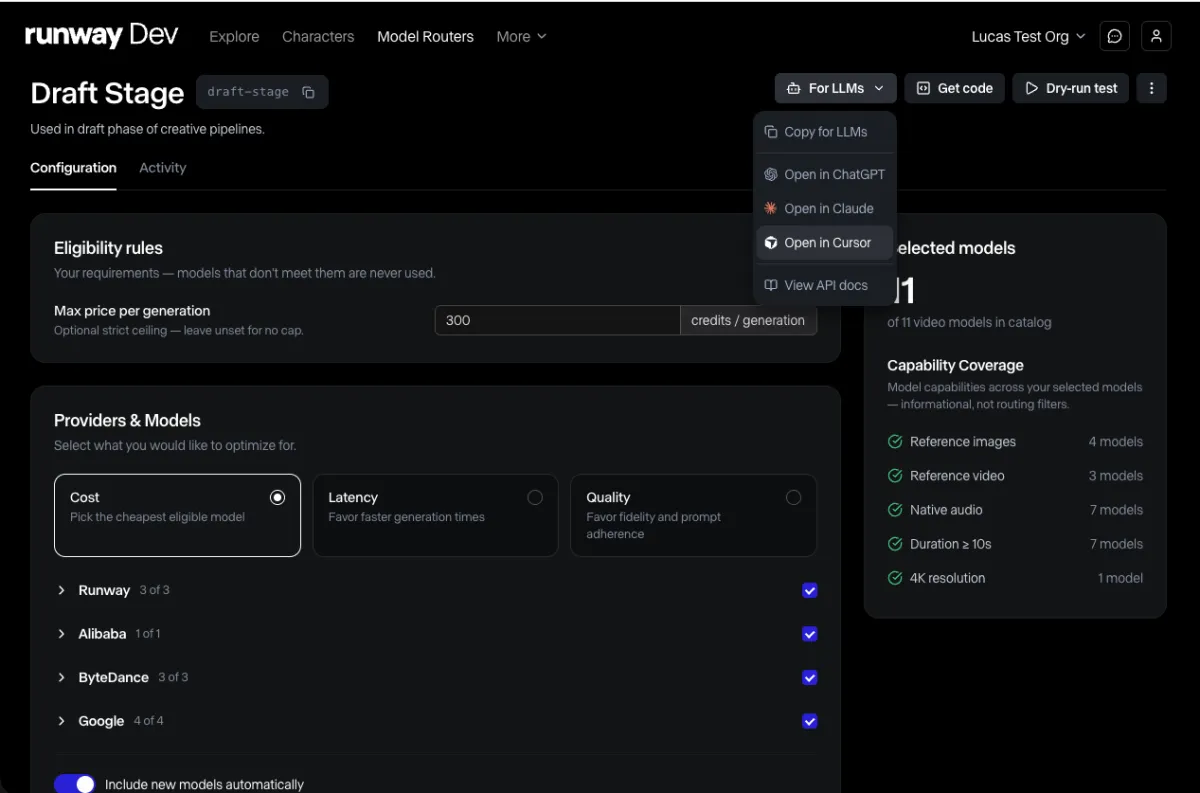
Runway launched Runway Media Router through Runway Dev, a developer platform released earlier this month, providing API access to a growing roster of third-party image, video, and audio models. For decision-makers, this reframes competition from raw model quality to orchestration, distribution, and developer lock-in.
Runway is done playing defense in the generative media gold rush. On Thursday, the startup launched Runway Media Router through Runway Dev, the developer platform it released earlier this month, and positioned it as the infrastructure layer for generative media, not just another AI model company.
The core product idea is simple and consequential: Media Router gives developers API access to a growing roster of third-party image, video, and audio models. In other words, Runway is trying to become the traffic cop for an ecosystem that is quickly turning into a crowded marketplace of models and capabilities. That matters because when there are more models than any single team can integrate, “which model is best” stops being the only question. “How do we plug them in fast, swap them out, and keep shipping” becomes the real operational advantage.
This is a classic infrastructure bet, and it comes at the right time. Generative media is getting crowded, which means developer workflows face a new kind of complexity. Teams are not just selecting algorithms, they are selecting versions, formats, safety constraints, and performance profiles, often across multiple model providers. A router model shifts value away from training every model in-house and toward managing the integration layer that sits above them. If it works, developers spend more time building product features and less time stitching together brittle, one-off model connections.
Runway’s stated framing is also important: it wants to be the infrastructure layer for generative media. That language is not accidental. Infrastructure companies gain leverage when they sit in the middle of a workflow, and in software, the middle often wins through adoption. Once developers build on Runway Dev and route requests through Media Router, switching away can become painful. The second-order effect is that distribution, not just model performance, can start to shape outcomes for everyone involved, from model providers to the startups trying to build user-facing apps.
There is also an ecosystem dynamic here. By providing API access to third-party image, video, and audio models, Runway is effectively creating a catalog plus a routing layer. That can help smaller model providers reach production developers without building their own full integration surface. But it also creates a new competitive battleground: model access terms, priority routing decisions, pricing strategy, and the long-term relationship between router platforms and the providers feeding them. If developers can get results through a single router interface, the router becomes a marketplace, whether Runway calls it that or not.
Regulation and risk management hover over all of this, even when the announcement does not spell them out. Generative media applications raise questions around content provenance, misuse, and the ability to detect or restrict certain outputs. In practice, enterprises and regulated teams care about how platforms support safety controls and auditability. A router layer can become the control plane for those requirements, because it is where requests are mediated and where policy enforcement can be standardized across many third-party models. Even if Runway is not claiming a specific compliance capability in the snippet we have, the architectural position is the kind that regulators and enterprise buyers tend to prefer, because it centralizes governance hooks.
Capital is chasing infrastructure plays for the same reason boards love them. They can create recurring developer usage, lower switching costs, and broaden the addressable market from “people who want our model” to “anyone building generative media who needs orchestration.” In that setting, the competitive question stops being whether Runway can train the best model, and starts being whether developers will prefer one routing interface over stitching together multiple providers directly.
For peers in the space, the stakes are straightforward: if Runway succeeds at becoming the integration layer, model companies face a choice. They can differentiate on performance alone, or they can invest in being the best fit for the router workflow, including documentation, reliability, and compatibility. Meanwhile, platforms and developer tooling teams should watch closely, because a router approach can accelerate adoption of new models, which in turn can make it harder for any single vendor to dominate purely by releasing the newest weights.
In the short term, Media Router is a product launch. In the long term, it is a strategic re-positioning. Runway is moving up the stack, away from being “just” a model provider and toward being the layer that developers build on when generative media gets too complicated to manage one integration at a time.
This story's Key Insights and Take-aways are locked.
Create a free account to unlock Executive Actions for one credit.
Register to UnlockAlways free for Executives Club members. Join the Club
More in Technology

Google quietly links your phone number to every Android account on your SIM
Adding a SIM now ties your phone number to all Google accounts - and future accounts inherit it. Here's the security and privacy stakes.

Hijacker AI 'Skynet mode' runs 100,000 attack steps against exposed models
Symantec caught a criminal AI agent that borrows other models, steals data, and mines crypto; the only relief is no confirmed victims yet.
Nvidia's AI-financier shift faces its first big test as neoclouds stumble
A rout in neocloud stocks is forcing investors to weigh Nvidia's hidden exposure as both supplier and lender to the AI buildout.