

Sound Waves Alone Power Tiny Motorless Robots That Fly and Steer
EPFL engineers repurpose a 19th-century acoustic effect to create sound-powered micro-bots, opening new paths for wireless drug delivery and micro-manipulation.
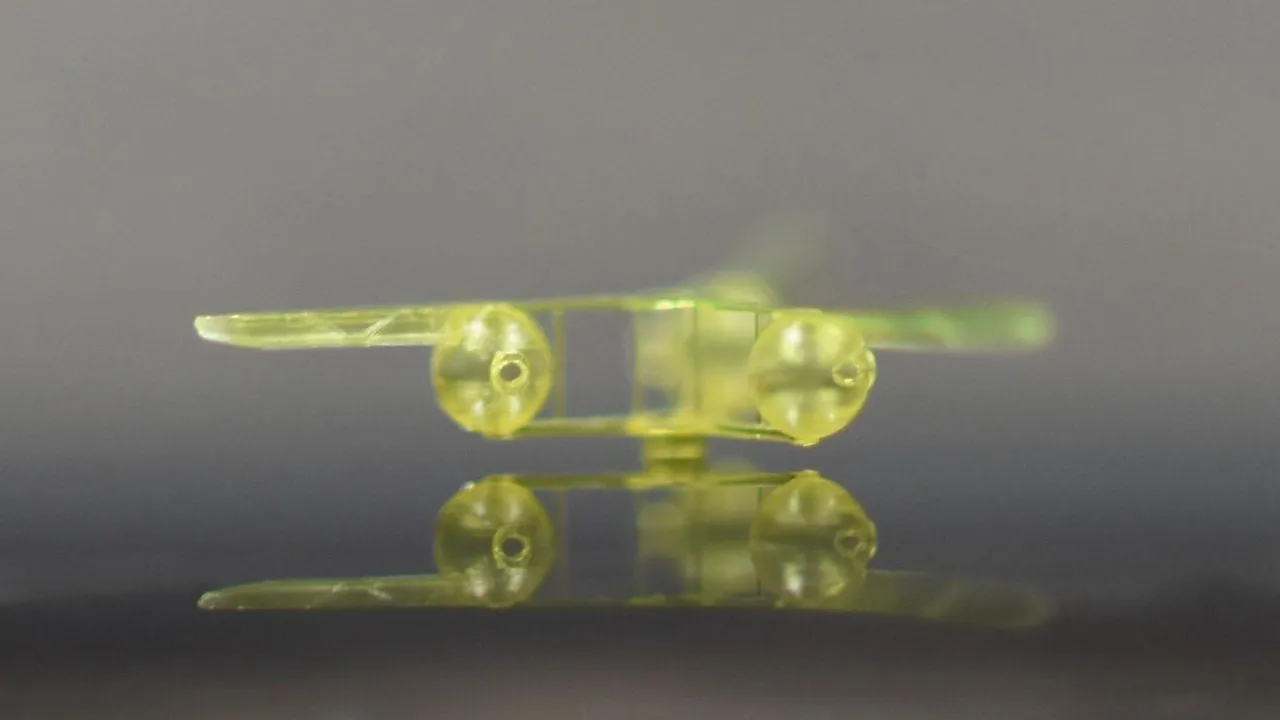
Engineers at EPFL, led by associate professor Selman Sakar, have built tiny robots that fly and steer using only sound waves, with no onboard motors. The breakthrough, published in Science Advances, offers a new paradigm for wireless micro-robotics in biomedical and industrial applications.
A team of engineers at EPFL, led by associate professor Selman Sakar, has demonstrated tiny robots that fly, steer, and even lift off using nothing but sound waves-no motors, no batteries, no moving parts. The research, published Aug. 12 in Science Advances, repurposes a 19th-century acoustic phenomenon known as Helmholtz resonance to generate thrust from precisely shaped cavities. This is not a marginal improvement; it is a fundamental shift in how micro-scale devices can be powered, one that could bypass the physical limits that have constrained conventional motors for decades.
The effect, first studied in 1856 by German physicist Hermann von Helmholtz while he was trying to tune musical instruments, occurs when air trapped in a cavity resonates at a specific frequency, producing a jet of air. By shrinking these resonators to millimeter and sub-millimeter scales and driving them with ultrasonic frequencies, the EPFL team generated enough thrust to propel small boats and even lift micro-fliers. The key insight: at these scales, the frequency needed shifts into the ultrasonic range, making the devices silent and more efficient. Larger versions would require audible sound loud enough to be both annoying and potentially harmful, but the miniaturized versions operate in a safe, inaudible band.
Conventional motors have a fundamental limit on miniaturization because they rely on physical components like magnets, coils, and shafts. As devices shrink, these parts become increasingly difficult to manufacture and power. Sound-based propulsion sidesteps those constraints entirely, offering a path to wireless, motorless robots that could operate inside the human body or in confined industrial spaces. The team built two types of micro-fliers: one that generates downward thrust like a rocket, and another that spins tiny blades like a helicopter. They also constructed small boats with multiple resonators tuned to different frequencies, allowing them to steer by changing the pitch of an external speaker. This directional control is crucial for real-world deployment, where precise navigation is required.
The biomedical potential is immediate and compelling. The researchers note that the same principle could eventually be used to manipulate small objects in midair without touching them, or to create soft, flexible surfaces that change shape on command when they 'hear' a particular frequency. That could lead to biomedical applications such as heart stents that expand or contract wirelessly, or targeted drug-delivery capsules that navigate through the body using acoustic signals. Unlike magnetic systems, which require strong external fields and often ferromagnetic materials, acoustic actuation is biocompatible and uses only simple external transducers-a significant advantage for implantable devices.
The micro-robotics market is projected to grow significantly over the next decade, driven by demand for minimally invasive surgery, targeted therapeutics, and micro-manufacturing. While current approaches often rely on magnetic fields or chemical propulsion, acoustic actuation offers a complementary tool that is biocompatible and requires only simple external transducers. However, challenges remain: the current devices are tethered to an external sound source, and scaling up to more complex tasks will require advances in control systems and navigation. The team's demonstration is a proof of concept, not a finished product, but it validates the underlying physics and opens a design space that others can now explore.
For executives in medical devices, robotics, and advanced manufacturing, this research signals a shift toward simpler, more robust actuation mechanisms at the microscale. Companies that invest early in acoustic actuation could gain a competitive edge in next-generation surgical tools or implantable devices. The fact that the technology is based on a well-understood physical principle also reduces technical risk, though engineering challenges around power delivery and precision control persist. The ability to steer with frequency changes suggests a new paradigm for multi-agent micro-robots controlled by a single sound source-a capability that could revolutionize how we think about coordinated micro-scale operations.
Sakar and his colleagues emphasize that this paper lays out the design principles, not the final product. Follow-up work will focus on more applied designs, control systems, and navigation. For now, the demonstration is a proof of concept that sound alone can move objects at the microscale-a capability that could reshape how we think about wireless robotics. The strategic stakes are clear: early movers who integrate acoustic actuation into their R&D pipelines could define the next generation of micro-robotic devices, while laggards risk being left behind as the technology matures.
This story's Key Insights and Take-aways are locked.
Create a free account to unlock Executive Actions for one credit.
Register to UnlockAlways free for Executives Club members. Join the Club
More in Science

2026 Nikon Small World Winners Reveal the Hidden Machinery of Everyday Life
A mycologist's frozen Edinburgh garden became the backdrop for vivid views inside cells, a reminder of what advanced imaging now makes visible to researchers and the industries built on biology.

Study: 1 in 4 depression cases may be a body-clock problem, not a chemical one
A 10,000-person study finds standard antidepressants often fail these patients, but melatonin and morning sunlight may hit the real root cause.

Start-Up Says A.I. Designed a Virus to Attack One Patient's Superbug
If the claim holds up, personalized phage therapy could become a new frontline weapon against antibiotic resistance - but proof is far from final.