
Spidey Tracker pings Spider-Man in outer space, and Avengers: Doomsday gets a Spider twist
The post-credits blip from Spider-Man: Brand New Day ties to multiverse incursions, Fantastic Four voyages, and even Secret Wars.
Spider-Man: Brand New Day ends with a Spidey Tracker post-credits scene that detects a new Spider-Man sighting and zooms out to show him somewhere beyond the moon. For decision-makers, it signals how Sony and Marvel are aligning Spider-Man’s next moves with the Avengers-era multiverse roadmap.
By the time the credits hit the “this is the last thing” moment in Spider-Man: Brand New Day, the movie has already trained you to look for the Spidey Tracker. In the post-credits scene, the app detects a new Spider-Man sighting and then zooms out to reveal that the newest Spidey appears somewhere in outer space beyond the moon. No actors. No live-action footage. Just a single data-style blip that raises one immediate question: is this a tease for Avengers: Doomsday, or a pivot into the next layer of Marvel’s multiverse machine?
To answer that, you have to start with what the Spidey Tracker is in-universe, and why the movie and the marketers took it so seriously. Ned Leeds (Jacob Batalon) develops the tracker to help locate Spider-Man using reported sightings. Ned’s motivation is personal, too: he wants to find Spider-Man and thank him for saving him so many times during high school, not fully realizing that Spidey’s constant presence (and the recurring danger) was tied to Peter Parker and Ned’s best-friend status. In the real world, Sony and Marvel leaned into the concept hard, using the Spidey Tracker in marketing, featuring it heavily in promos and giving it its own website at spideytracker.com. The story also borrows from Insomniac’s Spider-Man video games, where a similar Friendly Neighborhood Spider-Man app was developed in Spider-Man: Miles Morales by Miles’ friend Ganke Lee, a comic character that helped inspire the MCU version of Ned Leeds. So when the tracker reappears at the very end, it is not random. It is the movie’s chosen signal system.
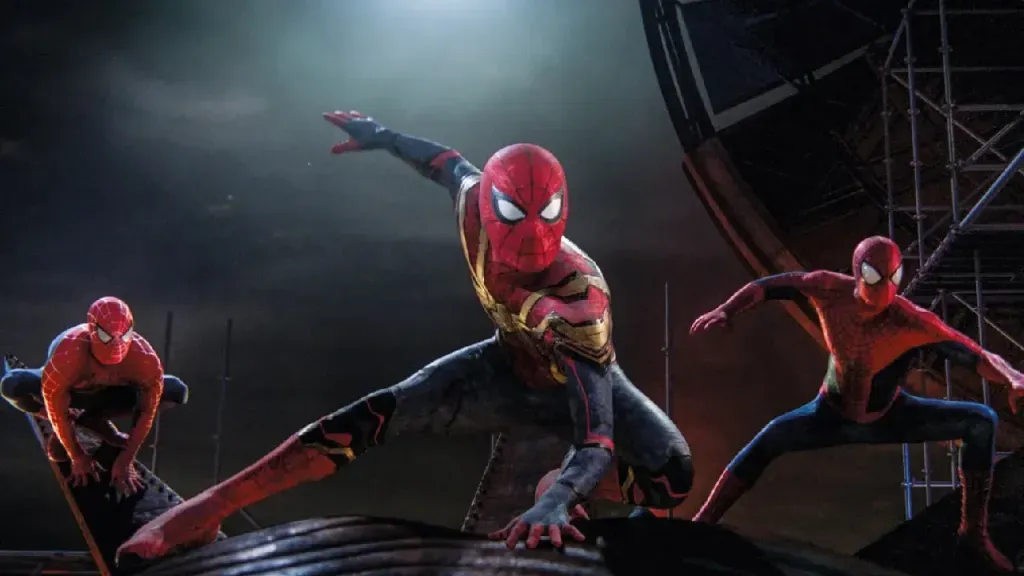
The first big theory is that this is how Earth-616 “goes into the Spider-Verse,” meaning the MCU is edging closer to the kind of multiverse boundary collapse that could be relevant to the Avengers: Doomsday universe. The reasoning leans on incursions, which Jonathan Hickman’s New Avengers comics connect to Secret Wars. Incursions are cosmic events where two universes cross over and threaten to crash, destroying life. In Hickman’s version, heroes are forced into a brutal choice: allow both Earths to crash (destroying both universes) or destroy one Earth to keep both universes alive. Applied to the Spidey Tracker blip, you could read the off-world appearance of another Spider-Man as evidence that boundaries between Earth-616 and some other multiverse point are eroding. The likeliest candidates to show up are Peter 2 (Tobey Maguire) and Peter 3 (Andrew Garfield), who both already visited the MCU in Spider-Man: No Way Home. But the multiverse has many Spideys that never made it into the MCU spotlight, including Miles Morales, Gwen Stacy (Ghost Spider), and Miguel O’Hara (Spider-Man 2099). If this is teasing a Spider-Man world being pulled into the broader MCU multiverse mix, it tracks with the Doomsday trailer’s hints that the MCU will cross over with Fox X-Men and Fantastic Four universes.
There is one complication, though. Incursion visuals in the MCU are not defined here, and the tracker’s location appears “pretty far out in space” for an incursion to be the clean explanation. That does not kill the theory, but it adds friction: without clear on-screen rules for what incursions look like in the MCU, you cannot fully confirm that “space-detected Spidey” equals “incursion doorway.” Still, for executives, the real takeaway is that the film is using an app-like plot device as a multiverse routing mechanism. It is a subtle way to tell audiences: when the tracker pings, the universe is doing something it was not doing an hour ago.
The second theory flips the logic from physics to logistics: if Spider-Man is heading to space, he might be hitching a ride with the Fantastic Four, who are seen entering Earth-616 on their rocket in the credits scene for Thunderbolts*. This theory has two readings. One: the Fantastic Four, after arriving on Earth-616, could return to space for a mission in Doomsday, and Holland’s Peter Parker could be the first Spider-Man connection audiences see in that phase of the story. Two: the Fantastic Four might arrive on Earth-616 already bringing another Spider-Man with them, presumably after another incursion event in that universe. Either way, the anchor is the idea that Doomsday and the Fantastic Four era are not separate tracks. They are a single logistical chain that can carry characters across worlds.
The third theory pulls the plug on Doomsday entirely and argues the post-credits scene is actually setting up Avengers: Secret Wars. In the comics, the original Secret Wars from the 1980s sent heroes to Battleworld, created by an all-powerful being named the Beyonder, and the event was designed to drive toy sales. In 2015, Hickman and Esad Ribić rebooted the concept as the conclusion to Hickman’s time on Avengers and New Avengers. In that reboot, Doctor Doom takes the power of the Beyonders to create a patchwork Battleworld made up of incursion points from various Earths, leaving the multiverse as a kind of mosaic of survivals. While most people lose memories of life before Battleworld, select heroes including Peter Parker and Miles Morales preserve their memories by boarding the ship known as the Life Raft, created by Reed Richards and T’Challa. Under this reading, Spider-Man showing up in outer space could mean he is appearing on Battleworld during Secret Wars-style story territory, not popping into Doomsday at random.
There is also a Sony Pictures angle that ties the tracker scene to Venom origins. 1984’s Secret Wars includes Venom in that story universe, and while the black costume is known to have debuted in The Amazing Spider-Man #252, that book takes place after Secret Wars despite being released earlier. In that continuity, Peter obtains the black costume on Battleworld, and later revelations connect it to an alien, which then feeds into Venom lore. The no-way-home post-credits detail about Venom left behind on Earth-616 suggests the symbiote thread is not dead. Maybe this outer-space Spider-Man sighting sets up symbiote or costume-related callbacks in the next films. Or maybe it is just the internet doing what it does.
For decision-makers, the operational implication is less about whether Spider-Man lands in space via incursion, Fantastic Four transport, or Battleworld and more about how deliberately the franchise is cross-wiring story systems. The Spidey Tracker is used as an in-universe prop, and it was used as a real-world marketing device with a website, so the end scene is likely engineered to feel like a “system notification” rather than a vague cameo. That means Marvel and Sony are treating audience attention as a pipeline: you learn the app, you trust the signal, and then you follow it into the next Avengers-era narrative gravity.
If you are leading a studio, investing in content, or advising on platform strategy, this is the kind of multi-title storytelling that can move margins. A single post-credits zoom-out can become a roadmap cue for what comes next in Doomsday and beyond, and it can do that while keeping the details intentionally light. That is how you convert curiosity into retention, and retention into box office discipline, across an interconnected universe.
This story's Key Insights and Take-aways are locked.
Create a free account to unlock Executive Actions for one credit.
Register to UnlockAlways free for Executives Club members. Join the Club
More in Entertainment

Ali G's 'stooge' says he was in on joke, outplayed Sacha Baron Cohen
A 54-year-old aspiring actor says he recognized Sacha Baron Cohen mid-shoot, kept his MAGA act up, and let the film-makers think they had fooled him.

Entertainer Russell Brand denies 7 sex charges amid accuser's 'couldn't breathe' claim
The alleged victim's account sharpens the reputational and legal stakes for Brand, his platforms, and any business tied to a public figure under criminal scrutiny.

Russell Brand's accuser 'bewildered and confused' as he denies 7 sex charges
The criminal case against the comedian is a live test of how media companies manage talent risk when serious allegations go public.