
Stanford’s James Zou deploys 10,000 agentic “scientists” to run drug discovery end-to-end
A hierarchical AI lab simulates discovery, safety, and trial design while keeping full project context alive between steps.
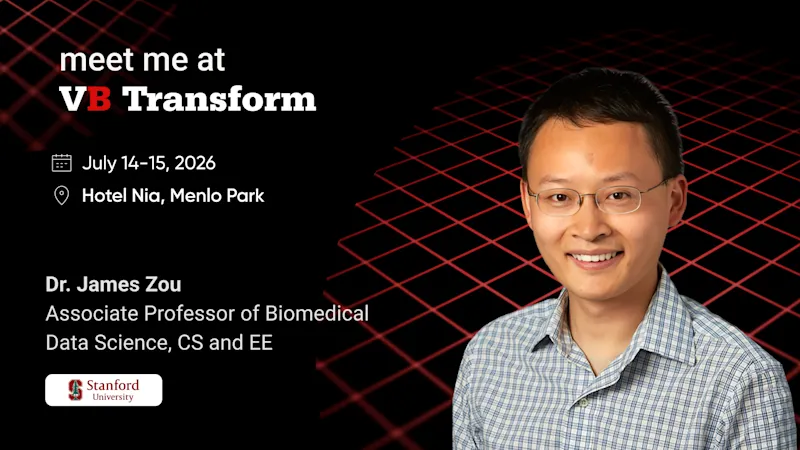
Stanford’s James Zou, associate professor of Biomedical Data Science, leads a system deploying thousands autonomous AI “scientist” agents in a virtual biotech to simulate the full lifecycle of drug development. For decision-makers, the bet is that continuity plus agent-native data can attack a drug pipeline that has a 90% to 95% reported failure rate.
Drug discovery has a brutal math problem: projects can run for years, hand off work between specialized teams, and lose knowledge at every step. According to published reports cited in the piece, 90% to 95% of drug discovery projects reportedly fail. Even when things go right, a single successful drug can take more than a dozen years and up to $1 billion, from initial discovery to patient distribution.
That’s the backdrop for the Stanford work that James Zou is bringing to VB Transform 2026. Zou is an associate professor of Biomedical Data Science at Stanford University, and he leads a team that has deployed thousands autonomous AI “scientist” agents in a virtual biotech environment designed to simulate the full lifecycle of drug development. In plain English, the agents are meant to do more than generate ideas. They’re set up to maintain continuity across discovery, safety testing, and clinical trial design, which is exactly where today’s workflows often break down.
The core design is a hierarchical orchestration framework. At the top sits a “chief scientist officer” agent that acts as a planner. It delegates tasks to teams of specialized agents, with different teams focusing on different phases, such as discovery, safety, and specialized analytical work. The pitch, and the key difference versus more fragmented AI approaches, is that the agents live in a unified hierarchical ecosystem. That matters because drug development is not one clean loop. It’s a long chain of decisions where earlier findings constrain what later steps can be.
Zou’s argument is that, inside this system, the “brain” can retain the full context of a project. The continuity is the point: from the first molecule identified through safety and analytical work and all the way to the final clinical outcome. In regulated domains like pharma, context is not a nice-to-have. It is the difference between “the model produced an answer” and “the model produced an answer that can be traced back to the evidence trail.” The article links the system’s performance to access to a vast amount of primary data and emphasizes that agents are granted access to data sources ranging from genomics and FDA chemistry data to clinical trial databases.
Under the hood, the architecture depends on more than one model. The piece notes that Claude often serves as the backbone for coding and data analysis, while the overall design uses a mixture of models, including those fine-tuned for specialized use cases. That multi-model setup is paired with an emphasis on agent-native and agent-friendly data, meaning the team has invested heavily in making data usable by agents to synthesize complex information more effectively. This is a subtle but important operational detail for executives. The constraint in AI adoption is often not the model alone. It is the ability to reliably transform messy enterprise data into something the system can actually use across many steps.
Zou is also raising money for his startup, Human Intelligence, based on the research, at a roughly $1 billion valuation. That funding context matters because it signals where capital is going in agentic AI right now: not toward isolated demos, but toward systems that can run long-running, multi-step workflows with enough structure to keep working even when tasks span phases and datasets.
At VB Transform, the session is explicitly about running agentic workflows at scale. During Zou’s session on July 15, titled “How 10,000 agentic scientists in Stanford’s lab are set to revolutionize medical research and discovery,” he will share strategies for managing context and long-running, multi-step workflows in a multi-agent system. The session will also cover how to transform and index raw enterprise data to make it agent native, and how to use human auditing and experimental reward signals to verify agent actions.
Why should operators and board members care beyond the novelty of “agents”? Because agentic AI is starting to shift the investment and execution conversation from “can AI write code or summarize papers” to “can AI run an end-to-end process under governance.” In drug discovery, that governance question is hard: every step connects to regulatory expectations, scientific validity, and reproducibility. If a multi-agent system can genuinely reduce handoff friction by preserving continuity, it could change how teams allocate time and reduce the waste caused by disconnected workflows. For decision-makers evaluating similar builds, the strategic stakes are simple: the winners will be the teams that can keep context intact, verify actions, and feed the system data that is structured enough to support downstream accountability.
This story's Key Insights and Take-aways are locked.
Create a free account to unlock Executive Actions for one credit.
Register to UnlockAlways free for Executives Club members. Join the Club
More in Business

SK Hynix jumps 11% after seeking up to $29.4B in Nasdaq listing
The chip giant filed for a Nasdaq listing plan that could raise $29.4 billion, instantly reshaping investor expectations.

Micron revenue hits nearly $42B as AI memory lifts gross margins above 81%
Fiscal Q3 results crush estimates, prove AI memory is rewriting Micron's margins, and change the momentum math for the whole chip stack.

SpaceX sells $25B in debt under two weeks after IPO, despite $90B in orders
The satellite and rocket company’s quick $25 billion borrowing move signals how it plans to finance scale after going public.