
Stephen Colbert declines Jimmy Kimmel’s guest-host offer, citing it’s premature
Kimmel’s CBS late-night rebound runs on ratings, and Colbert’s next move is already in production.
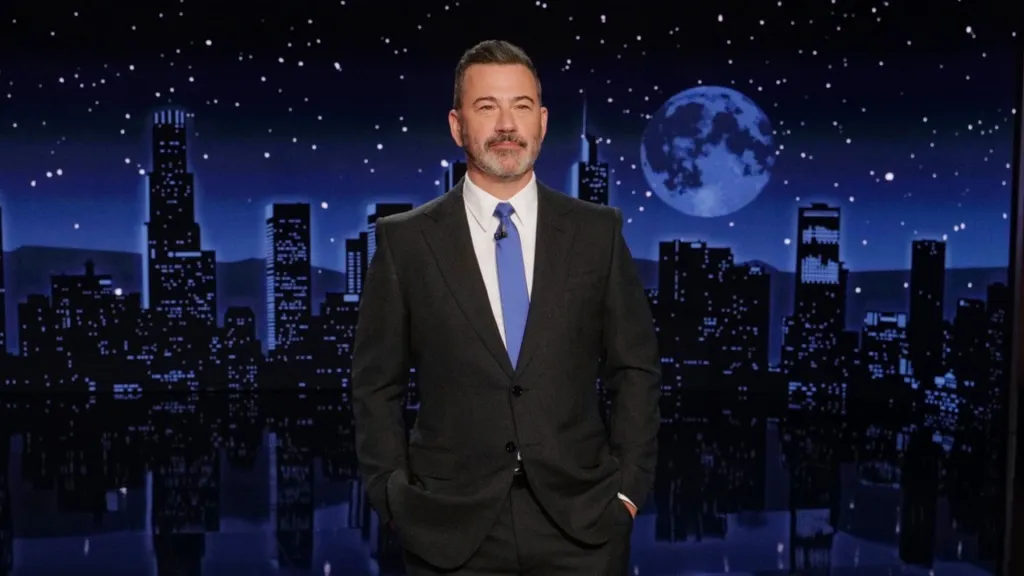
Stephen Colbert declined Jimmy Kimmel’s offer to guest host on ABC’s late-night show during Kimmel’s summer break. Kimmel says Colbert felt premature and calls CBS’ wisdom “very grateful,” while citing June as his best-ever month with 3.15 million viewers per night.
Stephen Colbert declined Jimmy Kimmel’s offer to guest host on ABC during Kimmel’s summer break, and Kimmel framed it as a timing issue. “Of course, I asked him, and I think it feels premature,” Kimmel told Variety. Then he made the invitation evergreen: anytime Colbert wants to host, Kimmel will “gladly step aside.”
This wasn’t a story about an awkward TV side quest. It mattered because the hole Colbert left in the late-night schedule helped Kimmel, and Kimmel points to the numbers. He credits the shift to CBS, saying “The ratings are very strong,” adding that they are “very grateful to CBS for their wisdom.” Variety reports that June was Kimmel’s best-ever monthly audience, with an average of 3.15 million viewers per night.
To understand why this is bigger than celebrity scheduling, look at how late-night operates as a real-time attention market. In the back half of July, most late-night hosts are on vacation, which changes the competitive mix overnight. Kimmel’s show ran with a rotating cast of guest hosts while he was on summer break, and those guest spots are typically a way for networks to keep programming continuity. In that context, Colbert not taking a guest slot is a reminder that late-night is not just content. It is a daily habit, a distribution channel, and a competition for the same limited pool of viewers.
Colbert is also not “unemployed” in the way the headlines might imply. The source notes that Colbert “pretty immediately went to work on a new Lord Of The Rings.” That detail matters for decision-makers who track talent availability as an input to strategy. When a marquee host exits a daily slot, networks and competitors rush to fill the calendar, but talent might still be productive elsewhere, meaning the host-brand can remain active without being visible in the usual format. For boards and executives, it is one more example of how personal brand extensions can keep momentum even when day-to-day distribution changes.
Kimmel, for his part, sees a broader lesson in media consumption patterns, and he uses late-night as the case study. He tells Variety that it is “silly” how people go wild about a podcast that is No. 5, adding that “the numbers still don’t even compare to a television show.” He then underlines his thesis: “There’s still a lot of people watching late night television,” and he includes other shows when he makes that point. The argument is not just about TV versus audio. It is about measurement and behavior. Kimmel also notes that people watch late-night on YouTube the next day and that “a lot of people” are interested in what the shows say even if they are not watching it live on their TV.
Second-order implications show up fast for executives in adjacent media categories too. Late-night talent and format are increasingly multi-platform by necessity, but live broadcast still anchors the franchise economics. If networks can defend viewership through scheduling competence, then platform fragmentation becomes a feature rather than a threat. You can run clips, capture delayed engagement, and still win the day with the primary broadcast audience. Kimmel’s framing suggests ABC believes that even as audiences diversify, television remains a dominant reference point, especially when competitors are dealing with transition periods.
There is also an organizational dynamic hiding in plain sight. Colbert’s late-night departure created the opening Kimmel benefited from, and Kimmel publicly acknowledges CBS. That is not just sportsmanship. It is a signal to internal stakeholders and advertisers that the network is interpreting change as an advantage rather than a disruption. When Kimmel says he is grateful to CBS for their “wisdom,” he is essentially telling his audience and partners that the competitive environment shifted in a favorable way and the show is capturing it.
Strategically, the stakes for peers are straightforward: when a major host exits, the schedule does not sit empty, it becomes contested. Networks fill gaps with guest rotation, and competitors either absorb new viewers or lose them if the transition is messy. At the same time, talent decisions are not limited to network executives. Colbert’s refusal, based on timing being “premature,” shows that even when invitations exist, hosts control their own arcs. That means boards should treat late-night transitions as a two-sided equation: programming strategy plus talent availability and readiness.
In the end, this is a story about timing, ratings, and the stubborn endurance of TV habits. Colbert leaves the door where Kimmel can keep it open, but he moves on to his next production. Kimmel gets his strongest month and uses the moment to argue that television still wins, even in a world that loves to talk about podcasts and algorithms. For late-night competitors and media executives broadly, the message is clear: distribution matters, scheduling matters, and when the spotlight shifts, the smartest teams can turn a vacancy into a measurable advantage.
This story's Key Insights and Take-aways are locked.
Create a free account to unlock Executive Actions for one credit.
Register to UnlockAlways free for Executives Club members. Join the Club
More in Entertainment

Ali G's 'stooge' says he was in on joke, outplayed Sacha Baron Cohen
A 54-year-old aspiring actor says he recognized Sacha Baron Cohen mid-shoot, kept his MAGA act up, and let the film-makers think they had fooled him.

Entertainer Russell Brand denies 7 sex charges amid accuser's 'couldn't breathe' claim
The alleged victim's account sharpens the reputational and legal stakes for Brand, his platforms, and any business tied to a public figure under criminal scrutiny.

Russell Brand's accuser 'bewildered and confused' as he denies 7 sex charges
The criminal case against the comedian is a live test of how media companies manage talent risk when serious allegations go public.