
Synthesia rolls out AI Roleplay Sessions to turn video training into live coaching
The enterprise AI training platform adds interactive roleplay with feedback, scoring, and analytics to measure real workplace improvement.
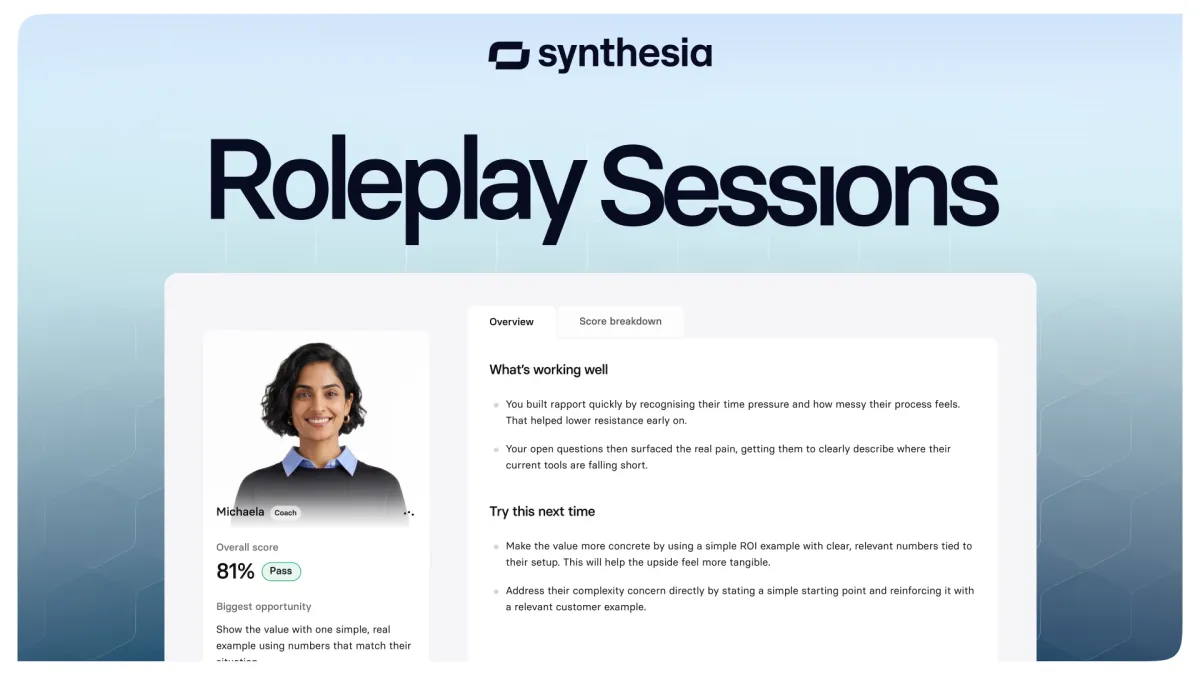
Synthesia launched AI Roleplay Sessions, an interactive enterprise training platform where employees practice workplace conversations with AI avatars that deliver feedback, scoring, and analytics. For decision-makers, the move shifts training from passive viewing toward measurable coaching, aimed at proving ROI and effectiveness.
Synthesia just took a swing at one of enterprise training's most stubborn problems: it is easy to watch videos and impossible to know whether anyone improved at the job. Its new product, AI Roleplay Sessions, moves the company's AI training platform beyond videos into live coaching-style practice.
Here is the core of what Synthesia launched. AI Roleplay Sessions are interactive enterprise training where employees practice workplace conversations with AI avatars. During the practice, the avatars provide feedback, scoring, and analytics. The stated purpose is to help companies measure training effectiveness, not just deliver content.
That shift matters because “training completion” is a blunt instrument. Many organizations can count views, clicks, and course completion rates while still lacking evidence that a manager can deliver tough feedback, handle a customer escalation, or negotiate without setting the company on fire. Video-first platforms can simulate learning, but they rarely force the behavior change that happens when someone responds in real time, under the pressure of a conversation that does not end politely after ten minutes.
AI Roleplay Sessions tries to bridge that gap by turning employees into active participants. Instead of watching how a conversation should go, employees practice it, then receive structured input from an AI avatar. Feedback, scoring, and analytics are not just features in the marketing deck. In practical terms, they create the building blocks for measurement: you can track outcomes at the session level, compare performance across cohorts, and potentially identify where training is succeeding or failing.
For enterprise buyers, this also reframes how they evaluate vendors. Video training is often purchased because it is scalable and easy to deploy. Interactive roleplay adds a different burden: it increases the need for clarity on what “good performance” looks like, how scoring is defined, and what analytics can actually do for reporting. Synthesia’s pitch, as described, is that its system gives those measurable signals so companies can assess training effectiveness.
Zoom out, and the timing is obvious. Workforces are more distributed than they used to be, and training programs have been under pressure to show impact. Meanwhile, AI capabilities have moved from experimental to commercially usable, and enterprises increasingly want tools that can be integrated into training workflows without requiring a small army of facilitators.
There is also a second-order implication for governance and risk. When training becomes interactive and feedback-driven, the system is effectively participating in employee development, even if it is not “teaching” in the traditional classroom sense. Enterprises typically have to think about privacy, data handling, and how performance data is stored and used. While the source does not discuss those policies directly, the addition of scoring and analytics inevitably increases the administrative and compliance surface area compared with a platform that just hosts videos.
Boards and executive teams should also notice what this signals about competitive dynamics. Synthesia is not just adding another course or another avatar. It is moving toward a coaching model where the platform can generate measurable evidence of practice. In an environment where learning and development budgets are scrutinized, shifting from content delivery to demonstrable outcomes can change how spending is defended internally.
The strategic stakes are straightforward for peers building, buying, or governing AI training. If an organization can better quantify whether employees actually perform in workplace conversations, training stops being a cost center that “feels helpful” and becomes an initiative that can be tracked like any other operational investment. Synthesia’s launch of AI Roleplay Sessions is a bet that enterprises want more than instruction. They want practice, feedback, and analytics they can use to prove it worked.
This story's Key Insights and Take-aways are locked.
Create a free account to unlock Executive Actions for one credit.
Register to UnlockAlways free for Executives Club members. Join the Club
More in Technology

Google quietly links your phone number to every Android account on your SIM
Adding a SIM now ties your phone number to all Google accounts - and future accounts inherit it. Here's the security and privacy stakes.

Hijacker AI 'Skynet mode' runs 100,000 attack steps against exposed models
Symantec caught a criminal AI agent that borrows other models, steals data, and mines crypto; the only relief is no confirmed victims yet.

Nvidia's AI-financier shift faces its first big test as neoclouds stumble
A rout in neocloud stocks is forcing investors to weigh Nvidia's hidden exposure as both supplier and lender to the AI buildout.