

Ultracold atoms just created a 'fractional Fermi sea' that breaks quantum rules
A new quantum state challenges decades of theory and hints at 'super-Fermions,' with real stakes for quantum computing and materials science.
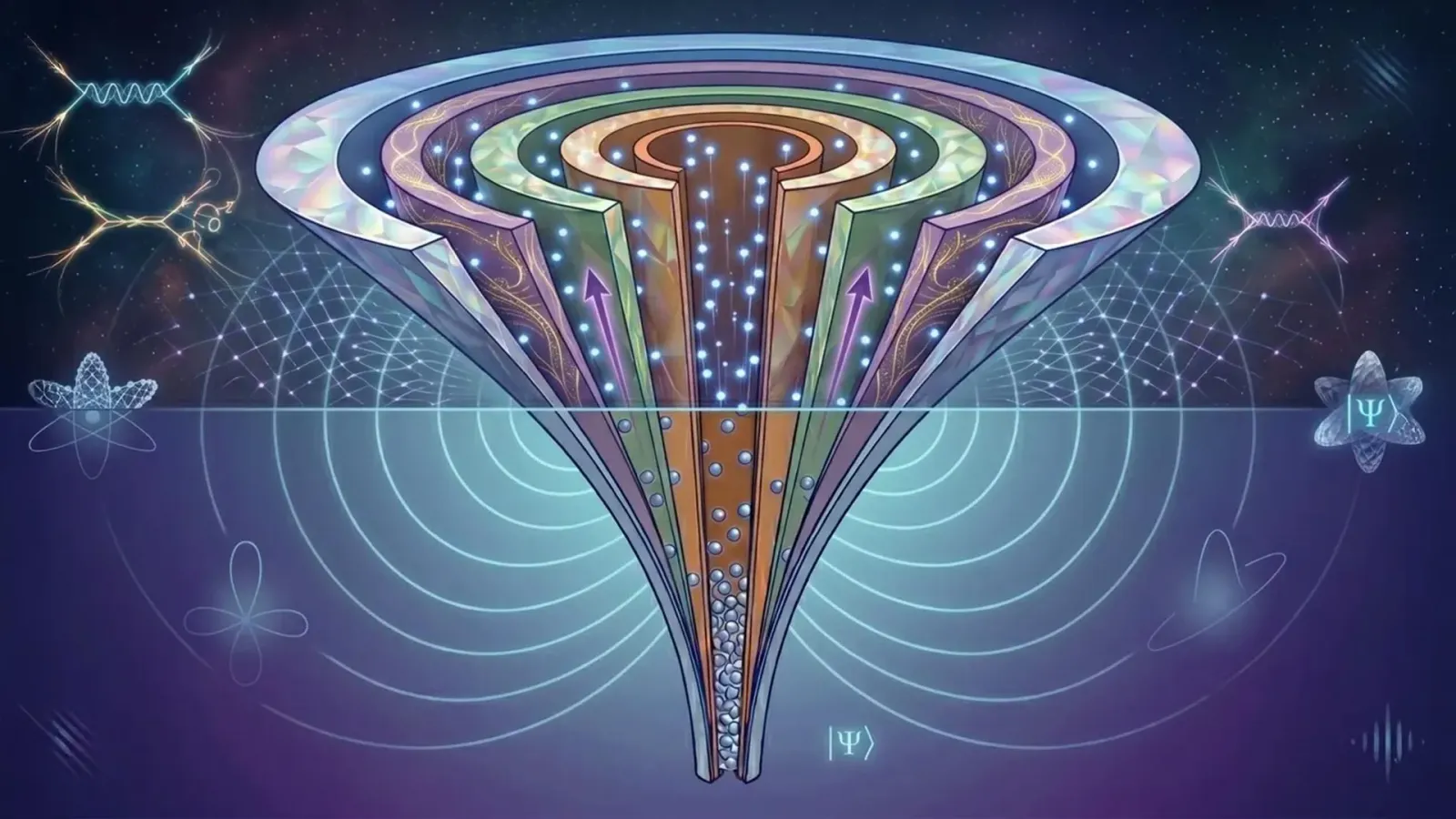
Physicists have discovered a fractional Fermi sea, a highly excited yet orderly quantum state in ultracold atoms. The finding challenges established quantum theories and could reshape research into exotic quasiparticles and quantum technologies.
Physicists have created a bizarre new quantum state called a fractional Fermi sea, in which ultracold atoms arrange themselves in a highly excited yet surprisingly orderly pattern that defies the familiar rules of how matter organizes. The discovery, made by researchers working with ultracold atoms, challenges established quantum theories and hints at exotic quasiparticles the team has dubbed potential "super-Fermions." For anyone betting on the future of quantum technology, this is not a lab curiosity. It represents a new class of quantum matter that could unlock novel ways to manipulate particles, potentially informing the design of more robust quantum computers or revealing entirely new phases of matter.
To understand why this matters, a quick physics refresher: fermions, the family that includes electrons, protons, and neutrons, obey the Pauli exclusion principle, meaning no two can occupy the same quantum state. At absolute zero, they stack into the lowest available energy levels, forming a "Fermi sea," a kind of frozen ocean of particles. In this new state, the atoms are excited to high energies but still maintain a structured, orderly configuration. That is like a crowd that is simultaneously rioting and perfectly choreographed, a contradiction that has left theorists scrambling to update their models.
The fractional Fermi sea is particularly striking because it suggests that under the right conditions, particles can behave as if they have fractions of their usual properties. This phenomenon has been seen before in the fractional quantum Hall effect, where electrons in a magnetic field form quasiparticles with fractional charge. Those quasiparticles are the building blocks for topological quantum computing, an approach that Microsoft and other tech giants have poured billions into. The new discovery hints that similar fractional behavior can emerge in a completely different setting, ultracold atomic gases, which could open a more accessible experimental playground for studying these exotic states.
For context, ultracold atom experiments are a cornerstone of modern quantum research. They allow scientists to cool atoms to temperatures near absolute zero and trap them with lasers, creating clean, controllable systems for probing quantum mechanics. These experiments are typically funded by national science agencies, but they increasingly attract corporate investment from companies exploring quantum sensing, simulation, and computing. A discovery like this can shift research priorities, because it offers a new way to test the theoretical foundations that underpin everything from cryptography to materials science.
The timing is notable. Quantum computing has reached a critical inflection point, with companies racing to build machines that can outperform classical computers on practical tasks. But the field remains far from settled. The rules that govern qubits, error correction, and even the basic physics of quantum matter are still being rewritten at the most fundamental level. The fractional Fermi sea is a reminder that the next big leap in computing power may come not from better engineering alone, but from a deeper understanding of how matter itself behaves.
For executives and investors tracking quantum technology, the strategic stakes are clear. Companies that tie their roadmaps too tightly to a single theoretical model risk being blindsided by a breakthrough like this one. The discovery also highlights the value of fundamental research, which often produces commercial payoffs only years or decades later. The fractional Fermi sea may not ship in a product anytime soon, but it could reshape the intellectual property landscape around quasiparticles and quantum states, making it a development worth monitoring closely.
Ultimately, this is a story about the limits of human knowledge being pushed outward. The physicists behind the discovery have shown that even the most well-established rules of quantum mechanics have exceptions waiting to be found. For the rest of us, the lesson is that the quantum future is not a straight line. It is a landscape full of surprises, and the organizations that stay flexible, keep funding curiosity-driven science, and watch for unexpected results will be the ones best positioned to capitalize on the next revolution.
This story's Key Insights and Take-aways are locked.
Create a free account to unlock Executive Actions for one credit.
Register to UnlockAlways free for Executives Club members. Join the Club
More in Science

Study: 1 in 4 depression cases may be a body-clock problem, not a chemical one
A 10,000-person study finds standard antidepressants often fail these patients, but melatonin and morning sunlight may hit the real root cause.

Start-Up Says A.I. Designed a Virus to Attack One Patient's Superbug
If the claim holds up, personalized phage therapy could become a new frontline weapon against antibiotic resistance - but proof is far from final.

1000 mathematicians pledge to shun AI in their research
A thousand researchers are publicly refusing AI tools, and the reason is a warning for every company betting on AI-generated answers.