
Windows 11 KB5101650 cut one gamer’s 400 Hz monitor down to 240 Hz
A record 570-patch update is linked to display glitches, including 400 Hz modes collapsing unless you accept lower refresh rates.
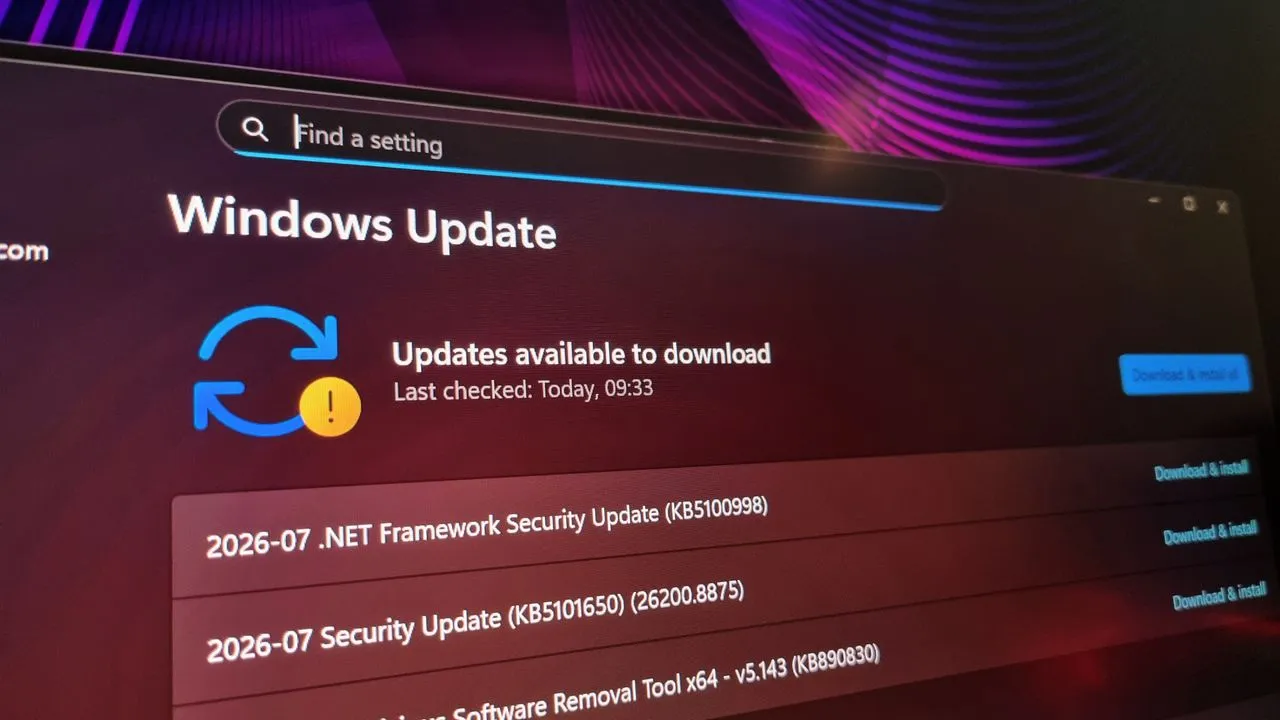
PC Gamer reports that Windows 11 update KB5101650, delivered with AI-driven security discovery, coincided with a monitor losing 400 Hz capability for the author. For decision-makers, it is a sharp reminder: high-volume security update cadence can create measurable hardware and compatibility blast radius.
The morning after Windows 11 update KB5101650 landed, the author’s monitor stopped doing the one thing it is supposed to do at full bragging rights: run at 400 Hz. The fix was not a clever settings tweak. It was accepting lower refresh rate caps, because at 400 Hz the display would “cut to black and re-connect every second or two,” and even at 360 Hz it would still do it every three or four seconds. Drop to 240 Hz and it works “fine.”
What makes this worth more than one unlucky anecdote is the update context around KB5101650. PC Gamer notes that it is the first Windows update that Microsoft used AI to help it discover security fixes, and that it included a record 570 patches. The article is careful to frame what Microsoft likely means by “AI” here. It is not claiming AI will be used broadly for new types of fixes. Instead, AI is being used to discover more vulnerabilities, which then become more patches pushed out in each update cycle. More security fixes per release sounds great in theory, but the author’s lived reality is that a bigger patch payload can raise the odds that something breaks in the real world, especially where display drivers, refresh-rate negotiation, and hardware behaviors have lots of moving parts.
This is where the incident starts to look less like “my machine is weird” and more like a pattern worth tracking. The author says they are not alone, pointing to Reddit threads describing display and graphics issues after the update dropped, with special emphasis on people running AMD graphics cards. The key is that the article draws a line between complete certainty and plausible correlation. Some posters may not link their issues to the update, but the author doubts that all of them are unrelated, given what happened on their own system.
Even Microsoft is showing signals that compatibility issues are not just theoretical. PC Gamer reports that Microsoft paused the update for some Dell PCs because of a compatibility issue that could lead, in some cases, to “changes in performance, power consumption, or system behavior.” That matters because it indicates the update pipeline and validation process are catching some problems, but also that the problems can manifest across a wide range of hardware profiles. When you pair that with the author’s monitor behavior collapsing specifically at high refresh rates, you get a practical takeaway for ops and product teams: updates are increasingly arriving in larger, more complex bundles, and high-end display features are not always tolerant of unexpected changes in driver behavior, system timing, or settings negotiation.
There is also an important strategic angle for boards and executives who think of security updates as a low-risk, purely technical obligation. KB5101650 is being positioned as a security delivery improvement, driven by AI-enabled vulnerability discovery. But more patches means more opportunities for regressions, especially in the “last mile” layer where the OS meets GPU firmware, monitor controllers, and link training behaviors that determine whether 400 Hz is even stable. If your organization sells devices, runs fleets of workstations, or supports customers who rely on specific display modes, the cost of an update is not just a support ticket. It is downtime, reputational friction, and sometimes lost productivity that is hard to quantify until it shows up in tickets and churn.
The article also highlights a frustrating reality: remediation is not always one-click. The author tried reverting the update and reports the system “didn’t seem to want to get rid of the whole thing.” That kind of partial rollback can extend the time window where devices sit in an in-between state, increasing the chance that a temporary workaround becomes a semi-permanent operational workaround. For decision-makers, the practical question becomes: how fast can you detect these issues, how cleanly can you roll back, and how do you communicate to users when the trade is “keep the update, lose 400 Hz, or pause until compatibility is confirmed”? In the meantime, the author’s experience of forced refresh-rate downgrades is not cosmetic. It changes how competitive gaming feels and how demanding workloads perform.
PC Gamer closes with the author’s frustration, framed as a call for attention “pronto,” and while the story is personal, the pressure is industry-wide. If an update with AI-enabled security discovery and a record 570 patches can correlate with display failures severe enough to cut to black and reconnect at 400 Hz, then similar issues could surface across other high-performance peripherals and modes. The second-order risk for peers in the Windows and PC ecosystem is clear: higher patch throughput and broader vulnerability coverage may improve security posture, but it can also expand the surface area for compatibility regressions. The business stake is that reliability is part of security operations too. The fastest way to lose trust is to push protections that accidentally degrade the user experience enough to make people delay updates, disable settings, or demand exceptions.
This story's Key Insights and Take-aways are locked.
Create a free account to unlock Executive Actions for one credit.
Register to UnlockAlways free for Executives Club members. Join the Club
More in Entertainment

12TB Steam 'teraleak' goes beyond Valve: GTA 3, Mafia 2 prototypes exposed
A 12-terabyte dump of Steam data reveals prototypes and builds of third-party classics like GTA 3 and Mafia 2, plus unreleased Valve content, rewriting game history.

LinkedIn's romance problem: 1 in 4 workers say dating on it is fair game
A new survey shows a quarter of U.S. employees treat the professional network as fair game for romance, even as LinkedIn bans it and removes hundreds of thousands of offending posts.

Enhypen's first No. 1 album breaks K-pop's Billboard 200 streak
The K-pop group's 98,000-unit debut tops the chart while Dolly Parton's catalog reentry shows how death reshapes streaming.